Last updated: · Originally published August 4, 2026 · Published by Eternal Elixir
Edited by Elaine Fletcher, Researcher
Quick answer: Spermidine is a polyamine, a small molecule your cells make and your diet supplies, and it is studied for its role in autophagy, the cell’s recycling system. Its benefits in humans are less settled than the marketing suggests. The strongest signal comes from diet: in a 20-year study, people who ate the most spermidine had lower death rates, which shows a link, not cause. The longest supplement trial, 12 months at 0.9 mg a day, found no memory benefit. On dosage and safety, trials have used 0.9 mg to 40 mg a day, and even 40 mg a day for four weeks was well tolerated. Our pick is Eternal Elixir Spermidine 10mg: 10 mg of spermidine trihydrochloride per capsule (about 5.7 mg of spermidine itself), 60 capsules, $0.83 a serving. That is above the food-extract trials and below the high-dose ones.
Eternal Elixir makes Spermidine 10mg, and it is our pick in this guide. Our product facts come from our US product page. Competitor figures come from their own product pages, read in September 2026, and every study claim links to its source. Each benefit carries an evidence level, and we flag where study authors had ties to spermidine companies. Here is how we write and review content.
What is spermidine?
Spermidine is one of three main polyamines in the body, alongside putrescine and spermine. Cells use polyamines for growth and normal function. You get spermidine three ways: your cells make it, food supplies it, and gut bacteria produce some. The body’s own production tends to fall with age, which is why dietary sources get more attention in older adults (Muñoz-Esparza and colleagues, Frontiers in Nutrition, 2019).
The interest in supplements comes from autophagy. Cells tag worn-out proteins and parts, wrap them up and break them down for reuse. In lab studies spermidine switches this process on, and in mice it extended lifespan and supported heart function in old age (Eisenberg and colleagues, Nature Medicine, 2016). A review by the same research group describes spermidine as a “caloric restriction mimetic”, a compound that triggers some of the same cell pathways as eating less (Madeo and colleagues, Science, 2018). Mouse results do not transfer to people automatically, and the human trials below are the test.
Spermidine benefits: what human studies show
Here is every benefit area with human data we could find. Several of these studies had authors with equity or consulting ties to companies that sell spermidine extracts, and we note that where it applies.
| Area | What human studies found | Who, dose, length | Evidence level |
|---|---|---|---|
| Lifespan (diet) | Higher dietary spermidine linked to lower death rates | 829 adults, food questionnaires, 20 years | Observational, cannot show cause |
| Memory | Small pilot: moderate improvement. Longer trial: no change on the main memory test | 30 adults, 1.2 mg a day, 3 months. 100 adults, 0.9 mg a day, 12 months | Mixed. The larger, longer trial was negative |
| Immune response in older adults | Better antibody responses to a vaccine dose in people who had responded poorly | 40 adults over 65, 6 mg a day, 13 weeks | One small pilot trial |
| Autophagy markers | Small rises in two autophagy proteins against baseline | 12 adults, 3.3 mg a day, 8 weeks, no placebo group | Very preliminary |
| Blood spermidine levels | No rise in blood spermidine, even at high doses | 12 adults at 15 mg a day for 5 days. 37 men at 40 mg a day for 28 days | Two controlled trials |
| Heart function | Mouse data only, plus a diet link with blood pressure | No human supplement trial | Animal and observational |
| Safety | Well tolerated in every trial | 0.9 mg to 40 mg a day, up to 12 months | Several controlled trials |
Lifespan: a strong diet link, not a supplement result
In the Bruneck study, 829 adults aged 45 to 84 filled in repeated food questionnaires between 1995 and 2010 and were followed to 2015 (Kiechl and colleagues, American Journal of Clinical Nutrition, 2018). Deaths fell across thirds of spermidine intake, from 40.5 to 23.7 to 15.1 per 1,000 person-years. After adjusting for lifestyle and other diet factors, each step of one standard deviation higher intake carried a 24% lower risk of death (hazard ratio 0.76). The gap between the top and bottom thirds was similar to being 5.7 years younger, and a second cohort showed the same pattern.
Nobody in that study took a capsule. People who eat more wheat germ, soy, legumes and mushrooms may differ in many ways that questionnaires cannot fully capture. Evidence level: observational.
Memory: a promising pilot, then a negative trial
A three-month pilot gave 30 adults aged 60 to 80 with self-reported memory concerns a spermidine-rich wheat germ extract or placebo. The extract supplied 1.2 mg of spermidine a day, and memory scores improved moderately against placebo (Wirth and colleagues, Cortex, 2018).
The follow-up was the SmartAge trial: 100 adults aged 60 to 90 with the same kind of memory concerns, 0.9 mg of spermidine a day from wheat germ extract or placebo, for 12 months. Memory on the main test did not change compared with placebo (p = 0.47), and neither did the secondary outcomes. Exploratory analyses hinted at effects on verbal memory and inflammation, which the authors said need testing at higher doses (Schwarz and colleagues, JAMA Network Open, 2022). Three of its authors reported equity in The Longevity Labs, a spermidine extract company. Our own product page cites this trial and its negative result. Evidence level: mixed, and the better trial was negative.
Immune response in older adults: one pilot trial
In a 2026 pilot, 40 adults over 65 took 6 mg of spermidine a day from wheat germ extract, or placebo, for 13 weeks after their third coronavirus vaccine dose. The supplement was well tolerated with no adverse reactions. People who had responded poorly to the vaccine produced more antibodies on spermidine, and their immune cells showed fewer markers of cellular aging (Alsaleh and colleagues, Aging Cell, 2026). The effect was in a subgroup of a small trial, and three authors consult for spermidine supplement companies. It is a reason for a larger trial, not yet a reason to buy. Evidence level: one small pilot.
Autophagy markers: early and uncontrolled
An eight-week pilot gave 12 healthy adults 1.5 mg or 3.3 mg of spermidine a day from rice germ extract. Against their own baseline, the 3.3 mg group showed a 7.3% rise in Beclin-1 and a 13.4% rise in ULK1, two proteins involved in autophagy (Bruno and colleagues, 2025). There was no placebo group, the study was single-blinded, and one author works for the extract’s supplier. Evidence level: very preliminary.
Does a spermidine supplement raise blood spermidine?
Not by much, in the two trials that checked. In a crossover trial, 12 healthy adults took 15 mg of spermidine a day for five days. Blood spermidine did not rise, but blood spermine did, which suggests the body converts much of the spermidine before it reaches circulation. The authors concluded that doses under 15 mg a day are unlikely to have short-term effects (Senekowitsch and colleagues, Nutrients, 2023).
In the highest-dose trial so far, 37 healthy men aged 50 to 70 took 40 mg of high-purity spermidine trihydrochloride a day for 7 and 28 days, against placebo. Blood and urine polyamines barely changed, and blood chemistry, lipids and blood counts stayed the same (Keohane and colleagues, Nutrition Research, 2024). Two of its authors are employees of Chrysea Labs, which funded the trial. The body appears to hold its polyamine levels steady. That does not rule out effects inside cells, but it does mean “more milligrams” is not a simple lever.
Spermidine dosage: trial doses against US labels
There is no recommended daily intake for polyamines (Muñoz-Esparza, 2019). Trials have used a wide range, and one detail changes the math: many labels state the weight of spermidine trihydrochloride, a salt. Spermidine has a molecular weight of 145.25 and the trihydrochloride salt 254.6 (PubChem), so 10 mg of the salt contains about 5.7 mg of spermidine.
| Study or product | Daily amount | Source | Length |
|---|---|---|---|
| SmartAge, 2022 | 0.9 mg spermidine | Wheat germ extract | 12 months |
| Wirth, 2018 | 1.2 mg spermidine | Wheat germ extract | 3 months |
| Bruno, 2025 | 1.5 or 3.3 mg spermidine | Rice germ extract | 8 weeks |
| Alsaleh, 2026 | 6 mg spermidine | Wheat germ extract | 13 weeks |
| Senekowitsch, 2023 | 15 mg spermidine | Supplement | 5 days |
| Keohane, 2024 | 40 mg spermidine trihydrochloride (about 23 mg spermidine) | High-purity salt | 28 days |
| Eternal Elixir Spermidine 10mg | 10 mg spermidine trihydrochloride (about 5.7 mg spermidine) | Salt, 1 capsule | Open-ended |
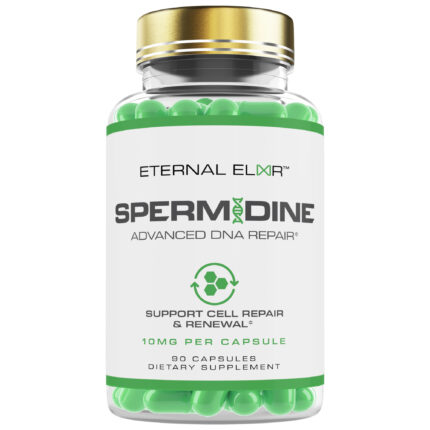
To put our capsule plainly: one capsule gives about 5.7 mg of spermidine. That is more than the 0.9 mg to 3.3 mg in the food-extract trials and close to the 6 mg in the immune pilot. It is well below the 15 mg a day in the blood-level trial and the roughly 23 mg of spermidine in the 40 mg safety trial. No trial has tested our exact product or dose for any outcome.
Add Spermidine 10mg to cart · $49.99
How US spermidine labels compare
Labels mix salt weight and spermidine weight, so read the form before comparing. Prices as of Sep 2026:
| Product | Per capsule, as labeled | Spermidine itself | Label serving | Price |
|---|---|---|---|---|
| Eternal Elixir Spermidine 10mg (our pick) | 10 mg spermidine trihydrochloride | About 5.7 mg | 1 capsule | $49.99 for 60 capsules, view product |
| Codeage Amen Spermidine | 10 mg spermidine trihydrochloride plus 90 mg vitamin C | About 5.7 mg | 1 capsule | $24.99 for 30 capsules |
| Double Wood Spermidine | 5 mg spermidine trihydrochloride | About 2.9 mg | 1 to 2 capsules, up to 4 | $39.95 |
| Solaray Spermidine | 3.3 mg spermidine from rice germ extract | 3.3 mg (as stated) | 1 capsule | $38.19 |
Add Spermidine 10mg to cart · $49.99
Codeage matches our dose and our $0.83 cost per serving, and adds vitamin C, but its bottle holds 30 capsules to our 60. Double Wood’s 5 mg capsules let you take smaller or larger steps, and its page suggests 1 to 2 capsules a day, with the option of up to 4. Solaray uses the same rice germ extract as the 2025 autophagy pilot, at its higher 3.3 mg dose. Our comparison of five spermidine supplements covers more brands, and our Codeage review, Double Wood review and Solaray review look at each brand’s wider range. The gap between trial and label doses runs across the whole category, as our report on trial doses versus US labels shows.
Spermidine in food
Spermidine is found in plant foods of every kind, and it is usually the main polyamine in them. Cereals, legumes and soy products carry the most. In the food review, wheat germ had the highest spermidine figure, 2,437 nmol per gram, which works out to about 35 mg per 100 g, followed by soybeans at 1,425 nmol per gram. Mushrooms, peas, hazelnuts, pistachios, spinach, broccoli, cauliflower and green beans also contain it. Most cheeses are lower, though one blue cheese in the review had a high level (Muñoz-Esparza, 2019).
That is why so many supplements are wheat germ extracts. With an extract, the milligram figure on the front of the bottle can describe the extract rather than the spermidine in it, so check the facts panel. The Bruneck findings came from whole diets, which bring fiber, protein and polyphenols along with the spermidine. A capsule adds spermidine, and it does not replace the foods.
Spermidine side effects and who should avoid it
Every trial above reported spermidine as well tolerated. In SmartAge, adverse events were balanced between spermidine and placebo over 12 months. In a three-month safety trial of 1.2 mg a day in 30 older adults, vital signs, weight, blood chemistry and blood counts did not differ from placebo (Schwarz and colleagues, Aging, 2018). At 40 mg of the trihydrochloride a day for 28 days, no product-related adverse events were reported.
Some people should talk to their doctor before taking it:
- Anyone with a current or past cancer diagnosis, because polyamines are involved in cell growth and raised polyamine levels are associated with tumor growth in diagnosed patients (Muñoz-Esparza, 2019).
- Anyone who is pregnant or breastfeeding, because there are no trial data.
- Anyone taking prescription medicines or managing a chronic condition.
- Anyone with a wheat allergy or celiac disease who is considering a wheat germ extract. Our capsule is spermidine trihydrochloride, not a wheat extract.
Trials so far have run up to 12 months. Nobody has studied years of daily use.
How to take spermidine
- Follow your label. Ours is one capsule a day.
- Pick a consistent time. No trial has compared morning and evening doses, or doses with and without food. Double Wood’s label suggests the morning, with or without food.
- Give it months, not days. Trials that looked for benefits measured them after 8 weeks to 12 months, and there is nothing you should expect to feel from one capsule.
- Keep the foods. The strongest human signal is dietary, so treat a capsule as an addition to wheat germ, legumes, soy and mushrooms.
Spermidine alongside NMN, Ca-AKG and other longevity supplements
Spermidine works on a different pathway from NAD+ precursors such as NMN, and no trial has compared the two or tested them together. Many people take both. Our guide to the best NMN supplements for NAD+ support covers the NMN evidence, our NMN safety review covers its trial side effects, and our NMN versus resveratrol breakdown helps if you are choosing between those two. Our range includes NMN 500mg.
Ca-AKG is another common companion. Our Ca-AKG evidence review sets out its human data, and our Ca-AKG 500mg comes as 60 capsules at one capsule per serving, for $49.99.
No trial has tested spermidine and Ca-AKG together. The pairing is for people who already plan to take both. If you are building something broader, our longevity supplement stacks comparison shows how single ingredients combine without doubling up. The same evidence standard runs through our guides to methylene blue benefits, pterostilbene benefits and dosage and what TUDCA is, and our TUDCA supplement comparison.
Our Spermidine 10mg: who it suits and who it doesn’t
We make this one, so here are the label facts. Each capsule holds 10 mg of spermidine trihydrochloride, about 5.7 mg of spermidine, with rice flour and a cellulose capsule. A bottle holds 60 capsules at one capsule per label serving, for $49.99, or $0.83 a serving. Two bottles save 10%, three save 15% and five save 20%. We offer a 30-day money-back guarantee, free US shipping over $100, and orders ship in 24 hours. Our product page states that the linked 12-month trial did not meet its main memory goal.
It suits you if you want a single, clearly labeled form of spermidine at a dose above the food-extract trials, in a plant capsule, with two months of servings per bottle. It does not suit you if you want the exact wheat germ extract used in SmartAge, the finer dose steps of a 5 mg capsule, or a dose that matches the 15 mg to 40 mg a day of the high-dose trials.
Add Spermidine 10mg to cart · $49.99
Spermidine benefits FAQ
What does spermidine do for you?
Spermidine is a polyamine involved in normal cell growth and autophagy, the cell’s recycling process. In mice it supported heart function and lifespan. In people, higher dietary intake is linked to lower death rates, but a 12-month supplement trial found no memory benefit, so human results are still mixed.
How much spermidine should I take per day?
Follow your label. Trials have used 0.9 mg to 40 mg a day, and there is no recommended daily intake. Our label serving is one capsule of 10 mg spermidine trihydrochloride, about 5.7 mg of spermidine itself.
Can you take spermidine every day?
Daily use is how every trial dosed it, for up to 12 months, and it was well tolerated. Nobody has studied years of daily use. Check with your doctor first if you are pregnant, breastfeeding, have a cancer history or take prescription medicines.
What foods are high in spermidine?
Wheat germ and soybeans have the highest levels in the food review we used. Legumes, mushrooms, peas, hazelnuts, pistachios, spinach, broccoli, cauliflower and green beans also supply it. Most cheeses have less.
Is spermidine trihydrochloride better than wheat germ extract?
Neither has been shown to work better. The salt form gives a clear, stated dose. Wheat germ extracts were the form used in the memory and immune trials, but their labels can quote extract weight rather than spermidine content.
Does spermidine raise spermidine levels in the blood?
Not much. At 15 mg a day for five days, blood spermidine did not rise, though spermine did. At 40 mg of the trihydrochloride a day for 28 days, blood and urine polyamines barely changed.
How long does spermidine take to work?
There is no known timeline. Trials that looked for benefits measured them after 8 weeks to 12 months, and none reported an effect you would feel. If you try it, plan on months and keep your diet in place.
Which is better, NMN or spermidine?
No trial has compared them. NMN is studied as an NAD+ precursor, and spermidine for polyamine levels and autophagy. They work on different pathways, so many people who take one consider the other as an addition rather than a swap.
The bottom line on spermidine
Spermidine has a well-mapped mechanism in animals and a strong diet link in people, but its supplement trials are small and mixed. The longest one found no memory benefit, and high doses barely move blood levels. It has been well tolerated at every dose tested. If you want to try it, choose a clearly labeled form, take it daily for months, and keep eating spermidine-rich foods. Our pick is Eternal Elixir Spermidine 10mg, and you can browse the full Eternal Elixir range too.
Sources
- Muñoz-Esparza NC, Latorre-Moratalla ML, Comas-Basté O, et al. Polyamines in food. Frontiers in Nutrition, 2019. PubMed 31355206
- Eisenberg T, Abdellatif M, Schroeder S, et al. Cardioprotection and lifespan extension by the natural polyamine spermidine. Nature Medicine, 2016. PubMed 27841876
- Madeo F, Eisenberg T, Pietrocola F, Kroemer G. Spermidine in health and disease. Science, 2018. PubMed 29371440
- Kiechl S, Pechlaner R, Willeit P, et al. Higher spermidine intake is linked to lower mortality: a prospective population-based study. American Journal of Clinical Nutrition, 2018. PubMed 29955838
- Wirth M, Benson G, Schwarz C, et al. The effect of spermidine on memory performance in older adults at risk for dementia: a randomized controlled trial. Cortex, 2018. PubMed 30388439
- Schwarz C, Benson GS, Horn N, et al. Effects of spermidine supplementation on cognition and biomarkers in older adults with subjective cognitive decline: a randomized clinical trial. JAMA Network Open, 2022. PubMed 35616942
- Alsaleh G, Ali M, Kayvanjoo AH, et al. Spermidine mitigates immune cell senescence and boosts vaccine responses in healthy older adults: a pilot study. Aging Cell, 2026. PubMed 42169618
- Bruno G, La Monica M, Ziegenfuss TN. Effects of spermidine-rich rice germ extract supplement on biomarkers of healthy aging and autophagy: proof-of-concept pilot study. Alternative Therapies in Health and Medicine, 2025. PubMed 40862848
- Senekowitsch S, Wietkamp E, Grimm M, et al. High-dose spermidine supplementation does not increase spermidine levels in blood plasma and saliva of healthy adults. Nutrients, 2023. PubMed 37111071
- Keohane P, Everett JR, Pereira R, et al. Supplementation of spermidine at 40 mg/day has minimal effects on circulating polyamines. Nutrition Research, 2024. PubMed 39405978
- Schwarz C, Stekovic S, Wirth M, et al. Safety and tolerability of spermidine supplementation in mice and older adults with subjective cognitive decline. Aging, 2018. PubMed 29315079
- PubChem compound records for spermidine (CID 1102) and spermidine trihydrochloride (CID 9539). PubChem
- Product pages for Codeage Amen Spermidine, Double Wood Spermidine, Solaray Spermidine and Eternal Elixir Spermidine 10mg, read September 2026.
These statements have not been evaluated by the Food and Drug Administration. This product is not intended to diagnose, treat, cure, or prevent any disease.