Last updated: · Originally published August 7, 2026 · Published by Eternal Elixir
Edited by Elaine Fletcher, Researcher
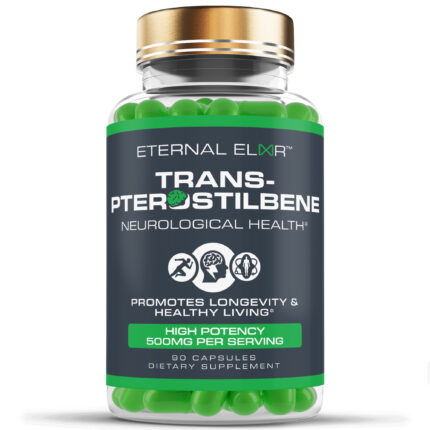
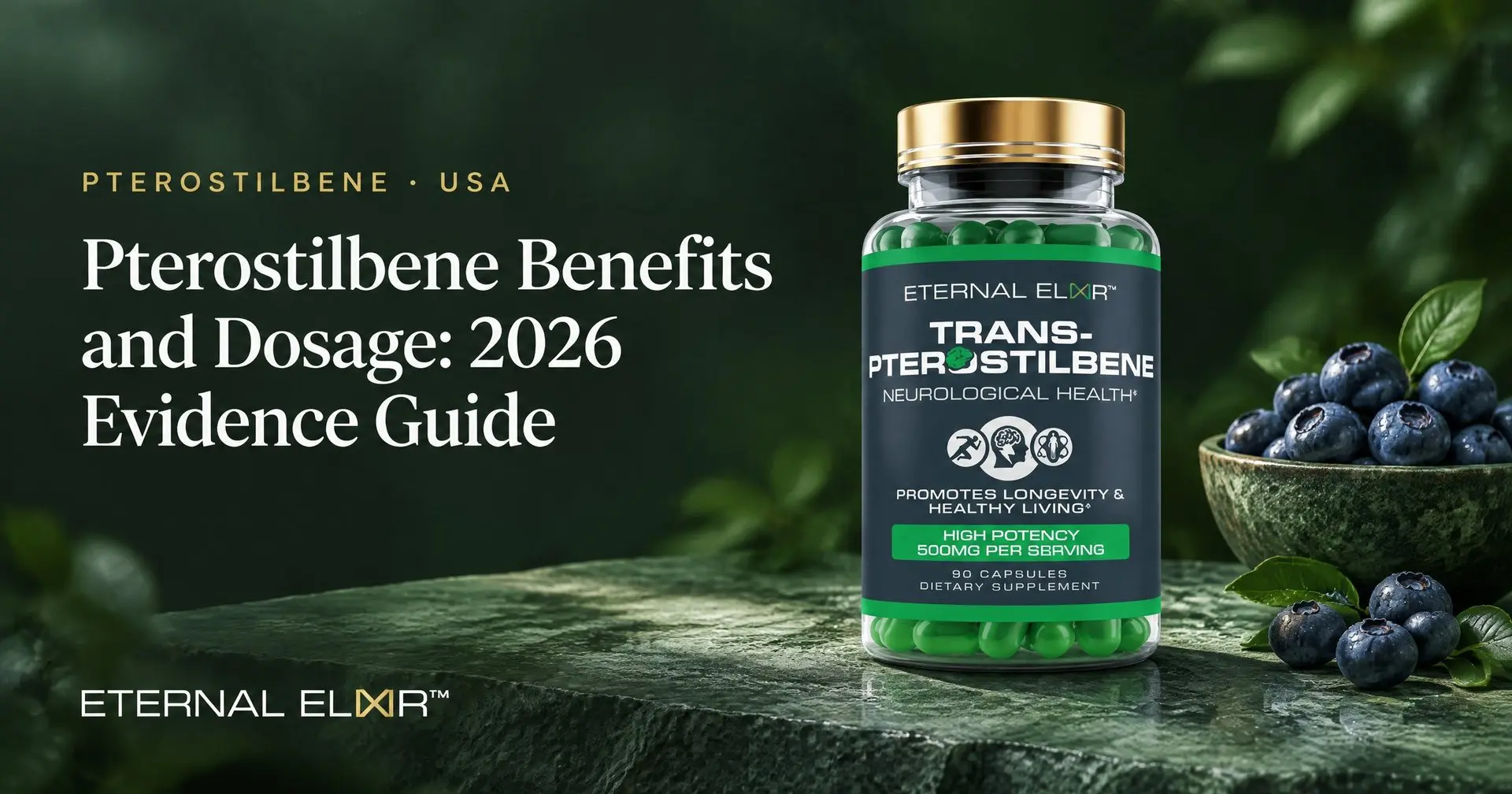
Quick answer: Pterostilbene is a stilbene found in some blueberries and closely related to resveratrol. The best human data come from one 80-person trial that ran 6 to 8 weeks. At 250 mg a day it lowered blood pressure readings, and taken on its own it also raised LDL cholesterol by 17.1 mg/dL. Trials of pterostilbene alone have used 10 to 250 mg a day for up to 12 weeks without serious safety problems. The antioxidant, brain and longevity benefits you read about come from cell and animal studies. There is no official dose. Our pick is Eternal Elixir Trans-Pterostilbene 500mg, the lowest cost per milligram of the six US products we compared ($0.14 per 100 mg, or $0.72 a capsule). That capsule holds 500 mg, twice the highest daily dose we found in any trial of pterostilbene on its own, so read the dosage section before you order.
Eternal Elixir makes Trans-Pterostilbene 500mg, and it is our pick in this guide. Our product facts come from our US product page. Competitor figures come from their US product pages, read in September 2026, and every study claim links to its source. Here is how we write and review content.
Pterostilbene at a glance
- What it is: a stilbene with two methoxy groups where resveratrol has hydroxyl groups.
- Human trials: a handful. The largest trial of pterostilbene on its own enrolled 80 adults. Several more pair it with nicotinamide riboside (NR).
- Doses tested alone: 10 mg to 250 mg a day, for 6 to 12 weeks.
- Main human findings: lower blood pressure readings at 250 mg a day, higher LDL cholesterol when taken alone, and no serious safety signals in short trials.
- Not shown in people: better memory, longer life or sirtuin activation.
- US labels: 50 mg to 500 mg per capsule in the six products we checked.
What is pterostilbene?
Pterostilbene belongs to the stilbene family, the same group of plant compounds as resveratrol. Its chemical name is trans-3,5-dimethoxy-4′-hydroxystilbene. Resveratrol carries three hydroxyl groups. Pterostilbene swaps two of them for methoxy groups, which makes the molecule more fat-soluble. Reviews credit those two groups for its better absorption in animal studies.
A 2013 review calls pterostilbene the primary antioxidant component of blueberries and says it is found mainly in blueberries and in the heartwood of the Pterocarpus marsupium tree (McCormack and McFadden, Oxidative Medicine and Cellular Longevity, 2013). The blueberry part needs a footnote. A 2004 analysis of berries from 10 Vaccinium species found pterostilbene in only two rabbiteye blueberry cultivars and in deerberry, at 99 to 520 nanograms per gram of dried fruit (Rimando and colleagues, 2004). At the top of that range, getting 100 milligrams would take more than 400 pounds of dried berries. Supplements are the only practical way to reach the amounts used in trials.
Look for “trans” on the label. The main human trial used an ingredient that was more than 99% trans-pterostilbene. If you are also weighing resveratrol, our resveratrol supplement comparison covers seven US products, and our NMN vs resveratrol breakdown sets both against an NAD+ precursor.
Pterostilbene benefits: what is claimed and what has been shown
Most pages list the same benefits: antioxidant protection, heart health, blood sugar, brain health and better absorption than resveratrol. Here is where each claim stands in September 2026.
- Blood pressure. In one trial of 80 adults, 250 mg a day lowered systolic pressure by 7.8 mmHg and diastolic pressure by 7.3 mmHg compared with placebo over 6 to 8 weeks. A later trial in 60 healthy adults found no blood pressure difference. Evidence level: one small human trial, not confirmed.
- Cholesterol. The same 80-person trial found that LDL cholesterol went up by 17.1 mg/dL when pterostilbene was taken alone. Human data so far do not back cholesterol claims. Evidence level: human data point the other way.
- Blood sugar and weight. The glucose work summarized in the 2013 review is in rodents. In people, glucose was checked as a safety marker and the researchers flagged no problem. People not on a cholesterol medicine saw a small drop in body mass index. Evidence level: animal data for blood sugar, one small human subgroup for weight.
- Brain health. Aged rats and fast-aging mice fed pterostilbene did better on memory tests. No controlled trial has tested memory or focus in people. Evidence level: animal only.
- Absorption. In rats, about 80% of an oral dose of pterostilbene reached the bloodstream, against about 20% for resveratrol. We found no human study that compares the two directly. Evidence level: animal pharmacokinetics.
- Antioxidant protection. Shown in cell and animal models. In 60 healthy adults, blood antioxidant enzymes did not differ significantly from placebo after two months. Evidence level: preclinical, with one neutral human result.
- Longevity. No study has measured lifespan or aging outcomes in people taking pterostilbene. Our own product page says the same. Evidence level: not studied in humans.
The Mississippi trial: blood pressure down, LDL up
The main pterostilbene trial ran at the University of Mississippi in 2011 and produced two papers. Researchers enrolled 80 adults whose total cholesterol was at least 200 mg/dL or whose LDL was at least 100 mg/dL. The average age was 54, and 71% were women. Twenty people went into each of four groups for 6 to 8 weeks:
- pterostilbene 125 mg twice a day (250 mg a day)
- pterostilbene 50 mg twice a day (100 mg a day)
- pterostilbene 50 mg plus 100 mg grape extract twice a day
- a matching placebo twice a day
The pterostilbene was a commercial ingredient that was more than 99% trans-pterostilbene, and its maker, ChromaDex, supplied the capsules and funded the work. About 91% of participants finished.
The safety paper found no adverse effects on liver, kidney or blood glucose markers. It concluded that pterostilbene is generally safe in humans up to 250 mg a day (Riche and colleagues, Journal of Toxicology, 2013). One side effect showed up in all three pterostilbene groups and not in placebo: a bigger appetite. The four people who reported it gained an average of 1.7 pounds.
The second paper reported the headline numbers (Riche and colleagues, Evidence-Based Complementary and Alternative Medicine, 2014). At 250 mg a day, systolic blood pressure fell by 7.8 mmHg and diastolic by 7.3 mmHg compared with placebo. Nobody reported dizziness. Across both pterostilbene-only groups, LDL cholesterol rose by 17.1 mg/dL whatever the dose. Among the 51 people not taking a cholesterol medicine, body mass index fell by 0.62 kg/m².
Keep the population in mind. Everyone started with raised cholesterol, 44 of the 80 had high blood pressure at baseline, and the average body mass index was about 30. A blood pressure drop in that group tells you little about a healthy 35-year-old with normal readings.
Why the grape extract group matters
The group that took 50 mg of pterostilbene with 100 mg of grape extract twice a day did not have a significant LDL rise. The grape extract contained no pterostilbene of its own. That group’s systolic pressure also fell, by 6.72 mmHg. The authors noted that people already on a cholesterol medicine seemed to have a smaller LDL rise too.
One group of 20 people cannot settle whether other polyphenols blunt the LDL effect. It is a good reason to get a lipid panel before you start pterostilbene and again a few months in.
Two newer trials in healthy adults
Two smaller trials have since tested healthy people. Neither reported safety problems.
In 2023, a team employed by the ingredient maker Sabinsa gave 60 healthy adults (27 men and 33 women) either placebo or 100 mg twice a day of a Pterocarpus marsupium extract that is at least 90% pterostilbene, for two months (Majeed and colleagues, Journal of Evidence-Based Integrative Medicine, 2023). Blood counts, lipids, glucose, thyroid, liver and kidney tests stayed in the normal range, with no difference from placebo. Blood pressure, weight and ECG readings did not differ either, and there were no serious adverse events.
In 2025, a Japanese pilot trial run with the food company Kewpie gave 30 healthy men 10 mg, 100 mg or placebo daily for 12 weeks (Otsuka and colleagues, Journal of Nutritional Science and Vitaminology, 2025). No adverse events were reported. Two blood microRNAs rose sharply in some people taking pterostilbene. That is an early lab marker, not a health outcome.
Pterostilbene with nicotinamide riboside
Several trials test pterostilbene inside NRPT, a pairing of NR and pterostilbene that Elysium Health sells as Basis. In the first, 120 healthy adults aged 60 to 80 took placebo, 250 mg NR with 50 mg pterostilbene, or double that, at breakfast for eight weeks (Dellinger and colleagues, npj Aging and Mechanisms of Disease, 2017). Whole-blood NAD+ rose by about 40% on the standard dose and about 90% on the double dose after four weeks, and it stayed up through week eight. No serious adverse events were reported. Elysium funded the trial, and several authors worked for the company.
The lipid results carry a weaker version of the Mississippi signal. LDL rose about 3% more than placebo on the standard dose at day 30 and 3.5% more at day 60, with bigger rises on the double dose. The authors cautioned that the placebo group started with lower cholesterol, which muddies the comparison.
Two things limit what NRPT tells you about pterostilbene. NR is a known NAD+ precursor, so the NAD+ rise cannot be credited to pterostilbene. And a 2022 Danish trial in 32 adults aged 55 to 80 found that a much larger daily dose, 1,000 mg NR with 200 mg pterostilbene, was safe but did not improve recovery after a lab-induced muscle injury (Jensen and colleagues, JCI Insight, 2022).
Brain and aging research is still in animals
The interest in memory comes from rodents. In a 2008 study, 19-month-old rats were fed a diet with 0.004% or 0.016% pterostilbene. Pterostilbene improved their performance on cognitive tests, and working memory tracked how much of it reached the hippocampus (Joseph and colleagues, Journal of Agricultural and Food Chemistry, 2008). In 2012, two months of a pterostilbene diet improved maze performance in SAMP8 mice, a strain bred to age quickly, while the same dose of resveratrol did not (Chang and colleagues, Neurobiology of Aging, 2012).
That second study also checked the sirtuin story that many labels repeat. Neither compound raised SIRT1 or its downstream markers in the mice, and the authors pointed to PPAR-alpha instead. None of this has been tested in a controlled human memory trial. A claim that pterostilbene sharpens memory or focus in people runs ahead of the evidence.
Better absorbed than resveratrol, in rats
The case for pterostilbene over resveratrol is mostly about absorption. In a 2011 study, rats given equal molar doses by mouth for 14 days absorbed about 80% of the pterostilbene and about 20% of the resveratrol, and they had much higher blood levels of pterostilbene and its sulfate (Kapetanovic and colleagues, 2011). That is a good reason to expect more exposure per milligram. It says nothing yet about results in people, and we found no human study that measured the two side by side.
Pterostilbene dosage: what trials used and what US labels give
There is no official daily amount for pterostilbene. The useful reference points are the doses researchers actually gave people. Trials of pterostilbene on its own used 10 mg to 250 mg a day. Combination trials with NR used 50 mg to 200 mg a day for weeks, and up to 400 mg a day for two days in a hospital safety study.
Every dose used in a published human trial
| Trial | Who took part | Pterostilbene per day | How long | What it found |
|---|---|---|---|---|
| Riche, 2013 and 2014 | 80 adults with raised cholesterol | 100 mg, 250 mg, or 100 mg with 200 mg grape extract | 6 to 8 weeks | Blood pressure down at 250 mg. LDL up 17.1 mg/dL on pterostilbene alone. No liver, kidney or glucose problems. |
| Majeed, 2023 | 60 healthy adults | 200 mg of an extract that is at least 90% pterostilbene | 2 months | No difference from placebo in lab tests, lipids or vital signs |
| Otsuka, 2025 | 30 healthy men | 10 mg or 100 mg | 12 weeks | No adverse events. Exploratory blood microRNA changes. |
| Dellinger, 2017 (NRPT) | 120 healthy adults aged 60 to 80 | 50 mg or 100 mg, with 250 mg or 500 mg NR | 8 weeks | NAD+ up about 40% and 90%. Small LDL rises. |
| Jensen, 2022 (NRPT) | 32 adults aged 55 to 80 | 200 mg, with 1,000 mg NR | 14 days before a lab-induced muscle injury to 30 days after | Safe. No effect on muscle recovery. |
| Simic, 2020 (NRPT) | 24 hospital patients | 100 mg to 400 mg, with 500 mg to 2,000 mg NR | 2 days | Well tolerated. Minor stomach upset in 3 of 20. |
What US pterostilbene labels give
Prices are from each brand’s US site or a US retailer as of Sep 2026. Servings come from each label or product page.
| Product | Pterostilbene per serving | Serving | Capsules | Price | Cost per serving | Cost per 100 mg | Buy |
|---|---|---|---|---|---|---|---|
| Eternal Elixir Trans-Pterostilbene 500mg (our pick) | 500 mg trans-pterostilbene | 1 capsule | 90 | $64.99 | $0.72 | $0.14 | View product |
| ProHealth Pterostilbene Pro 250 | 250 mg | 1 capsule | 60 | $29.15 | $0.49 | $0.19 | ProHealth |
| Double Wood Pterostilbene | 100 mg | 1 capsule | 60 | $19.95 | $0.33 | $0.33 | Double Wood |
| Swanson Ultra Pterostilbene | 50 mg | 1 capsule | 30 | $8.19 | $0.27 | $0.55 | Swanson |
| Jarrow Formulas trans-Pterostilbene | 50 mg trans-pterostilbene | 1 capsule | 60 | $24.09 | $0.40 | $0.80 | Swanson |
| Thorne Resveratrol Complex | 100 mg trans-pterostilbene, plus 100 mg trans-resveratrol and three phytosome extracts | 2 capsules | 60 | $59 | $1.97 | $1.97 | Thorne |
Add Trans-Pterostilbene 500mg to cart · $64.99
Our capsule has the lowest cost per 100 mg in the table, at $0.14, and the most capsules per bottle. ProHealth gives the trial’s top daily total, 250 mg, in one capsule. Double Wood gives the trial’s low daily total, 100 mg, in one capsule, and it posts a lot test on its product page showing 98.24 mg per capsule against a 90 to 125 mg specification. Swanson has the lowest bottle price. Jarrow’s label names Pterocarpus marsupium wood as its source, the same plant as the extract in the 2023 safety trial, and we used Swanson’s listing for its price. Thorne pairs pterostilbene with resveratrol and three phytosome extracts. Its page lists 60 servings, but at two capsules a serving a 60-capsule bottle holds 30, which is the figure we used for cost.
Our side-by-side of six pterostilbene supplements scores these products in more detail. Our Double Wood review, Swanson review and Thorne review cover the rest of each range.
Where our 500 mg capsule fits
Here is the plain version. One capsule of Eternal Elixir Trans-Pterostilbene gives 500 mg. That is twice the 250 mg top dose we found in trials of pterostilbene on its own and five times the 100 mg low dose. The largest daily amount we found in any published trial is 400 mg, given for two days with NR to hospital patients. We found no published human data at 500 mg a day, and the LDL rise in the Mississippi trial appeared at doses well below that.
What a 500 mg capsule does well is cost. At $0.14 per 100 mg it is the cheapest pterostilbene per milligram in our table, and the formula is a single active with rice flour and a cellulose capsule. One capsule every other day averages 250 mg a day. That pattern has not been studied, and the trials split their doses into two a day. If you want to stay inside tested doses every day, a 100 mg or 250 mg capsule from the table is the closer fit, and we would rather you buy that than take more than you meant to.
How to take pterostilbene
- Take it with a meal. Pterostilbene is fat-soluble, the first NRPT trial gave it at breakfast, and the ProHealth and Double Wood pages both say to take it with food. We found no human study of how food changes its absorption.
- Split the day’s amount if your capsules allow it. The Mississippi trial gave its doses twice a day. With 50 mg or 100 mg capsules you can copy that pattern.
- Check your lipids. Get a lipid panel before you start and again after two to three months.
- Give it the trial window. Trials measured results after 6 to 12 weeks. There is no data on quick effects.
- Talk to your doctor first if you take blood pressure or cholesterol medicine, or if you are pregnant or breastfeeding.
Pterostilbene vs resveratrol
No human trial has compared them head to head. Pterostilbene has the absorption edge in rats. Resveratrol has far more human research. In September 2026, PubMed tagged 274 records that mention resveratrol as randomized controlled trials, against 7 for pterostilbene, and four of those seven test pterostilbene combined with other compounds.
If you want the compound with the larger human record, choose resveratrol. If you want better-absorbed exposure and accept thinner human data, choose pterostilbene. If you take both, separate capsules let you set each dose yourself, which is why we sell Trans-Resveratrol 600mg and Trans-Pterostilbene 500mg as single-ingredient products. For combined formulas, see our guide to NMN and resveratrol supplements.
Pterostilbene side effects and safety
Short trials of up to 250 mg a day of pterostilbene alone, and up to 200 mg a day inside NRPT, reported no serious adverse events. The longest exposure we found in a published trial is six months, in a 111-person NRPT study where the combination appeared safe and well tolerated. These effects did show up:
- Higher LDL cholesterol. Up 17.1 mg/dL on pterostilbene alone in the Mississippi trial, with smaller rises in the first NRPT trial. The 2023 trial in healthy adults found no lipid difference.
- Bigger appetite. Reported in all three pterostilbene groups in the Mississippi trial, with a small weight gain in the four people who noticed it.
- Lower HDL in one subgroup. At 250 mg a day, HDL fell by 5.03 mg/dL in people not taking a cholesterol medicine.
- Stomach upset. Three of 20 hospital patients on NRPT reported minor gut side effects.
We found no trials in pregnancy, breastfeeding or children, and no data beyond six months. Talk to your doctor before you start if you take blood pressure or cholesterol medicine, because pterostilbene moved both blood pressure and LDL in the Mississippi trial. Our review of NMN human safety data takes the same approach to another longevity supplement.
Eternal Elixir Trans-Pterostilbene 500mg: who it suits
We make this one, so here are the label facts and the limits. Each capsule contains 500 mg of trans-pterostilbene. The only other ingredients are rice flour and a cellulose capsule. A bottle holds 90 capsules at one capsule per label serving, for $64.99, or $0.72 a serving. You save 10% on two bottles, 15% on three and 20% on five, and US shipping is free over $100. The product page states the evidence level for the ingredient and says this exact product has not been clinically tested.
It suits you if you want the lowest cost per milligram, a plant-based capsule with nothing else in the formula, or a single-ingredient pterostilbene to pair with your own resveratrol or NAD+ precursor.
It does not suit you if you want to stay inside the daily doses trials have tested, or you want to split your intake into small doses the way the Mississippi trial did. A 100 mg or 250 mg capsule fits those goals better.
Add Trans-Pterostilbene 500mg to cart · $64.99
How pterostilbene fits a longevity routine
Pterostilbene is often sold alongside NAD+ precursors. The pairing with the most human data is NRPT, where NR plus pterostilbene raised blood NAD+, and NR, a known NAD+ precursor, is the likelier driver. Our Nicotinamide Riboside 500mg gives 500 mg of NR per serving, twice the NR in a standard NRPT dose. One capsule of our pterostilbene gives ten times the 50 mg of pterostilbene in that dose, so the pair does not copy the trial ratio.
Other common pairings have their own evidence files. See our guides to choosing an NMN supplement and our NMN 500mg capsules, plus spermidine and autophagy research, what the Ca-AKG evidence shows and glutathione supplement forms and absorption. Our comparison of longevity stacks and our report on trial doses versus US label doses show how often labels run past the research. You can also read our longevity supplement comparison or browse the full Eternal Elixir range.
Frequently asked questions about pterostilbene
What does pterostilbene do to the body?
In people, the clearest measured effects come from one 80-person trial. At 250 mg a day, blood pressure readings fell. Taken alone at 100 or 250 mg a day, it raised LDL cholesterol. Its antioxidant and brain effects have been shown in cells and animals, not in human trials.
How much pterostilbene should I take per day?
There is no official dose. Trials of pterostilbene on its own used 10 to 250 mg a day for up to 12 weeks, and the main safety conclusion covers up to 250 mg a day. US capsules run from 50 mg to 500 mg. Start at the low end of the tested range and check your lipids after a few months.
Is 500 mg of pterostilbene too much?
It is above every dose we found in trials of pterostilbene on its own, and we found no published human data at 500 mg a day. That includes our own 500 mg capsule. One capsule every other day averages 250 mg a day, though that pattern has not been studied. If you want tested daily doses, a 100 mg or 250 mg capsule is the better fit.
Is pterostilbene better than resveratrol?
No human trial has compared them directly. Pterostilbene is better absorbed in rats, about 80% against 20%. Resveratrol has far more human trials. Choose pterostilbene for absorption, resveratrol for the depth of human data, or take both as separate capsules.
Add Trans-Resveratrol 600mg to cart · $59.99
What are the side effects of pterostilbene?
In trials of up to 250 mg a day, the main effects were a rise in LDL cholesterol when it was taken alone and a bigger appetite in some people. No serious adverse events were reported. Talk to your doctor first if you take blood pressure or cholesterol medicine, or if you are pregnant or breastfeeding.
Which food has the most pterostilbene?
Blueberries are the best-known source, but a 2004 analysis found it in only two rabbiteye blueberry cultivars and in deerberry, at 99 to 520 nanograms per gram of dried fruit. That is far too little to reach trial doses from food.
How long does pterostilbene take to work?
Trials measured their results after 6 to 12 weeks. There is no data on faster effects, and no reason to expect you will feel a change within days.
What is the best pterostilbene supplement?
Our pick is Eternal Elixir Trans-Pterostilbene 500mg, which we make. It has the lowest cost per 100 mg of the six US products we compared, at $0.14, with 90 capsules and nothing in the formula besides trans-pterostilbene, rice flour and the capsule. Its 500 mg dose is above the amounts trials have tested. If you want the trial’s 250 mg daily total in one capsule, ProHealth Pterostilbene Pro 250 matches it, and Double Wood’s 100 mg capsule matches the low dose.
Add Trans-Pterostilbene 500mg to cart · $64.99
The bottom line on pterostilbene benefits and dosage
Pterostilbene is better absorbed than resveratrol in rats, and a handful of short human trials suggest it is well tolerated up to 250 mg a day. The one trial that measured health markers found lower blood pressure readings at 250 mg a day and higher LDL cholesterol when it was taken alone. Brain and longevity benefits have not been shown in people. Our pick for value per milligram is Eternal Elixir Trans-Pterostilbene 500mg, as long as you are comfortable with a dose above the tested range. Whatever you buy, choose a trans-pterostilbene label, decide on your daily amount on purpose, and check your lipids.
Sources
- Riche DM, McEwen CL, Riche KD, et al. Analysis of safety from a human clinical trial with pterostilbene. Journal of Toxicology, 2013. PubMed 23431291
- Riche DM, Riche KD, Blackshear CT, et al. Pterostilbene on metabolic parameters: a randomized, double-blind, and placebo-controlled trial. Evidence-Based Complementary and Alternative Medicine, 2014. PubMed 25057276, full text
- Majeed M, Nagabhushanam K, Paulose S, Mundkur L. A short-term safety evaluation of Silbinol, an extract from Pterocarpus marsupium, in healthy adults: a randomized, double-blind, placebo-controlled study. Journal of Evidence-Based Integrative Medicine, 2023. PubMed 37671486
- Otsuka K, Kuriki D, Kamachi K, Tanaka A, Matsuoka R. Analysis of the effects of short-term pterostilbene intake on healthy participants: a pilot study. Journal of Nutritional Science and Vitaminology, 2025. PubMed 40024751
- Dellinger RW, Santos SR, Morris M, et al. Repeat dose NRPT (nicotinamide riboside and pterostilbene) increases NAD+ levels in humans safely and sustainably: a randomized, double-blind, placebo-controlled study. npj Aging and Mechanisms of Disease, 2017. PubMed 29184669, full text
- Jensen JB, Dollerup OL, Møller AB, et al. A randomized placebo-controlled trial of nicotinamide riboside and pterostilbene supplementation in experimental muscle injury in elderly individuals. JCI Insight, 2022. PubMed 35998039
- Simic P, Vela Parada XF, Parikh SM, et al. Nicotinamide riboside with pterostilbene (NRPT) increases NAD+ in patients with acute kidney injury: a randomized, double-blind, placebo-controlled, stepwise safety study of escalating doses of NRPT. BMC Nephrology, 2020. PubMed 32791973
- Dellinger RW, Holmes HE, Hu-Seliger T, et al. Nicotinamide riboside and pterostilbene reduces markers of hepatic inflammation in NAFLD: a double-blind, placebo-controlled clinical trial. Hepatology, 2023. PubMed 36082508
- Kapetanovic IM, Muzzio M, Huang Z, Thompson TN, McCormick DL. Pharmacokinetics, oral bioavailability, and metabolic profile of resveratrol and its dimethylether analog, pterostilbene, in rats. Cancer Chemotherapy and Pharmacology, 2011. PubMed 21116625
- Joseph JA, Fisher DR, Cheng V, Rimando AM, Shukitt-Hale B. Cellular and behavioral effects of stilbene resveratrol analogues: implications for reducing the deleterious effects of aging. Journal of Agricultural and Food Chemistry, 2008. PubMed 18954071
- Chang J, Rimando A, Pallas M, et al. Low-dose pterostilbene, but not resveratrol, is a potent neuromodulator in aging and Alzheimer’s disease. Neurobiology of Aging, 2012. PubMed 21982274
- McCormack D, McFadden D. A review of pterostilbene antioxidant activity and disease modification. Oxidative Medicine and Cellular Longevity, 2013. PubMed 23691264
- Rimando AM, Kalt W, Magee JB, Dewey J, Ballington JR. Resveratrol, pterostilbene, and piceatannol in Vaccinium berries. Journal of Agricultural and Food Chemistry, 2004. PubMed 15264904
- PubMed searches for resveratrol and pterostilbene records tagged as randomized controlled trials, run September 2026.
- Product pages for ProHealth Pterostilbene Pro 250, Double Wood Pterostilbene, Swanson Ultra Pterostilbene, Jarrow Formulas trans-Pterostilbene (Swanson listing), Thorne Resveratrol Complex, Elysium Basis, and Eternal Elixir Trans-Pterostilbene 500mg, Trans-Resveratrol 600mg and Nicotinamide Riboside 500mg, read September 2026.
These statements have not been evaluated by the Food and Drug Administration. This product is not intended to diagnose, treat, cure, or prevent any disease.