Last updated: · Originally published August 3, 2026 · Published by Eternal Elixir
Edited by Elaine Fletcher, Researcher
Disclosure: Eternal Elixir makes supplements, including the Ca-AKG capsule mentioned in this guide. Every study figure below comes from the published paper, and every claim is tagged with the species and study design behind it. Here is how we write and review content.
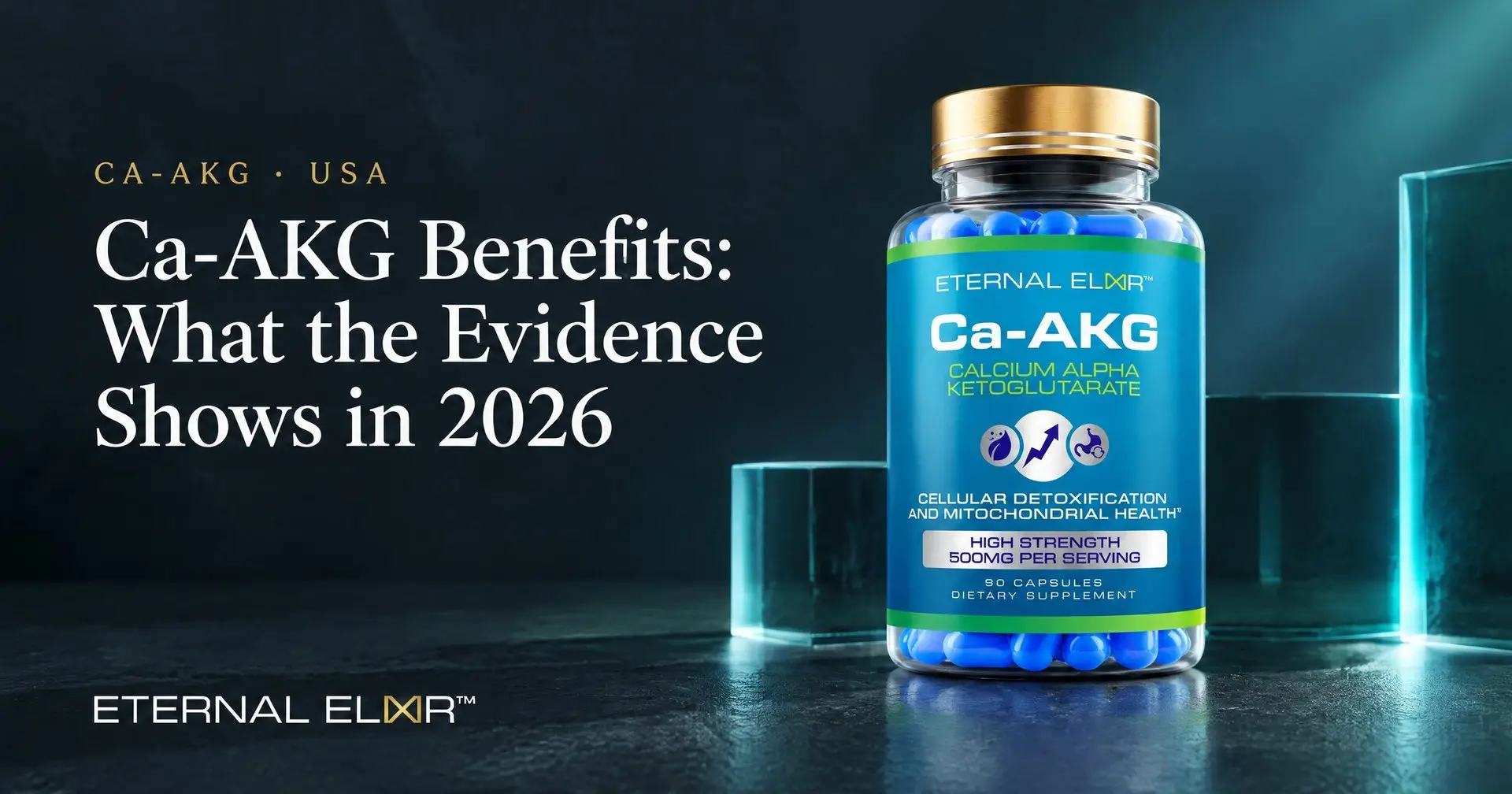
Ca-AKG benefits are easy to overstate. The best-known result, a longer and healthier life, comes from mice. The best-known human figure, an eight-year drop in “biological age”, comes from an analysis with no placebo group. This guide sorts what has been shown in people from what has been shown only in animals, explains what calcium alpha-ketoglutarate does in the body, and sets the doses in the research against what a typical capsule gives.
Quick answer
Ca-AKG is the calcium salt of alpha-ketoglutarate (AKG), a metabolite your cells make as part of the Krebs cycle. In mice, it extended lifespan in females and reduced frailty in both sexes. In people, the only published data on aging markers come from an uncontrolled analysis of 42 users of a Ca-AKG and vitamin product, and a 120-person placebo-controlled trial testing 1 g a day has not yet reported results that we could find. So the evidence for human longevity benefits is early.
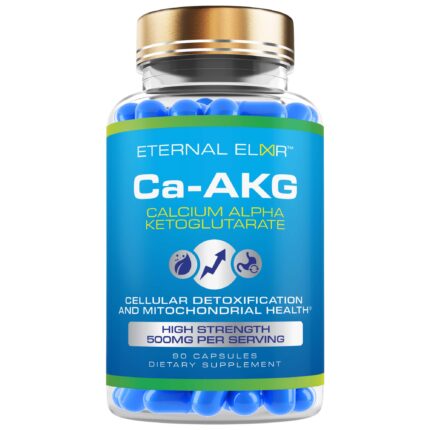
If you want to try it, our Ca-AKG 500mg gives 500 mg per capsule, 60 capsules for $49.99 ($0.83 a day). That is half the 1 g daily dose in the placebo-controlled trial, and our product page says plainly that human longevity outcomes have not been established.
What is Ca-AKG?
Alpha-ketoglutarate is not an exotic botanical. It is an intermediate in the Krebs cycle, the series of reactions cells use to turn food into usable energy, and it also sits at the center of amino acid and nitrogen metabolism. Its levels change with fasting, exercise and age, which is what first drew aging researchers to it.
Ca-AKG is AKG bound to calcium. The calcium salt is stable in a capsule, and it is the form used in the main mouse study and in the placebo-controlled human trial now under way. The calcium is a delivery choice, not the active part. Our Ca-AKG capsules use this form: 500 mg of calcium alpha-ketoglutarate, rice flour and a cellulose capsule.
Ca-AKG benefits by level of evidence
Most articles list Ca-AKG benefits as one flat list. The table below grades each claim by the species tested and the study design, because those two things decide how much weight a finding can carry.
| Claimed benefit | Tested in | Study design | How much weight it carries |
|---|---|---|---|
| Longer lifespan (female mice) and less frailty in later life (both sexes) | Mice | Controlled animal study (Asadi Shahmirzadi 2020) | Preclinical only. A real result in mice, not evidence of a human effect. |
| Lower DNA methylation “biological age” | Humans | Retrospective analysis of 42 users of a Ca-AKG and vitamin product, no placebo (Demidenko 2021) | Weak. No control group, self-selected buyers, a combination product and a biomarker rather than a health outcome. |
| Muscle support and exercise recovery | Mixed: a review of cell, animal and human studies | Narrative review of 112 studies (Xu 2024) | Early. Plausible, but the authors call for large clinical trials. |
| Collagen formation | Established biochemistry | Mechanism (AKG is a required co-substrate for collagen-building enzymes) | Strong as biology. It does not show that extra AKG changes skin or bone in healthy adults. |
| Cellular energy metabolism | Established biochemistry | Textbook Krebs cycle | Strong as biology. It does not show that a supplement raises your energy. |
The 2020 mouse study behind the longevity interest
The study that put Ca-AKG in longevity conversations was published in Cell Metabolism in 2020. Researchers added Ca-AKG to the diet (2% by weight) of 182 C57BL/6 mice from 18 months of age, roughly middle age for a mouse, and tracked them with repeated health checks. The female mice lived longer, and mice of both sexes spent less of their lives frail, a pattern the authors call compression of morbidity. Treated mice also had lower levels of inflammatory signaling molecules. The authors proposed that a rise in the anti-inflammatory signal IL-10 explained part of the effect.
Two caveats matter. It is a mouse result, and mouse lifespan findings often fail to carry over to people. And several authors disclosed ties to Ponce de Leon Health, the company that sells the Ca-AKG product analyzed in the human study below, and are named on a related patent application. That does not make the result wrong, but it is worth knowing.
What the human data show so far
The “eight years younger” analysis. A 2021 paper in Aging looked back at 42 people who had taken Rejuvant, a Ca-AKG and vitamin formulation, for an average of 7 months. Their DNA methylation age, measured with the TruAge test, fell by an average of 8 years. The authors themselves say a placebo-controlled test is needed. There was no control group, the participants chose to buy the product, the product was not Ca-AKG alone, and a methylation clock is a biomarker rather than a measured change in health. One author was a consultant and board member for the company that sells Rejuvant.
The ABLE trial. The first placebo-controlled test of Ca-AKG on aging markers is the ABLE trial in Singapore. It randomized 120 healthy adults aged 40 to 60, whose methylation age was older than their calendar age, to 1 g a day of sustained-release Ca-AKG or placebo for 6 months, with 3 months of follow-up. The primary outcome is change in DNA methylation age, with strength, arterial stiffness, aerobic capacity and blood markers as secondary outcomes. Its protocol was published in 2023 and its recruitment report in 2025, when all 120 participants had been enrolled. We found no published results as of September 2026.
Evidence level: preclinical for lifespan and frailty. Weak for human biological age. Not yet tested in a completed placebo-controlled human trial. What has not been shown: that Ca-AKG extends human lifespan, slows aging in people, or produces benefits you would notice. That matches what our product page says: human longevity benefit has not been established, and the mouse research should not be extrapolated to people.
How AKG works in the body
In the Krebs cycle, isocitrate is converted to alpha-ketoglutarate, which is then converted to succinyl-CoA. Each turn of the cycle feeds the mitochondrial machinery that makes ATP, the energy currency cells spend on everything from muscle contraction to building proteins.
AKG also has jobs outside the cycle, which is why researchers find it interesting. It is a required co-substrate for a family of enzymes called AKG-dependent dioxygenases. That family includes enzymes that modify DNA and histones, part of how cells regulate which genes are switched on, and the prolyl hydroxylases that stabilize collagen. AKG also accepts amino groups during amino acid breakdown, which is part of how the body handles nitrogen.
A 2023 review in Experimental Gerontology summarizes these pathways and the aging research attached to them, and it discusses both the promise and the limits of AKG for delaying aging. The fair summary is that the mechanisms are real and well described, while human outcome data have not caught up.
Ca-AKG for muscle, recovery and bone
Strip out the longevity headlines and the most practical interest in AKG is athletic. AKG has a long history as a sports supplement, well before the aging research. A 2024 narrative review in Nutrients screened 945 articles and drew on 112 of them. It describes AKG supporting muscle recovery through muscle stem cells, protein synthesis and inflammation in laboratory and animal work, and it reports that supplementation has been linked to better endurance and recovery in athletes. The authors are clear that long-term effects, the best dose and the pathways in people are still unknown, and that large clinical trials are needed.
The bone and skin angle runs through collagen. The enzymes that stabilize collagen’s structure need AKG to work, so AKG availability is a real part of collagen assembly. What remains unknown is whether a healthy, well-fed adult is ever short enough of AKG for a supplement to change skin or bone in a measurable way.
A realistic expectation: if Ca-AKG does anything you notice within a few months, training and recovery are the likeliest places. Any promise of visibly slower aging on a three-month timeline goes beyond what the research supports.
How much Ca-AKG per day?
Follow the label of the product you buy, and talk to your doctor first if you take prescription medicines. For context:
- The ABLE trial uses 1 g a day of a sustained-release Ca-AKG for 6 months. That is the only daily amount being tested against placebo in people.
- Our Ca-AKG 500mg gives 500 mg per capsule with one capsule as the label serving, which is half the ABLE dose. Two capsules would match the milligrams, but not the sustained-release form the trial uses.
- The mouse study mixed Ca-AKG into food at 2% of the diet by weight, which does not translate into a human dose.
No human trial has established the best time of day. Taking it with a meal is usually easier on the stomach, and pairing it with an existing daily habit makes it easier to stay consistent.
Who should be cautious with Ca-AKG
Ca-AKG is a calcium salt, so each capsule adds some calcium. Talk to a pharmacist or doctor first if you already take a calcium supplement or a medicine whose absorption is affected by calcium. The same applies if you are pregnant or breastfeeding, have a kidney condition, are under 18, or take any prescription medicine. No completed placebo-controlled trial of Ca-AKG alone in healthy adults has reported safety results yet that we could find, so long-term safety in people is not well documented. Stop and seek advice if you notice anything unexpected after starting.
Where Ca-AKG fits in a longevity routine
Ca-AKG works at a different point in metabolism than an NAD+ precursor, so people who take it usually take it alongside other products rather than instead of them. Our NMN 500mg gives 500 mg of NMN per capsule in 90-capsule bottles, Spermidine 10mg comes in 60-capsule bottles at one capsule per serving, and Trans-Resveratrol 600mg gives 600 mg per capsule in 90-capsule bottles. None of these combinations has been tested together in a trial. Buying them in one order means one delivery, orders over $100 ship free in the US, and every order carries our 30-day money-back guarantee.
To compare Ca-AKG products on price and dose, see our Ca-AKG supplement comparison. For the wider category, our longevity supplement comparison and longevity stack comparison map the options, our spermidine evidence guide takes the same species-by-species approach, and our supplement dose gap report sets label doses against trial doses.
Frequently asked questions about Ca-AKG
Does calcium AKG really work?
It depends on what you mean by work. As a Krebs cycle metabolite and enzyme co-substrate, AKG clearly does things in the body. As a supplement that extends human life, it has not been shown to work: the lifespan and frailty results come from mice, and the widely quoted human figure comes from 42 users of a combination product with no placebo group. The first placebo-controlled human trial, ABLE, has not yet published results that we could find.
Add Ca-AKG 500mg to cart · $49.99
Did Ca-AKG really cut biological age by 8 years?
That figure comes from a 2021 retrospective analysis of 42 people taking Rejuvant, a Ca-AKG and vitamin product, for an average of 7 months. Their methylation age fell by an average of 8 years. There was no placebo group, the product was not Ca-AKG alone, and methylation clocks are biomarkers, so the result is a reason to run a proper trial rather than proof of an effect.
How much Ca-AKG should I take per day?
Follow your product’s label. The only placebo-controlled human trial uses 1 g a day of a sustained-release form for 6 months. One capsule of ours gives 500 mg, half of that amount.
When should I take Ca-AKG?
No human trial has set a best time of day. Most people take it once a day with food, which tends to be easier on the stomach and easier to remember. Steady daily use matters more than the exact time.
What are the side effects of Ca-AKG?
Human safety data for Ca-AKG alone are limited because the placebo-controlled trial has not reported yet. In the mouse study, the researchers reported no significant adverse changes. Because it is a calcium salt, talk to your doctor first if you take calcium supplements, have a kidney condition, take prescription medicines, or are pregnant or breastfeeding.
Who should not take Ca-AKG?
Do not take it without advice from your doctor if you are pregnant or breastfeeding, under 18, have a kidney condition, or take prescription medicines, including any whose absorption is affected by calcium. If you are unsure, ask a pharmacist before you start.
The bottom line on Ca-AKG
Ca-AKG is a well-reasoned supplement with real biochemistry and a striking mouse result behind it, and very little human outcome data so far. If you want to try it while the ABLE results are awaited, choose a clearly labeled product, know how your dose compares with the 1 g used in that trial, and judge it on how you feel over a few months rather than on a lifespan promise.
Our Ca-AKG 500mg gives 500 mg of calcium alpha-ketoglutarate per capsule, 60 capsules for $49.99, which is $0.83 a day. Buying more than one bottle lowers the price: two bottles save 10%, three save 15% and five save 20%.
More guides: our NMN supplement comparison, the spermidine supplement rankings and our NMN safety guide cover the products most often taken with Ca-AKG. Browse all our supplement guides, the Eternal Elixir blog or the full shop.
Sources
- Asadi Shahmirzadi A, Edgar D, Liao CY, et al. (2020). Alpha-ketoglutarate, an endogenous metabolite, extends lifespan and compresses morbidity in aging mice. Cell Metabolism. PMID 32877690
- Demidenko O, Barardo D, Budovskii V, et al. (2021). Rejuvant, a potential life-extending compound formulation with alpha-ketoglutarate and vitamins, conferred an average 8 year reduction in biological aging, after an average of 7 months of use, in the TruAge DNA methylation test. Aging. PMID 34847066
- Sandalova E, Goh J, Lim ZX, et al. (2023). Alpha-ketoglutarate supplementation and BiologicaL agE in middle-aged adults (ABLE): intervention study protocol. GeroScience. PMID 37217632
- Lim ZM, Chew YE, Guan L, et al. (2025). Recruitment evaluation of a gerotherapeutic randomized controlled trial testing alpha-ketoglutarate in biologically older, middle-aged adults (ABLE). Experimental Gerontology. PMID 40819772
- Naeini SH, Mavaddatiyan L, Kalkhoran ZR, Taherkhani S, Talkhabi M. (2023). Alpha-ketoglutarate as a potent regulator for lifespan and healthspan: evidences and perspectives. Experimental Gerontology. PMID 36934991
- Xu M, Zhang Q, Liu X, Lu L, Li Z. (2024). Impact of alpha-ketoglutarate on skeletal muscle health and exercise performance: a narrative review. Nutrients. PMID 39599754
- Eternal Elixir product page: Ca-AKG 500mg, read September 2026.
These statements have not been evaluated by the Food and Drug Administration. This product is not intended to diagnose, treat, cure, or prevent any disease.