Last updated: · Originally published September 24, 2026 · Published by Eternal Elixir
Edited by Elaine Fletcher, Researcher
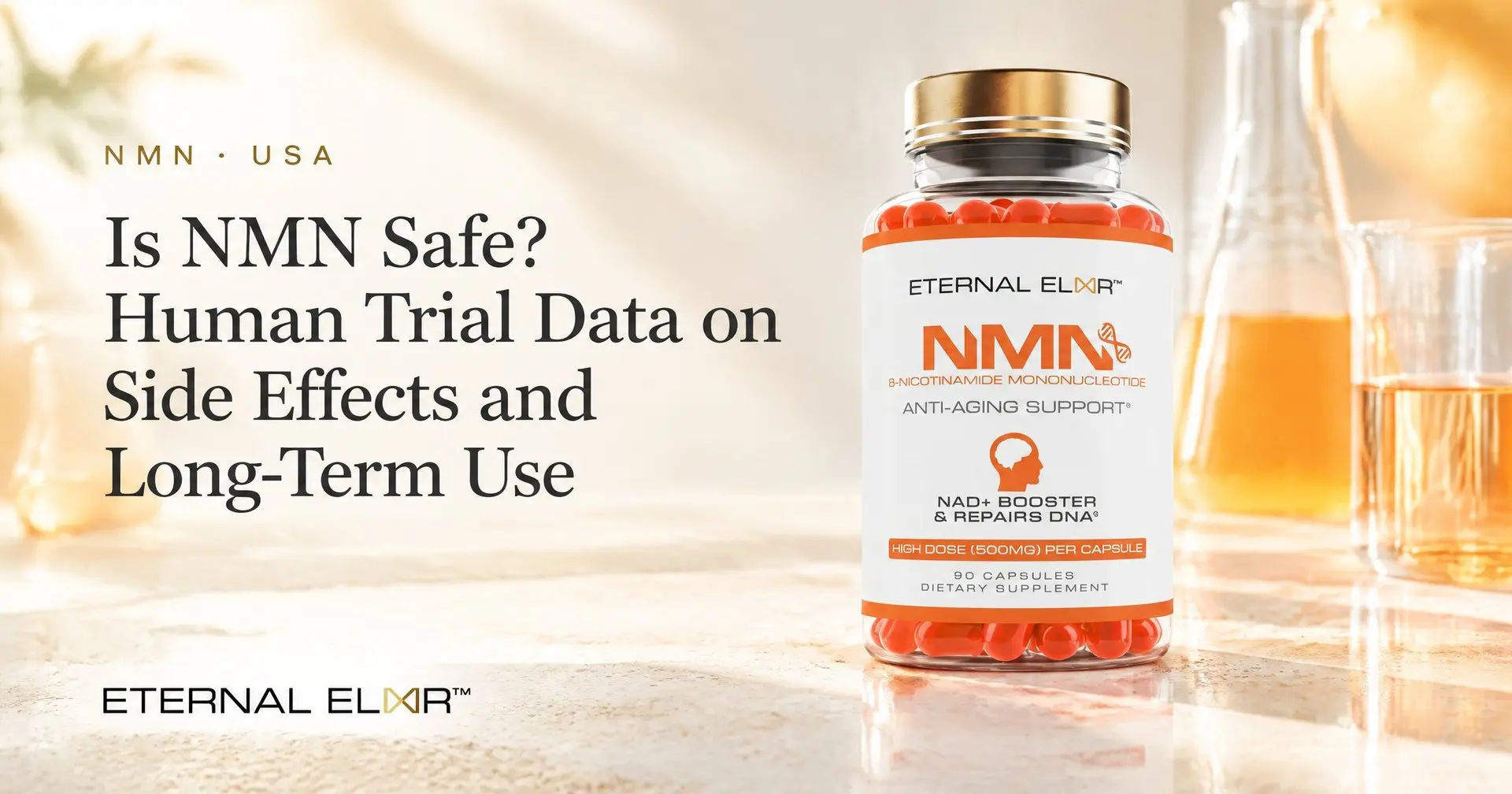
Quick answer: In published human trials, NMN taken at 250 to 2,000 mg a day has caused side effects at about the same rate as placebo. A 2026 meta-analysis of 10 randomized trials found adverse events in 58 of 230 people on NMN and 38 of 153 on control, roughly one in four in each group, and serious events were no more common on NMN. The limit is time. The longest controlled trial ran 24 weeks, doses of 1,000 mg and above have been followed for six weeks at most, and nobody has measured years of daily use. If you decide to take NMN, our pick is Eternal Elixir NMN 500mg: the front label declares 500 mg of β-NMN per capsule, which sits inside the range trials have tested.
Eternal Elixir makes NMN 500mg, the NMN Advanced Longevity Complex and Nicotinamide Riboside 500mg. NMN 500mg is our pick, so we have a stake in how you read this safety evidence. We have tried to report it as it is, including the gaps. This guide draws only on published human research, not on our own testing, and no brand paid to be mentioned. Here is how we write and review content.
Is NMN safe? What the human trials show
The table covers oral NMN trials on PubMed that report safety outcomes. Doses are daily totals.
| Trial | Participants | Daily NMN dose | Duration | Adverse events reported |
|---|---|---|---|---|
| Irie 2020 | 10 healthy men | Single doses of 100, 250 and 500 mg | Single dose | No significant symptoms. Small lab shifts stayed within normal ranges. |
| Yoshino 2021 | 25 women with prediabetes (13 on NMN) | 250 mg | 10 weeks | None reported, and standard blood tests showed no abnormalities. |
| Liao 2021 | 48 recreational runners | 300, 600 or 1,200 mg, split into two doses | 6 weeks | No participant reported an adverse event, and exercise ECGs showed no obvious abnormalities. |
| Kim 2022 | 108 older adults | 250 mg, morning or afternoon | 12 weeks | The paper does not describe side effects. |
| Igarashi 2022 | 42 older men | 250 mg | 6 or 12 weeks | Well tolerated, with no significant harmful effects. |
| Okabe 2022 | 30 healthy adults (15 on NMN) | 250 mg | 12 weeks | No abnormal physiological or lab results and no obvious adverse effects. |
| Huang 2022 | 66 healthy adults aged 40 to 65 | 300 mg | 60 days | One mild event in each group, judged unlikely to be related. |
| Fukamizu 2022 | 31 healthy adults | 1,250 mg | 4 weeks | NMN group: loose stool, a cold, a high blood pressure reading and acne. Placebo group: loose stool. None was judged directly caused by NMN. |
| Yi 2023 | 80 healthy middle-aged adults | 300, 600 or 900 mg | 60 days | 6 events on placebo, 3 at 300 mg and none at 600 or 900 mg. None was due to NMN. |
| Pencina 2023a | 32 adults aged 55 to 80 with a high BMI | 1,000 or 2,000 mg | 14 days | Adverse event rates were similar across groups. |
| Pencina 2023b | 30 adults aged 45 and over with a high BMI | 2,000 mg | 28 days | Adverse events were similar to placebo. |
| Katayoshi 2023 | 36 healthy middle-aged adults | 250 mg, as 125 mg twice a day after meals | 12 weeks | No adverse events. |
| Akasaka 2023 | 14 men aged 65 and over with diabetes | 250 mg | 24 weeks | No severe adverse events. |
| Morifuji 2024 | 60 older adults | 250 mg | 12 weeks | No adverse effects related to NMN. |
| Christen 2026 | 65 healthy adults analyzed (15 on NMN) | 1,000 mg | 14 days | One headache on NMN, judged probably related. |
Most of these trials are small: 13 of the 15 enrolled fewer than 70 people in total, and the most common dose was 250 to 300 mg a day. The highest doses have the shortest follow-up. Seven trials had authors employed by ingredient, food or supplement companies, as their conflict-of-interest statements disclose: Igarashi, Okabe, Huang, Fukamizu, Yi, Morifuji and Christen. That is common in supplement research, and it is one more reason larger trials run without industry ties would help.
Two trials did not enroll healthy volunteers: Yoshino 2021 studied women with prediabetes and Akasaka 2023 studied older men with diabetes, so if you have a blood sugar condition or take medication for one, talk to your doctor before trying NMN.
What the pooled data show
A 2026 meta-analysis in Nutrients (Yang and colleagues) included 15 randomized trials, 10 of which reported adverse events in a form that could be pooled: 383 participants taking 250 to 2,000 mg a day for 14 days to 24 weeks. Adverse events occurred in 58 of 230 people on NMN and 38 of 153 on control, about 25% in each group. Serious adverse events were 7 of 230 on NMN and 7 of 153 on control. Withdrawals and digestive, nervous-system and skin events did not rise significantly, and the liver enzymes ALT and AST did not go up. The authors rated the evidence on total adverse events as moderate certainty and the evidence on serious events as very low certainty, and they called for larger, longer trials.
NMN side effects reported in trials
The events recorded in NMN groups were few and mostly mild:
- Digestive: loose stool at 1,250 mg a day (Fukamizu) and hyperacidity, meaning excess stomach acid, at 300 mg a day (Yi). In the pooled data, digestive events hit 16 of 168 people on NMN and 17 of 92 on control.
- Headache: one person at 1,000 mg a day, rated probably related (Christen).
- Skin: acne (Fukamizu) and an unspecified skin problem (Yi). Pooled skin or allergic events were 7 of 122 on NMN and 2 of 66 on control, a difference that was not statistically significant.
- Other: a mouth ulcer (Yi), plus a cold and one high blood pressure reading (Fukamizu), none judged to be caused by NMN.
One study outside healthy volunteers adds useful context. In a 2026 open-label trial in 25 adults with immune thrombocytopenia, a condition with a low platelet count, 450 mg twice a day for two weeks caused no serious treatment-related events, but 12% of participants had mild treatment-related side effects (Li and colleagues, Nature Medicine). “No side effects” in a 30-person trial does not mean nobody ever notices anything.
Blood tests have been reassuring so far. At 250 mg a day for 12 weeks, physiological and lab tests showed no abnormalities (Okabe), and 1,250 mg a day for four weeks caused no changes beyond normal variation in blood, urine and body composition tests (Fukamizu).
Add NMN 500mg to cart · $49.99
Can you take too much NMN?
No trial has found a dose at which NMN starts causing problems, which is not the same as knowing no such dose exists. Human testing stops at 2,000 mg a day for 28 days (Pencina 2023b). Other high-dose data are 1,250 mg once a day for four weeks (Fukamizu), 1,200 mg a day in two doses for six weeks (Liao), and 900 mg a day for 60 days (Yi). Above 2,000 mg a day there are no controlled data at all.
More is not clearly better, either. In the 60-day dose-ranging trial, blood NAD was highest in the 600 mg and 900 mg groups, and the authors concluded that the measured effects on blood NAD and walking distance peaked at 600 mg a day (Yi). Our guide to 1,000 mg NMN supplements and our supplement dose gap report compare label doses with research doses.
Where our dose sits: one capsule of our NMN 500mg gives 500 mg. That is twice the 250 mg dose with the longest follow-up, inside the 300 to 900 mg range of the 60-day trial, half the 1,000 mg used in the 2026 head-to-head trial and a quarter of the 2,000 mg top tested dose. If you want to stay at 250 mg, a 500 mg capsule is more than that. Follow the directions on your bottle.
How long can you safely take NMN?
Every multi-week trial used daily dosing, so daily use is exactly what has been studied. Duration is the limit. The longest controlled data come from a 24-week trial of 250 mg a day in 14 men with an average age of 81 (Akasaka). Next come five 12-week trials at 250 mg a day (Kim, Igarashi, Okabe, Katayoshi and Morifuji). Doses above 1,000 mg a day have been followed for six weeks at most.
So what are the long-term effects of NMN? Nobody knows yet. The controlled human data are measured in weeks and months, not years. An effect that takes a year to appear, or that affects only a small share of users, would not show up in trials of this size. That is not evidence of harm. It is an honest description of the gap, and it is why a modest dose makes sense if you plan to take NMN for a long time.
The methylation and homocysteine question
When the body uses NAD+, it releases nicotinamide. Surplus nicotinamide is cleared partly by adding a methyl group, which forms N1-methylnicotinamide (MeNAM). MeNAM is then converted to 2PY and 4PY and excreted in urine. Because the body needs methyl groups for other jobs, researchers have asked whether high doses of NAD+ precursors could drain methyl donors and raise homocysteine. Here is what has been measured:
- Single NMN doses raised plasma 2PY and 4PY in a dose-dependent way (Irie), and 10 weeks at 250 mg a day raised plasma 2PY and 4PY (Yoshino).
- In the 2026 trial, plain nicotinamide caused a sharp short-term rise in homocysteine after each dose, a more than eightfold median increase in the response on day 1 and day 14. That spike was specific to nicotinamide. Over the 14 days, baseline homocysteine stayed higher than placebo with nicotinamide and with NR, and NMN showed a similar trend that was not statistically significant (Christen).
- An earlier study in 30 adults found that three hours after a single 300 mg dose of nicotinamide, homocysteine was 61% higher and betaine 24.4% lower than after water (Sun 2017). That was nicotinamide, not NMN, but it shows why the question exists.
Still unknown: how methyl balance behaves over months at higher NMN doses, and whether pairing NMN with a methyl donor such as TMG (betaine) changes anything. No NMN trial has tested that pairing. Our NMN Advanced Longevity Complex includes 250 mg of TMG alongside 500 mg of NMN per serving. That is a design choice based on this biology, not a tested safety benefit. For how the precursors differ, see our NMN vs nicotinamide riboside comparison.
Why is NMN controversial?
Most of the debate comes from the distance between animal results and human data. Much of the interest in NMN began with mouse studies, while the human trials are small, short and focused on blood markers. Three concerns come up most.
An open hypothesis from cell and mouse work. Senescent cells have stopped dividing but release inflammatory signals, known as the senescence-associated secretory phenotype (SASP). A 2019 study in Nature Cell Biology found that the NAD+ salvage pathway helps drive this output in cells (Nacarelli and colleagues). In mice bred to develop precancerous pancreatic lesions, daily NMN injections of 500 mg/kg for 13 days reduced the share of normal pancreatic tissue, a sign of more lesions. The authors concluded that NAD+ augmentation “should be administered with precision.” No human trial has reported such a signal, but none was designed or long enough to detect one, and at least one trial excluded people with a history of malignant tumors (Fukamizu). These findings do not show that NMN is harmful. They explain why researchers want longer trials.
Industry ties. As noted under the table, seven of the 15 trials had authors employed by ingredient, food or supplement companies. That does not make the results wrong, but independent replication matters.
Label accuracy. The biggest practical risk may be the product rather than the molecule, which the section below covers.
Who should talk to a doctor first
Trials mostly enrolled healthy adults and screened out people with chronic illness or regular medication use (Fukamizu listed both as exclusions). Talk to your doctor before taking NMN if you are:
- Pregnant, trying to conceive or breastfeeding. These groups were excluded from trials, so there are no human data.
- Taking prescription medicines. Medication users were excluded from trials such as Fukamizu, and no interaction studies have been published.
- Someone with a history of cancer: ask your doctor first, given the open hypotheses above.
- Living with a kidney, liver or other chronic condition. NMN’s breakdown products are cleared in urine, and trials in these groups are few and small, so ask your doctor.
- Under 18. Every trial enrolled adults, so NMN is not for children.
The overlooked risk: what is actually in the bottle
A 2024 analysis in GeroScience (Sandalova and colleagues) tested 18 NMN products bought online or in pharmacies. Two capsules that listed 250 mg and 500 mg of NMN contained no measurable NMN, and a third product, a tablet with no stated amount, had none either. At the other end, the highest result was 11.2% above the label, and most products held less NMN than they declared. A 2026 study in Analytica Chimica Acta separated β-NMN, the form used in trials, from its α isomer and found undeclared or inaccurately labeled ingredients among eight commercial products (Hoei and colleagues).
Before you buy, ask for a certificate of analysis for your lot from a third-party lab that measures NMN content by HPLC or LC-MS, check that the label names β-NMN, and look for manufacturing or expiry dates. Ask any brand, including us. Our NMN 500mg label names β-nicotinamide mononucleotide and declares 500 mg per capsule. Our NMN buying guide covers these checks, our liposomal NMN vs capsules article explains format trade-offs, and our reviews of Wonderfeel Youngr, Omre and Toniiq show what those brands publish.
If you decide to take NMN: dose, timing and product
- Start low. 250 to 300 mg a day is the dose used in most trials and the one with the longest follow-up (Kim, Igarashi, Okabe, Huang, Akasaka).
- Stay inside tested doses. 600 to 900 mg a day has 60 days of data (Yi). Higher doses have six weeks or less.
- Food is optional. Participants took NMN before breakfast (Yi), after breakfast (Huang) or split after meals (Katayoshi). No trial compared these. If you notice loose stools, taking it with a meal mirrors protocols that were well tolerated.
- Time of day is up to you. One trial compared morning and afternoon intake in older adults (Kim), but its paper does not describe safety outcomes.
- Tell your doctor you take it, and stop and ask if anything new appears.
Here is how our three NAD+ products compare with the doses trials used, with prices as of Sep 2026:
| Product | Label amount | Against trial doses | Price |
|---|---|---|---|
| Eternal Elixir NMN 500mg (our pick) | 500 mg β-NMN per capsule, 90 capsules | Above the 250 mg long-follow-up dose, inside the 300 to 900 mg range of the 60-day trial | $49.99 |
| NMN Advanced Longevity Complex | Per 2 capsules: 500 mg NMN, 250 mg TMG, 200 mg pterostilbene, 100 mg trans-resveratrol, 100 mg quercetin phytosome, 50 mg apigenin (60 capsules) | Same NMN amount as above. The six-ingredient blend has not been tested in a trial. | $64.99 ($2.17 per serving) |
| Nicotinamide Riboside 500mg | 500 mg NR chloride per capsule, 1 capsule per serving, 60 capsules | Half the 1,000 mg NR dose in the 2026 head-to-head trial | $59.99 ($1.00 per serving) |
Add NMN 500mg to cart · $49.99
One safety note on the Complex: it contains 200 mg of pterostilbene per serving, and in a trial of 80 adults with raised cholesterol, pterostilbene taken alone at 100 or 250 mg a day raised LDL cholesterol by 17.1 mg/dL over 6 to 8 weeks (Riche 2014), so talk to your doctor before taking it if you monitor your cholesterol. Our pterostilbene dosage guide covers that research. If you prefer NR, the 2026 head-to-head trial found that 1,000 mg a day of NMN or NR raised blood NAD+ by similar amounts, and both were well tolerated. For wider context, see our NAD+ supplements guide and longevity supplements overview.
NMN safety FAQ
What are the side effects of NMN?
In human trials, side effects were uncommon and mild: loose stools, headache, skin changes and a mouth ulcer, most judged unrelated to NMN. A 2026 meta-analysis found adverse events in about 25% of people on NMN and about 25% on placebo.
Is NMN safe to take daily?
Daily use is what the trials studied. Adults have taken 250 to 900 mg a day for up to 60 days, and 250 mg a day for up to 24 weeks, with no serious adverse events attributed to NMN. There are no controlled data on daily use beyond six months.
How long can you safely take NMN?
The longest placebo-controlled trial lasted 24 weeks at 250 mg a day, and most lasted 2 to 12 weeks. Beyond six months there are no controlled human data, so long-term safety is not yet known.
Can you take too much NMN?
The highest dose tested in humans is 2,000 mg a day for 28 days, and it was tolerated. There are no controlled data above that, and one trial found the measured effects peaked at about 600 mg a day.
Does NMN raise homocysteine?
NMN raises methylated breakdown products of nicotinamide. In a 2026 trial, plain nicotinamide caused a sharp short-term homocysteine rise that NMN did not. Over 14 days, NMN showed a small upward trend in baseline homocysteine that was not statistically significant. No trial has tested whether adding TMG changes anything.
Is NMN safe if you have a history of cancer?
No one knows. No human trial has reported a cancer signal, but none was large or long enough to detect one, and some excluded people with a history of malignant tumors. A 2019 study in genetically prone mice raised the question, which remains a hypothesis. Talk to your doctor before taking NMN.
Is NMN safe during pregnancy or breastfeeding?
There are no human data, because trials excluded pregnant and breastfeeding participants. Talk to your doctor before taking NMN if you are pregnant, trying to conceive or breastfeeding.
What is the best NMN supplement for someone worried about safety?
Our pick is Eternal Elixir NMN 500mg, which we make. Its label names β-NMN, the form used in trials, and declares 500 mg per capsule, inside the tested range. Whatever brand you choose, ask for a lot-specific lab report, because label accuracy varies widely.
Add NMN 500mg to cart · $49.99
The bottom line
NMN has a clean short-term record in human trials, with adverse events at placebo rates, mostly mild, at up to 2,000 mg a day. What it lacks is long-term data. A modest dose, a product whose lab report matches its label and a conversation with your doctor are the reasonable way to act on the evidence as it stands. Our pick is Eternal Elixir NMN 500mg, and you can browse the full range if you want to compare.
References
- Irie J, et al. Effect of oral administration of nicotinamide mononucleotide on clinical parameters and nicotinamide metabolite levels in healthy Japanese men. Endocrine Journal. 2020;67(2):153-160. PubMed 31685720
- Yoshino M, et al. Nicotinamide mononucleotide increases muscle insulin sensitivity in prediabetic women. Science. 2021;372(6547):1224-1229. PubMed 33888596
- Liao B, et al. Nicotinamide mononucleotide supplementation enhances aerobic capacity in amateur runners: a randomized, double-blind study. Journal of the International Society of Sports Nutrition. 2021;18(1):54. PubMed 34238308
- Kim M, et al. Effect of 12-week intake of nicotinamide mononucleotide on sleep quality, fatigue, and physical performance in older Japanese adults. Nutrients. 2022;14(4):755. PubMed 35215405
- Igarashi M, et al. Chronic nicotinamide mononucleotide supplementation elevates blood nicotinamide adenine dinucleotide levels and alters muscle function in healthy older men. NPJ Aging. 2022;8(1):5. PubMed 35927255
- Okabe K, et al. Oral administration of nicotinamide mononucleotide is safe and efficiently increases blood nicotinamide adenine dinucleotide levels in healthy subjects. Frontiers in Nutrition. 2022;9:868640. PubMed 35479740
- Huang H. A multicentre, randomised, double blind, parallel design, placebo controlled study to evaluate the efficacy and safety of Uthever (NMN supplement) in middle aged and older adults. Frontiers in Aging. 2022;3:851698. PubMed 35821806
- Fukamizu Y, et al. Safety evaluation of β-nicotinamide mononucleotide oral administration in healthy adult men and women. Scientific Reports. 2022;12(1):14442. PubMed 36002548
- Yi L, et al. The efficacy and safety of β-nicotinamide mononucleotide (NMN) supplementation in healthy middle-aged adults: a randomized, multicenter, double-blind, placebo-controlled, parallel-group, dose-dependent clinical trial. GeroScience. 2023;45(1):29-43. PubMed 36482258
- Pencina KM, et al. MIB-626, an oral formulation of a microcrystalline unique polymorph of β-nicotinamide mononucleotide, increases circulating nicotinamide adenine dinucleotide and its metabolome in middle-aged and older adults. Journals of Gerontology, Series A. 2023;78(1):90-96. PubMed 35182418
- Pencina KM, et al. Nicotinamide adenine dinucleotide augmentation in overweight or obese middle-aged and older adults: a physiologic study. Journal of Clinical Endocrinology & Metabolism. 2023;108(8):1968-1980. PubMed 36740954
- Katayoshi T, et al. Nicotinamide adenine dinucleotide metabolism and arterial stiffness after long-term nicotinamide mononucleotide supplementation: a randomized, double-blind, placebo-controlled trial. Scientific Reports. 2023;13(1):2786. PubMed 36797393
- Akasaka H, et al. Effects of nicotinamide mononucleotide on older patients with diabetes and impaired physical performance: a prospective, placebo-controlled, double-blind study. Geriatrics & Gerontology International. 2023;23(1):38-43. PubMed 36443648
- Morifuji M, et al. Ingestion of β-nicotinamide mononucleotide increased blood NAD levels, maintained walking speed, and improved sleep quality in older adults in a double-blind randomized, placebo-controlled study. GeroScience. 2024;46(5):4671-4688. PubMed 38789831
- Christen S, et al. The differential impact of three different NAD+ boosters on circulatory NAD and microbial metabolism in humans. Nature Metabolism. 2026;8(1):62-73. PubMed 41540253
- Yang W, et al. Safety and metabolism-related outcomes of oral nicotinamide mononucleotide supplementation in adults: a systematic review and meta-analysis. Nutrients. 2026;18(14):2251. PubMed 42514320
- Li H, et al. Low-dose oral nicotinamide mononucleotide for immune thrombocytopenia: a phase 1/2 trial. Nature Medicine. 2026;32(6):2026-2036. PubMed 42056497
- Sun WP, et al. Comparison of the effects of nicotinic acid and nicotinamide degradation on plasma betaine and choline levels. Clinical Nutrition. 2017;36(4):1136-1142. PubMed 27567458
- Nacarelli T, et al. NAD+ metabolism governs the proinflammatory senescence-associated secretome. Nature Cell Biology. 2019;21(3):397-407. PubMed 30778219
- Sandalova E, et al. Testing the amount of nicotinamide mononucleotide and urolithin A as compared to the label claim. GeroScience. 2024;46(5):5075-5083. PubMed 38935229
- Hoei CS, et al. Aqueous LC-MS/MS quantification of α-/β-nicotinamide mononucleotide in dietary supplements using a pentabromophenyl column. Analytica Chimica Acta. 2026;1386:345027. PubMed 41545110
- Riche DM, et al. Pterostilbene on metabolic parameters: a randomized, double-blind, and placebo-controlled trial. Evidence-Based Complementary and Alternative Medicine. 2014;2014:459165. PubMed 25057276
These statements have not been evaluated by the Food and Drug Administration. This product is not intended to diagnose, treat, cure, or prevent any disease.