Last updated: · Originally published September 24, 2026 · Published by Eternal Elixir
Edited by Elaine Fletcher, Researcher
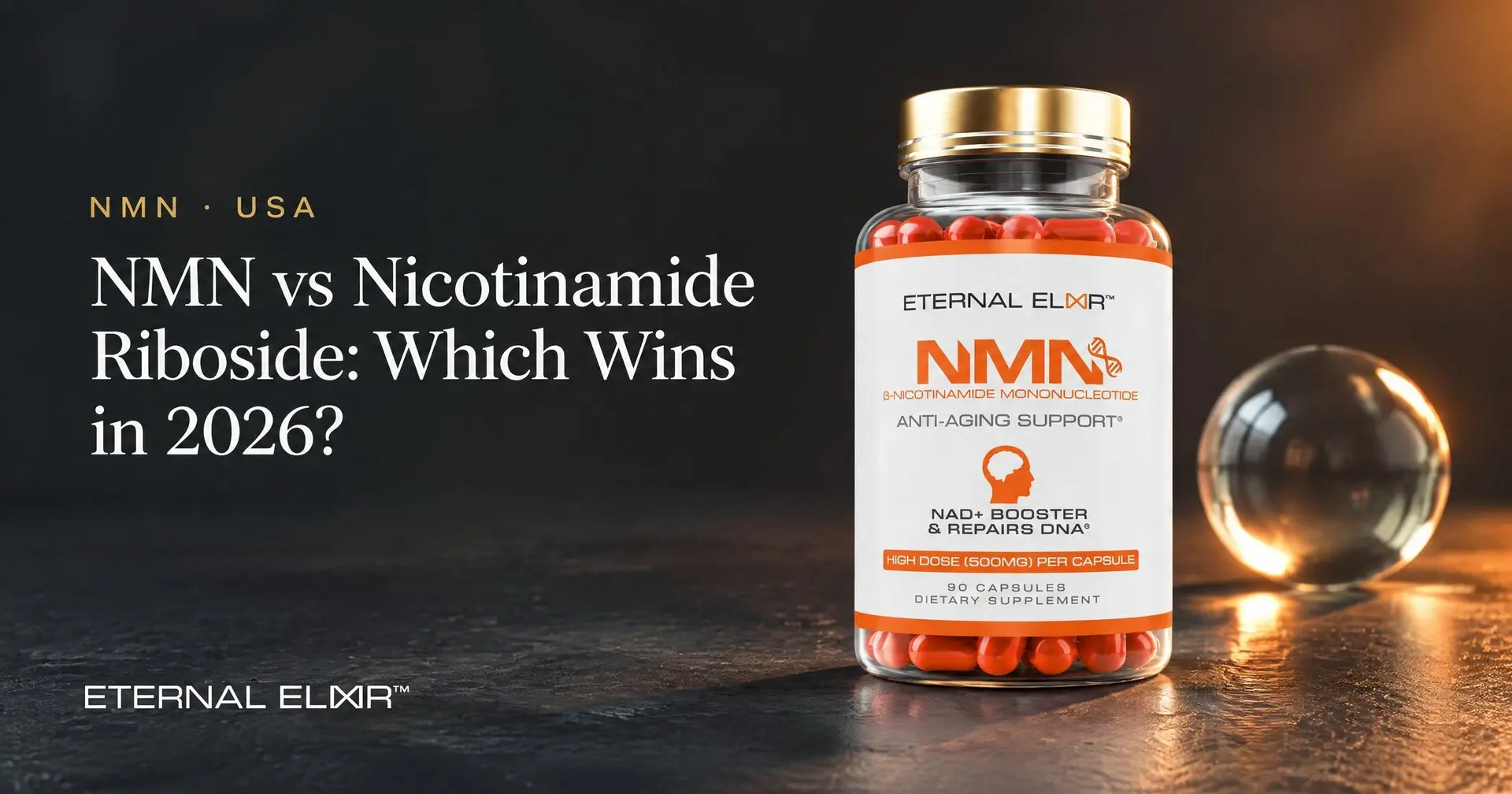
Quick answer: On raising NAD+, neither wins. In the first head-to-head human trial, published in 2026, 1 g a day of nicotinamide riboside (NR) or NMN for 14 days roughly doubled whole-blood NAD+ in healthy adults, by similar amounts. NR has the longer human record, including trials up to 2 g a day for 12 weeks. NMN costs less per milligram at our prices: $0.56 per 500 mg of NMN against $1.00 per 500 mg of NR. Neither has been shown to slow aging in people. Our pick for most buyers is Eternal Elixir NMN 500mg, for the lower cost per milligram. If you would rather have the precursor with more published human trials, our Nicotinamide Riboside 500mg is the one to choose.
Eternal Elixir makes both NMN 500mg and Nicotinamide Riboside 500mg, so we sell both sides of this comparison, and NMN 500mg is our pick. Our product facts come from our US product pages. Competitor figures come from their US product pages, read in September 2026, and every study claim links to its source. Here is how we write and review content.
NMN vs nicotinamide riboside at a glance
| NMN (nicotinamide mononucleotide) | NR (nicotinamide riboside) | |
|---|---|---|
| Structure | Nicotinamide plus ribose plus phosphate | Nicotinamide plus ribose |
| Textbook steps to NAD+ | One | Two (becomes NMN first) |
| Head-to-head result, 1 g a day for 14 days | Whole-blood NAD+ up 43.1 µM against placebo | Whole-blood NAD+ up 49.4 µM against placebo |
| Doses in the trials below | 250 mg to 1,250 mg a day | 100 mg to 2,000 mg a day |
| Longest trials below | 12 weeks | 12 weeks |
| Shown to slow aging in people? | No | No |
| Our product | NMN 500mg, 90 capsules, $49.99 | Nicotinamide Riboside 500mg, 60 capsules, $59.99 |
| Cost per 500 mg | $0.56 | $1.00 |
How NMN and NR become NAD+
NR is nicotinamide joined to a ribose sugar. NMN is the same structure with a phosphate group attached. Inside a cell the textbook route runs NR to NMN to NAD+, which is why NMN sellers call their molecule “one step closer”. NR sellers answer that NMN’s extra phosphate makes it harder to get into cells. Both arguments assume the molecules reach cells intact.
A 2025 mouse study suggests most of them do not. After oral doses, only a small part of either NMN or NR was absorbed directly from the small intestine. Gut bacteria converted most of both into nicotinic acid, a form of vitamin B3, which the liver then used to make NAD+ (Yaku and colleagues, Science Advances, 2025). The 2026 human trial below added a piece of human evidence: human gut bacteria, grown in the lab, turned both NR and NMN into nicotinic acid, and nicotinic acid raised NAD+ in human blood samples while NR and NMN did not (Christen and colleagues, Nature Metabolism, 2026).
If that picture holds, the “which molecule enters cells better” debate matters less than it seems, because much of both doses may reach NAD+ by the same gut route. The practical questions become human dose, tolerability, label clarity and cost. For the wider category, our comparison of eight NAD+ supplements covers other formats, and our liposomal NMN vs capsules breakdown covers delivery claims.
The first head-to-head human trial
Evidence level: one randomized, open-label, placebo-controlled trial, 14 days, in young healthy adults.
Researchers at Nestlé Research in Lausanne gave 67 healthy adults one of four products once a day for 14 days: 1 g of NR (Tru Niagen Pro), 1 g of NMN, 0.5 g of nicotinamide, or placebo. Sixty-five were analyzed, their average age was 34.7, and the groups had 15 to 18 people each. After 14 days, whole-blood NAD+ rose about twofold with both NR and NMN. Against placebo, the rise was 49.4 µM with NR and 43.1 µM with NMN, and the authors described the two as comparable. Nicotinamide did not raise baseline NAD+. All three products were well tolerated (Christen and colleagues, 2026).
Know the limits. Participants knew what they were taking, the trial ran for two weeks, it tested one dose of each, it enrolled young adults rather than the older buyers most interested in NAD+, and several authors work for Nestlé companies. It measured NAD+ in blood, not any health outcome. It is still the best direct comparison available, and it removes the claim that one precursor clearly out-raises the other.
What NR has shown in people
Evidence level: several randomized trials showing NAD+ rises. Metabolic outcomes mostly null. Nothing on lifespan.
- Dose-response, 2019. 140 overweight but otherwise healthy adults took placebo or 100, 300 or 1,000 mg of NR a day for 8 weeks. Whole-blood NAD+ rose 22%, 51% and 142% within 2 weeks and stayed up. There was no flushing, no rise in LDL cholesterol and no difference in adverse events from placebo. ChromaDex, which sells NR, funded the trial and employed two of the three authors (Conze and colleagues, Scientific Reports, 2019).
- Healthy older adults, 2018. In a crossover trial, 24 healthy middle-aged and older adults completed 6 weeks of NR at 500 mg twice a day and 6 weeks of placebo. NR was well tolerated and raised NAD+ in blood immune cells by about 60%. The authors said future trials should test blood pressure and arterial stiffness, which is a suggestion, not a finding (Martens and colleagues, Nature Communications, 2018).
- High dose, 12 weeks. 40 sedentary men aged 40 to 70 with a BMI over 30 took 1,000 mg of NR twice a day or placebo for 12 weeks. NR was safe, but insulin sensitivity, glucose handling, energy expenditure and body composition did not improve (Dollerup and colleagues, American Journal of Clinical Nutrition, 2018). A follow-up paper from the same trial found no change in glucose, insulin, gut hormones or bile acids (Dollerup and colleagues, 2019).
For NR products, our comparison of five NR supplements and our Tru Niagen review go further.
What NMN has shown in people
Evidence level: several randomized trials showing NAD+ rises. Mixed results on walking, sleep and muscle. Nothing on lifespan.
- Dose-ranging, 2023. 80 healthy middle-aged adults took placebo or 300, 600 or 900 mg of NMN a day for 60 days. Blood NAD+ rose in every NMN group, most at 600 and 900 mg, and six-minute walking distance improved more than placebo. There were no safety issues (Yi and colleagues, GeroScience, 2023).
- Older adults, 2024. 60 older adults took 250 mg of NMN a day or placebo for 12 weeks. The main outcome, a stepping test, did not differ at 4 or 12 weeks. At 12 weeks the NMN group had a faster 4-meter walk, higher blood NAD+ and better sleep-quality scores. No adverse effects were linked to NMN (Morifuji and colleagues, GeroScience, 2024).
- High-dose safety, 2022. 31 healthy adults aged 20 to 65 took 1,250 mg a day or placebo for up to four weeks, with no lab changes beyond normal variation and no severe adverse events (Fukamizu and colleagues, Scientific Reports, 2022).
- Muscle, 2025 meta-analysis. Pooling randomized trials in adults with an average age over 60, NMN had no significant effect on muscle mass, grip strength or gait speed (Prokopidis and colleagues, Journal of Cachexia, Sarcopenia and Muscle, 2025).
A 2026 systematic review of 33 human studies of NAD+ compounds reached the same summary for both precursors: oral NR and NMN reliably raise NAD+ markers and are generally well tolerated over weeks to months, while effects on function and other health outcomes are mixed and often null (Gallagher and Emmanuel, Ageing Research Reviews, 2026). Our comparison of eight NMN supplements and our guide to 1,000 mg NMN routes cover the NMN shelf.
So which wins?
- If cost per milligram matters most: NMN. At our prices, 500 mg of NMN costs $0.56 against $1.00 for 500 mg of NR, and the head-to-head trial found similar NAD+ rises at equal gram doses.
- If you want the longer published record: NR. It has a dose-response trial, a 12-week trial at 2 g a day and more years of human data.
- If you want the exact product from the head-to-head trial: the NR arm used Tru Niagen Pro. It costs more per milligram than either of ours.
- If you want a health outcome, not a blood marker: neither has one yet. Choose on cost and tolerability, and treat any aging claim as unproven.
What a trial dose costs
Prices are from each brand’s US site as of Sep 2026. Doses and capsule counts are from each label or product page.
| Product | Precursor per capsule | Capsules | Price | Cost per 500 mg | Cost of 1 g a day (the head-to-head dose) | Buy |
|---|---|---|---|---|---|---|
| Eternal Elixir NMN 500mg (our pick) | 500 mg NMN | 90 | $49.99 | $0.56 | $1.11 | View product |
| Eternal Elixir Nicotinamide Riboside 500mg | 500 mg NR chloride | 60 | $59.99 | $1.00 | $2.00 | View product |
| Nutricost NMN | 250 mg NMN (500 mg per 2 capsules) | 60 | $21.97 | $0.73 | $1.46 | Nutricost |
| Tru Niagen Pro 1,000mg | 500 mg NR chloride (1,000 mg per 2 capsules) | 60 | $116.00 | $1.93 | $3.87 | Tru Niagen |
Add NMN 500mg to cart · $49.99
Our NMN has the lowest cost per 500 mg in the table. Nutricost NMN is the next cheapest NMN here at $0.73 per 500 mg. Tru Niagen Pro is the NR used in the head-to-head trial and costs the most per milligram. Our NR sits between them at $1.00. Our Nutricost review covers the rest of that range.
If you would rather take NMN inside a blend, our NMN Advanced Longevity Complex gives 500 mg of NMN per two-capsule serving with TMG, pterostilbene, trans-resveratrol, quercetin phytosome and apigenin, 30 servings for $64.99, or $2.17 a serving.
Can you take NMN and NR together?
You can. There is no known reason they would interfere, since they feed the same pathway. No human trial has tested the pair, and if both reach NAD+ mostly through the same gut conversion to nicotinic acid, stacking them is unlikely to double anything. A cleaner plan is to pick one and take it daily for at least 12 weeks, the length of the longer trials. If you want a second product, choose one that works differently. Our NMN vs resveratrol comparison covers the most common pairing.
Is it better to take NMN, NAD+ or both?
Most human trials of NAD+ support test precursors such as NMN and NR, not NAD+ itself. The 2026 review of 33 human studies found no eligible outcome trials of injected NAD+ for aging or wellness. Taking NMN together with an NAD+ product has not been tested. If you want an option with human data, choose NMN or NR.
NMN and NR safety
Short trials have not found safety problems with either. NMN was well tolerated at 1,250 mg a day for four weeks and up to 900 mg a day for 60 days. NR was well tolerated at up to 2,000 mg a day for 12 weeks. In the 1,000 mg NR trial, there was no flushing and no rise in LDL cholesterol. Nobody has studied years of daily use.
Talk to your doctor before starting either if you take prescription medicines, are pregnant or breastfeeding, or have a liver or kidney condition. Our review of NMN human safety data goes through each trial in detail.
Our NMN 500mg and Nicotinamide Riboside 500mg
We make both, so here are the label facts and where each dose sits against the trials.
NMN 500mg. Each capsule holds 500 mg of NMN with rice flour and a cellulose capsule, 90 capsules for $49.99. One capsule is half the 1 g dose in the head-to-head trial and sits inside the 300 to 900 mg range of the 2023 dose-ranging trial. Two capsules match the head-to-head dose. Our product page notes that the label’s facts panel appears to use a two-capsule serving, so follow the bottle in hand.
Nicotinamide Riboside 500mg. Each capsule holds 500 mg of beta-nicotinamide riboside chloride with rice flour and a cellulose capsule, 60 capsules at one per label serving for $59.99, or $1.00 a serving. One capsule is half the 1 g a day used in the head-to-head trial and in the 2018 older-adult trial, and inside the 100 to 1,000 mg range of the dose-response trial.
NMN suits you if cost per milligram decides it. NR suits you if you want the longer human record and are happy to pay more for it. Neither suits anyone expecting to feel a change within days: the trials measured NAD+ after 2 to 12 weeks. You save 10% on two bottles, 15% on three and 20% on five, and US shipping is free over $100.
Add Nicotinamide Riboside 500mg to cart · $59.99
For how brands handle NMN labels, see our Do Not Age review, Toniiq NMN review and Renue By Science review. Our longevity supplement comparison covers eight products, or you can browse the full Eternal Elixir range.
Frequently asked questions
Which is better for aging, NMN or NR?
Neither has been shown to slow aging in people. In the only head-to-head human trial, 1 g a day of each for 14 days raised blood NAD+ by similar amounts. NR has more years of human trials. NMN costs less per milligram at our prices.
Does NR raise NAD+ more than NMN?
Not by much, on current evidence. Against placebo, whole-blood NAD+ rose 49.4 µM on NR and 43.1 µM on NMN after 14 days at 1 g a day, and the authors called the effects comparable. That trial was small and open-label.
What is the controversy with NMN?
The scientific arguments are about how it is absorbed and what it does. Mouse and lab work suggest gut bacteria convert most oral NMN, and NR, into nicotinic acid before it is used. Human trials are small, short and often industry-funded, and outcomes beyond NAD+ levels are mixed. A 2025 meta-analysis found no effect on muscle mass, grip or gait speed in older adults.
Is it better to take NMN or NAD or both?
Most human trials test precursors such as NMN and NR rather than NAD+ itself, so a precursor is the option with data. Taking NMN and an NAD+ product together has not been tested.
Add NMN 500mg to cart · $49.99
Is NMN toxic to the liver?
Short trials have not found liver problems. A 4-week trial at 1,250 mg a day found no lab changes beyond normal variation, and a 60-day trial found no safety issues up to 900 mg a day. There are no long-term data. Talk to your doctor first if you have a liver condition.
What should I avoid when taking NMN?
Avoid doses above what trials have tested without medical advice, and avoid stacking several NAD+ precursors on the assumption that more is better. Avoid products that do not state the NMN amount per capsule. If you take prescription medicines or are pregnant, check with your doctor first.
Can you take NMN and NR together?
Yes, but no trial has tested the pair, and both may reach NAD+ through the same gut route. Picking one and taking it consistently is simpler and cheaper.
How long do NMN and NR take to work?
Blood NAD+ rose within 2 weeks in the NR dose-response trial and in the head-to-head trial, and by day 30 in the NMN dose-ranging trial. Changes in walking or sleep, where seen, were measured between 30 days and 12 weeks.
How does NMN compare with resveratrol?
They are not substitutes. NMN is an NAD+ precursor, and resveratrol is a polyphenol with a different, disputed mechanism and poor absorption. Our NMN vs resveratrol comparison covers the choice between them.
What is the best NMN or NR supplement?
Our pick is Eternal Elixir NMN 500mg, which we make, at $0.56 per 500 mg, the lowest cost per milligram in our table. If you prefer NR, our Nicotinamide Riboside 500mg costs $1.00 per 500 mg. If you want the NR brand used in the head-to-head trial, Tru Niagen Pro costs $1.93 per 500 mg.
The bottom line on NMN vs nicotinamide riboside
The first head-to-head human trial found NMN and NR raise blood NAD+ by similar amounts at 1 g a day. NR has the longer record, and NMN is cheaper per milligram. Neither has a proven effect on aging, and both may work largely through the same gut conversion. Pick on cost and tolerability, take it daily for at least 12 weeks, and do not stack both. Our pick is Eternal Elixir NMN 500mg.
Sources
- Christen S, Redeuil K, Goulet L, et al. The differential impact of three different NAD+ boosters on circulatory NAD and microbial metabolism in humans. Nature Metabolism, 2026. PubMed 41540253, full text
- Yaku K, Palikhe S, Iqbal T, et al. Nicotinamide riboside and nicotinamide mononucleotide facilitate NAD+ synthesis via enterohepatic circulation. Science Advances, 2025. PubMed 40117359
- Conze D, Brenner C, Kruger CL. Safety and metabolism of long-term administration of NIAGEN (nicotinamide riboside chloride) in a randomized, double-blind, placebo-controlled clinical trial of healthy overweight adults. Scientific Reports, 2019. PubMed 31278280
- Martens CR, Denman BA, Mazzo MR, et al. Chronic nicotinamide riboside supplementation is well-tolerated and elevates NAD+ in healthy middle-aged and older adults. Nature Communications, 2018. PubMed 29599478
- Dollerup OL, Christensen B, Svart M, et al. A randomized placebo-controlled clinical trial of nicotinamide riboside in obese men: safety, insulin-sensitivity, and lipid-mobilizing effects. American Journal of Clinical Nutrition, 2018. PubMed 29992272
- Dollerup OL, Trammell SAJ, Hartmann B, et al. Effects of nicotinamide riboside on endocrine pancreatic function and incretin hormones in nondiabetic men with obesity. Journal of Clinical Endocrinology and Metabolism, 2019. PubMed 31390002
- Yi L, Maier AB, Tao R, et al. The efficacy and safety of β-nicotinamide mononucleotide (NMN) supplementation in healthy middle-aged adults. GeroScience, 2023. PubMed 36482258
- Morifuji M, Higashi S, Ebihara S, Nagata M. Ingestion of β-nicotinamide mononucleotide increased blood NAD levels, maintained walking speed, and improved sleep quality in older adults in a double-blind randomized, placebo-controlled study. GeroScience, 2024. PubMed 38789831
- Fukamizu Y, Uchida Y, Shigekawa A, et al. Safety evaluation of β-nicotinamide mononucleotide oral administration in healthy adult men and women. Scientific Reports, 2022. PubMed 36002548
- Prokopidis K, Moriarty F, Bahat G, et al. The effect of nicotinamide mononucleotide and riboside on skeletal muscle mass and function: a systematic review and meta-analysis. Journal of Cachexia, Sarcopenia and Muscle, 2025. PubMed 40275690
- Gallagher C, Emmanuel OO. NAD+ supplementation for anti-aging and wellness: a PRISMA-guided systematic review of preclinical and clinical evidence. Ageing Research Reviews, 2026. PubMed 41655607
- Product pages for Nutricost NMN, Tru Niagen Pro 1,000mg, and Eternal Elixir NMN 500mg, Nicotinamide Riboside 500mg and NMN Advanced Longevity Complex, read September 2026.
These statements have not been evaluated by the Food and Drug Administration. This product is not intended to diagnose, treat, cure, or prevent any disease.