Last updated: · Originally published September 6, 2026 · Published by Eternal Elixir
Edited by Elaine Fletcher, Researcher
By Eternal Elixir Editorial · Original research · First published September 6, 2026 · Dataset rebuilt September 28, 2026
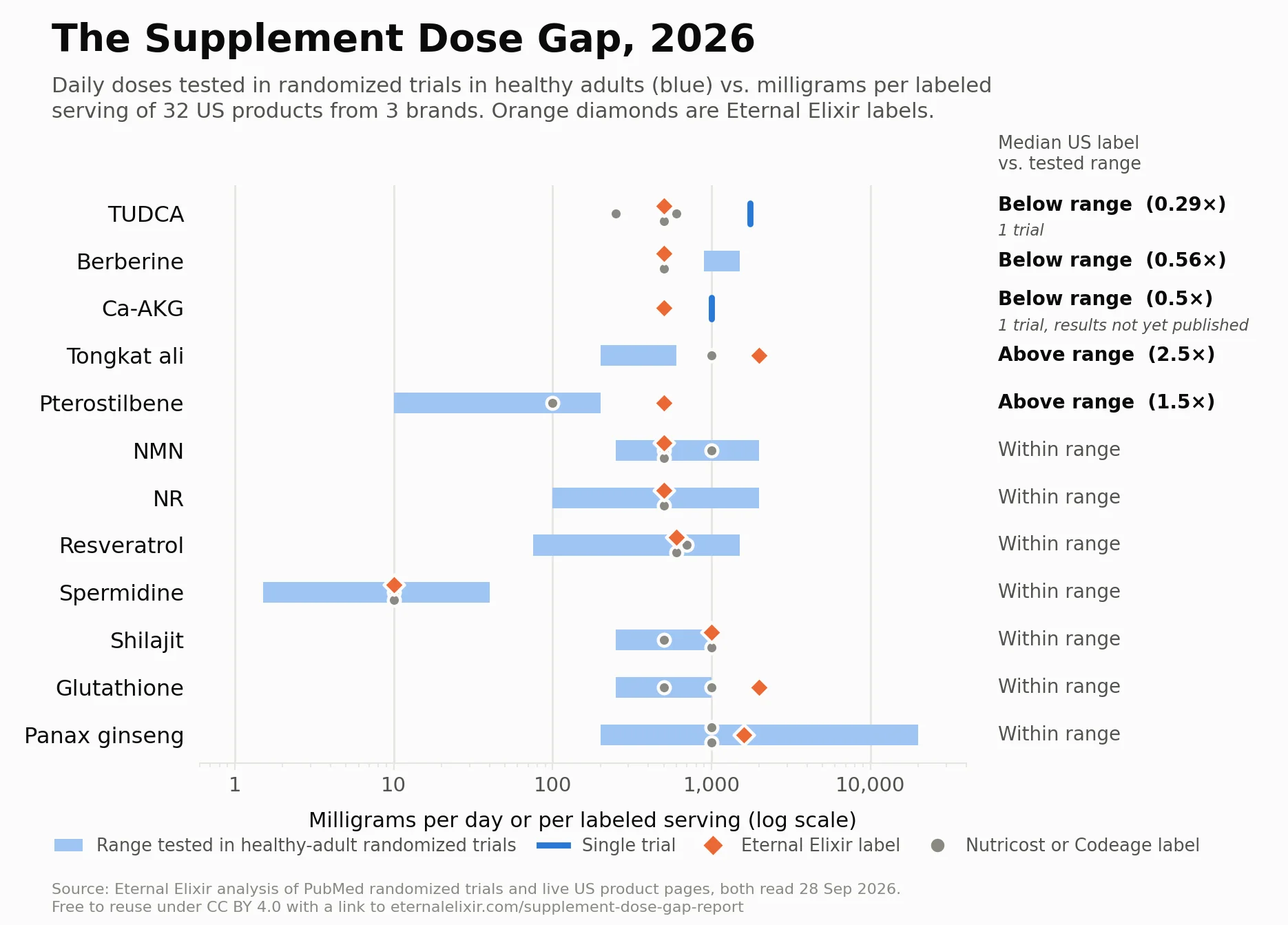
The Supplement Dose Gap Report 2026 asks one question about 12 longevity compounds sold in the United States. Does the amount on a typical US label fall inside the range of daily doses that randomized trials in healthy adults have actually tested? We searched PubMed for each compound, read the trials, and then read 32 product labels from three brands, including our own.
Seven of the 12 compounds have a median US label inside the tested range. Three sit below it (TUDCA, berberine and calcium alpha-ketoglutarate) and two sit above it (tongkat ali and pterostilbene). Counted label by label, 21 of the 32 products fall inside the range, 7 fall below it and 4 fall above it.
Correction, September 28, 2026. The first version of this report, published September 6, said only 4 of 12 compounds lined up with the research. That headline was wrong. Several trial doses it used came from patient populations, not healthy adults. The nicotinamide riboside figure of 2,000 mg/day cited PMID 38016950, which is a safety trial that tested 3,000 mg/day. The report also missed a 2019 trial of 100 to 1,000 mg/day of nicotinamide riboside in healthy adults. It said pterostilbene trials stopped at 200 mg/day when one went to 250 mg/day, left out an NMN trial at 2,000 mg/day, and called resveratrol labels higher than any dose ever tested, although gram-dose resveratrol studies exist.
We rebuilt the dataset from a fresh PubMed search, applied one rule for who counts as a healthy adult, read every label again, and regenerated the chart, the CSV file and the structured data. We also dropped the search-demand figures from the first version because we could not re-verify them.
Key findings
- 7 of 12 compounds have a median US label inside the range tested in healthy-adult randomized trials: NMN, nicotinamide riboside (NR), resveratrol, spermidine, shilajit, glutathione and Panax ginseng.
- TUDCA has the widest gap. The only randomized trial we found outside patient populations gave 1,750 mg/day for four weeks. US labels give 250 to 600 mg per serving, and the median label of 500 mg is 0.29x that dose.
- Berberine labels sit below the healthy-adult trials. The three short trials we found used 900 to 1,500 mg/day. The two labels we could verify give 500 mg per serving.
- Calcium alpha-ketoglutarate rests on one trial whose results are not out. The ABLE trial randomized 120 middle-aged adults to 1,000 mg/day or a placebo for six months. A 500 mg label is half that dose.
- Pterostilbene is the clearest case above the range. Healthy-adult trials used 10 to 200 mg/day, and the highest stated dose in any pterostilbene-only trial we found was 250 mg/day. Single capsules in our label panel go to 500 mg.
- NR moved from below to within. Healthy-adult trials span 100 to 2,000 mg/day, so a 500 mg label sits inside the range.
- The evidence is thin for four compounds. TUDCA and calcium alpha-ketoglutarate each rest on one healthy-adult trial, pterostilbene on two and berberine on three.
The dataset: tested doses vs. US label doses for 12 compounds
Each row pairs the range of daily doses given in randomized trials of healthy adults with the milligrams per labeled serving on US products. “Trials found” counts the healthy-adult trials that set or sit inside the range. For resveratrol, berberine, glutathione and Panax ginseng the literature is large, so we list the trials that define the ends of the range and do not claim a full count. The chart at the top of this page shows the same data on a log scale, and the CSV file holds every figure, PMID and product.
| Compound | Tested in healthy-adult RCTs (mg/day) | Trials found | US label servings | Median label | Verdict (median label) | Eternal Elixir label |
|---|---|---|---|---|---|---|
| TUDCA | 1,750 (one trial) | 1 | 250 to 600 mg (4 labels) | 500 mg | Below (0.29x lowest trial dose) | 500 mg: below |
| Berberine | 900 to 1,500 | 3 cited (not exhaustive) | 500 mg (2 labels) | 500 mg | Below (0.56x lowest trial dose) | 500 mg: below |
| Ca-AKG | 1,000 (one trial) | 1 | 500 mg (1 label) | 500 mg | Below (0.5x lowest trial dose) | 500 mg: below |
| Tongkat ali | 200 to 600 | 4 | 1,000 to 2,000 mg (2 labels) | 1,500 mg | Above (2.5x highest trial dose) | 2,000 mg: above |
| Pterostilbene | 10 to 200 | 2 | 100 to 500 mg (2 labels) | 300 mg | Above (1.5x highest trial dose) | 500 mg: above |
| NMN | 250 to 2,000 | 11 | 500 to 1,000 mg (4 labels) | 500 mg | Within range | 500 mg: within |
| NR | 100 to 2,000 | 6 | 500 mg (2 labels) | 500 mg | Within range | 500 mg: within |
| Resveratrol | 75 to 1,500 | 5 cited (not exhaustive) | 600 to 700 mg (3 labels) | 600 mg | Within range | 600 mg: within |
| Spermidine | 1.5 to 40 | 4 | 10 mg (3 labels) | 10 mg | Within range | 10 mg: within |
| Shilajit | 250 to 1,000 | 4 | 500 to 1,000 mg (3 labels) | 1,000 mg | Within range | 1,000 mg: within |
| Glutathione | 250 to 1,000 | 4 cited (not exhaustive) | 500 to 2,000 mg (3 labels) | 1,000 mg | Within range | 2,000 mg: above |
| Panax ginseng | 200 to 20,000 | 6 cited (not exhaustive) | 1,000 to 1,600 mg (3 labels) | 1,000 mg | Within range | 1,600 mg: within |
RCT means randomized controlled trial. Label figures are milligrams of the named compound per labeled serving, read from live product pages on September 28, 2026. Verdicts compare the median label with the tested range. A ratio below 1 is the share of the lowest tested dose that the label provides, and a ratio above 1 is the multiple of the highest tested dose.
How many US supplement labels sit inside the tested range?
By compound, seven of twelve. The median label for NMN, NR, resveratrol, spermidine, shilajit, glutathione and Panax ginseng falls inside the range that healthy-adult trials used. TUDCA, berberine and calcium alpha-ketoglutarate fall below it. Tongkat ali and pterostilbene fall above it.
By product, 21 of the 32 labels we read are inside the range, 7 are below and 4 are above. Our own 12 labels split the same way at the compound level with one exception. Our Reduced L-Glutathione lists 2,000 mg per two-capsule serving, which is above the 1,000 mg/day ceiling of the healthy-adult trials we found, so our labels come out at 6 inside, 3 below and 3 above.
Inside the range does not mean proven to work. It means someone has given that amount to healthy adults in a randomized trial and reported what happened. Most of these trials ran for weeks, measured blood markers or short-term performance, and enrolled dozens of people.
Which compound has the biggest dose gap?
TUDCA. We found one randomized trial that gave it daily to adults who were not recruited for a diagnosed disease. Kars and colleagues randomized 20 adults with a mean BMI of 37 to 1,750 mg/day or a placebo for four weeks. The other TUDCA trials in our search were single-dose studies or enrolled patients, mostly at 500 to 2,000 mg/day.
The four US TUDCA labels we read give 250 to 600 mg per serving. The median, 500 mg, is 0.29x the trial dose. Matching 1,750 mg from 500 mg capsules would take three and a half capsules a day, which is more than any of these labels suggest. A single four-week trial in 20 people is also a weak reference point. Treat this as a gap in the research as much as a gap on the label.
Which supplements are labeled below the tested range?
Berberine. Most berberine trials enroll patients. The three healthy-adult trials we found used 900 mg/day for two weeks, 1,000 mg/day of a micellar formulation for 30 days, and 1,500 mg/day for seven days. The two labels with a stated serving give 500 mg, which is 0.56x the lowest of those doses. One of those trials also found that 900 mg/day changed how the body processes several prescription drugs, so anyone on medication should talk to their doctor before using berberine at any dose.
Calcium alpha-ketoglutarate (Ca-AKG). The only randomized trial of Ca-AKG in healthy adults that our search found is ABLE, which randomized 120 adults aged 40 to 60 to 1,000 mg/day of a sustained-release form or a placebo for six months. Its published papers so far cover the protocol, recruitment and adherence. The main results were not in PubMed on September 28, 2026. A 500 mg label is half the ABLE dose, and nobody yet knows whether the ABLE dose does anything measurable.
TUDCA completes the group, as covered above.
Are any supplements labeled above what trials tested?
Pterostilbene. Two healthy-adult trials used 10 or 100 mg/day for 12 weeks and 200 mg/day of a 90% pterostilbene extract for two months. Among pterostilbene-only trials, the highest stated dose we found was 250 mg/day, in a patient population. Our Trans-Pterostilbene gives 500 mg per capsule, 2.5x the healthy-adult ceiling, and no trial in our search tested 500 mg/day. The other label we read gives 100 mg, which is inside the range.
Tongkat ali. Four healthy-adult trials used 200 to 600 mg/day of tongkat ali extract, two of them a standardized water extract. US labels list 1,000 to 2,000 mg of a 200:1 extract per serving. By weight that is above the range, but the comparison is loose. A 200:1 ratio describes how concentrated an extract is, and the trial extracts were prepared differently, so the milligram figures do not measure the same thing.
Glutathione sits inside the range at the median, but one label does not. Ours gives 2,000 mg per two-capsule serving, twice the highest dose in the healthy-adult trials we found. Each capsule holds 1,000 mg, the top dose Richie and colleagues gave for six months.
Above the tested range is not the same as unsafe. It means the amount has not been studied in healthy adults in a randomized trial that our search found.
What changed from the first version of this report?
The September 6 version mixed patient trials with healthy-adult trials and mis-cited one nicotinamide riboside paper. Rebuilding the ranges under one rule changed the verdict for four compounds.
| Compound | September 6 range (mg/day) | September 6 verdict | September 28 range (mg/day) | September 28 verdict |
|---|---|---|---|---|
| TUDCA | 2,000 (one patient trial) | Below | 1,750 (one trial) | Below |
| Berberine | 600 to 2,000 (patient trials) | Below | 900 to 1,500 | Below |
| Ca-AKG | not established | No established range | 1,000 (one trial) | Below (changed) |
| Tongkat ali | 600 (one trial) | Above | 200 to 600 | Above |
| Pterostilbene | 10 to 200 | Above | 10 to 200 | Above |
| NMN | 250 to 1,200 | Within | 250 to 2,000 | Within |
| NR | 1,000 to 2,000 (mis-cited) | Below | 100 to 2,000 | Within (changed) |
| Resveratrol | 80 to 500 (mostly patient trials) | Above | 75 to 1,500 | Within (changed) |
| Spermidine | 0.9 to 40 | Within | 1.5 to 40 | Within |
| Shilajit | 250 to 500 (patient trial) | Above | 250 to 1,000 | Within (changed) |
| Glutathione | 250 to 1,000 | Within | 250 to 1,000 | Within |
| Panax ginseng | 100 to 2,000 (mostly patient trials) | Within | 200 to 20,000 | Within |
The first version also compared labels with the lowest trial dose for “servings needed” and with search-demand figures. We kept the servings arithmetic in the CSV and dropped the demand figures.
Compound by compound: the trials behind each range
Every dose below comes from the PubMed abstract of the trial, or from the full text where the abstract did not state it. The list under each compound gives the dose, duration, number of participants where the abstract states it, and the population.
TUDCA
Tested range: 1,750 mg/day, one trial. Evidence: very thin.
- 1,750 mg/day for 4 weeks, 20 adults with a mean BMI of 37. Kars et al., 2010 (PMID 20522594).
Context, not counted in the range: Trials in patient populations used 500 to 2,000 mg/day (PMID 8674405, PMID 25664595, PMID 39447576).
US labels read September 28, 2026: Eternal Elixir TUDCA 500mg (500 mg per capsule) · Nutricost Tudca Capsules, 250 mg variant (250 mg per capsule) · Nutricost Tudca Capsules, 500 mg variant (500 mg per capsule) · Codeage Liposomal TUDCA+ (600 mg per serving, also contains 300 mg NAC). Median 500 mg: below (0.29x lowest trial dose).
Our product: TUDCA 500mg. Compared with other brands in our TUDCA supplement comparison.
Berberine
Tested range: 900 to 1,500 mg/day. Evidence: thin, three short trials.
- 900 mg/day (300 mg three times daily) for 2 weeks, healthy men (crossover). Guo et al., 2012 (PMID 21870106).
- 1,000 mg/day of a micellar berberine formulation for 30 days, 19 healthy adults (crossover). Ibi et al., 2025 (PMID 40278369).
- 1,500 mg/day for 7 days, 8 young adults. Van Arman et al., 2026 (PMID 42204774).
Context, not counted in the range: Most berberine trials enrolled patients, at 600 to 1,500 mg/day (PMID 31926918, PMID 34444711, PMID 41305635).
US labels read September 28, 2026: Eternal Elixir Berberine HCl 500mg (500 mg per capsule) · Codeage Berberine Phytosome+ (500 mg per capsule, also contains alpha lipoic acid). Median 500 mg: below (0.56x lowest trial dose).
A third label, Nutricost Berberine Capsules, states 600 mg per capsule but not the serving size, so we left it out. Our product: Berberine HCl 500mg. More in our berberine supplement comparison.
Calcium alpha-ketoglutarate (Ca-AKG)
Tested range: 1,000 mg/day, one trial with results not yet published. Evidence: very thin.
- 1,000 mg/day of sustained-release Ca-AKG for 6 months, 120 healthy adults aged 40 to 60, randomized to Ca-AKG or a placebo (ABLE trial protocol). Sandalova et al., 2023 (PMID 37217632).
- 1,000 mg/day of AKG (ABLE trial) for 6 months, 120 generally healthy middle-aged adults, 59 on AKG and 61 on placebo (adherence report). Lu et al., 2026 (PMID 42789532).
A 2012 trial in 33 untrained young men gave alpha-ketoglutarate at 0.2 g per kilogram of body weight per day for five weeks, with the salt form not stated in the abstract (PMID 22857787). It shows gram-scale AKG has been given to healthy adults, but it does not tell you about a calcium-salt capsule.
Context, not counted in the range: A six-month patient-population trial gave 6 g/day of AKG as its calcium salt (PMID 17896582).
US labels read September 28, 2026: Eternal Elixir Ca-AKG 500mg (500 mg per capsule). Median 500 mg: below (0.5x lowest trial dose).
We found two other AKG products but could not use them: one does not state milligrams per serving, and the other is alpha-ketoglutaric acid rather than the calcium salt. Our product: Ca-AKG 500mg.
Tongkat ali
Tested range: 200 to 600 mg/day. Evidence: limited, four trials with different extracts.
- 200 mg/day for 8 weeks, 40 young men in four groups, two of the groups taking tongkat ali. Chen et al., 2019 (PMID 31367282).
- 200 mg/day for 4 weeks, 84 middle-aged men and women. George et al., 2016 (PMID 26816234).
- 300 mg/day for 12 weeks, 109 men aged 30 to 55. Ismail et al., 2012 (PMID 23243445).
- 600 mg/day for 2 weeks, 32 healthy young men. Chan et al., 2021 (PMID 33559971).
Context, not counted in the range: Trials that selected participants on a hormone or symptom criterion used 50 to 200 mg/day (PMID 41283187, PMID 34262417).
US labels read September 28, 2026: Eternal Elixir Tongkat Ali 200:1 Extract 2000mg (2,000 mg per 3 capsules) · Nutricost Tongkat Ali Capsules (1,000 mg per 2 capsules, also contains 20 mg tribulus, BioPerine). Median 1,500 mg: above (2.5x highest trial dose).
Our product: Tongkat Ali 200:1 Extract 2000mg. More in our tongkat ali supplement comparison.
Pterostilbene
Tested range: 10 to 200 mg/day. Evidence: very thin, two small trials.
- 10 or 100 mg/day for 12 weeks, 30 healthy men. Otsuka et al., 2025 (PMID 40024751).
- 200 mg/day of an extract with at least 90% pterostilbene (100 mg twice daily) for 2 months, 60 healthy adults. Majeed et al., 2023 (PMID 37671486).
Context, not counted in the range: Among pterostilbene-only trials, the highest stated dose we found was 250 mg/day, in a patient population (PMID 23431291).
US labels read September 28, 2026: Eternal Elixir Trans-Pterostilbene 500mg (500 mg per capsule) · Nutricost Pterostilbene Capsules (100 mg per capsule). Median 300 mg: above (1.5x highest trial dose).
Our product: Trans-Pterostilbene 500mg. More in our pterostilbene supplement comparison.
NMN
Tested range: 250 to 2,000 mg/day. Evidence: moderate, 11 short trials that mostly measured blood NAD+.
- 250 mg/day for 12 weeks, 30 healthy adults. Okabe et al., 2022 (PMID 35479740).
- 250 mg/day (125 mg twice daily) for 12 weeks, 36 healthy middle-aged adults. Katayoshi et al., 2023 (PMID 36797393).
- 250 mg/day for 6 or 12 weeks, healthy older men. Igarashi et al., 2022 (PMID 35927255).
- 250 mg/day for 12 weeks, 108 older adults. Kim et al., 2022 (PMID 35215405).
- 250 mg/day for 12 weeks, 60 older adults. Morifuji et al., 2024 (PMID 38789831).
- 300, 600 or 1,200 mg/day for 6 weeks, 48 recreational runners. Liao et al., 2021 (PMID 34238308).
- 300, 600 or 900 mg/day for 60 days, 80 healthy middle-aged adults. Yi et al., 2023 (PMID 36482258).
- 1,250 mg/day for 4 weeks, 31 healthy adults aged 20 to 65. Fukamizu et al., 2022 (PMID 36002548).
- 1,200 mg/day for 7 days, 11 untrained young men (crossover). Yang et al., 2026 (PMID 41705654).
- 1,000 or 2,000 mg/day for 14 days, 32 adults aged 55 to 80 with a BMI in the overweight range or above. Pencina et al., 2023 (PMID 35182418).
- 2,000 mg/day (1,000 mg twice daily) for 28 days, 30 adults aged 45 or older with a BMI in the overweight range or above. Pencina et al., 2023 (PMID 36740954).
US labels read September 28, 2026: Eternal Elixir NMN 500mg (500 mg per capsule) · Nutricost NMN (500 mg per 2 capsules) · Codeage Amen NMN (500 mg per capsule) · Codeage Liposomal NMN 1000 Capsules (1,000 mg per serving, also contains betaine anhydrous (TMG)). Median 500 mg: within range.
Our product: NMN 500mg. See also our NMN supplement comparison and what human trials report about NMN side effects.
Nicotinamide riboside (NR)
Tested range: 100 to 2,000 mg/day. Evidence: moderate, six trials.
- 100, 300 or 1,000 mg/day for 8 weeks, healthy adults with a BMI in the overweight range. Conze et al., 2019 (PMID 31278280).
- 1,000 mg/day (500 mg twice daily) for 6 weeks, 22 healthy older adults (crossover trial NCT02921659). Vreones et al., 2023 (PMID 36515353).
- 1,000 mg/day for 21 days, 12 older men (crossover). Elhassan et al., 2019 (PMID 31412242).
- 1,000 mg/day for 6 weeks, 13 healthy adults with a BMI in the overweight range or above (crossover). Remie et al., 2020 (PMID 32320006).
- 1,000 mg/day for 6 weeks, adults aged 45 to 65 with a BMI of 27 to 35 (crossover). Nascimento et al., 2021 (PMID 33524145).
- 2,000 mg/day (1,000 mg twice daily) for 12 weeks, 40 healthy sedentary men with a BMI over 30. Dollerup et al., 2018 (PMID 29992272).
Context, not counted in the range: A four-week patient-population safety trial used 3,000 mg/day (PMID 38016950).
US labels read September 28, 2026: Eternal Elixir Nicotinamide Riboside 500mg (500 mg per capsule) · Codeage Liposomal Nicotinamide Riboside+ (500 mg per capsule, also contains betaine anhydrous, trans-pterostilbene). Median 500 mg: within range.
A Nutricost NR and resveratrol product was out of stock when we read it, so it is not in the panel. Our product: Nicotinamide Riboside 500mg. For a brand comparison, see our Tru Niagen review.
Resveratrol
Tested range: 75 to 1,500 mg/day. Evidence: moderate, many trials with mixed outcomes.
- 75 mg/day for 12 weeks, postmenopausal women with normal weight and normal glucose tolerance. Yoshino et al., 2012 (PMID 23102619).
- 150 mg/day for 6 months, 41 adults with a BMI in the overweight range. de Ligt et al., 2020 (PMID 32492138).
- 300 or 1,000 mg/day for 90 days, 32 older adults with a BMI in the overweight range. Anton et al., 2014 (PMID 24866496).
- 1,000 mg/day for 28 days, 9 healthy adults (randomized against no treatment). Espinoza et al., 2017 (PMID 28546852).
- 1,500 mg/day (500 mg three times daily) for 4 weeks, 24 men with a high BMI who were otherwise healthy. Poulsen et al., 2013 (PMID 23193181). Dose from the full text (Europe PMC).
Context, not counted in the range: A non-randomized study in healthy volunteers went to 5,000 mg/day for 29 days, and a patient-population trial used 2,000 to 3,000 mg/day (PMID 20935227, PMID 28329397).
US labels read September 28, 2026: Eternal Elixir Trans-Resveratrol 600mg (600 mg per capsule) · Nutricost Resveratrol Capsules (700 mg per 2 capsules) · Nutricost Organic Resveratrol (600 mg per serving). Median 600 mg: within range.
Our product: Trans-Resveratrol 600mg, 600 mg per capsule. At two capsules it would still sit inside the range. More in our resveratrol supplement comparison.
Spermidine
Tested range: 1.5 to 40 mg/day. Evidence: thin, four small trials.
- 1.5 or 3.3 mg/day (from rice germ extract) for 56 days, 12 healthy adults (randomized to dose, no placebo). Bruno et al., 2025 (PMID 40862848).
- 6 mg/day for 13 weeks, 40 adults over 65. Alsaleh et al., 2026 (PMID 42169618).
- 15 mg/day for 5 days, 12 healthy adults (crossover). Senekowitsch et al., 2023 (PMID 37111071).
- 40 mg/day (high-purity spermidine trihydrochloride) for up to 28 days, 37 healthy men aged 50 to 70. Keohane et al., 2024 (PMID 39405978).
Context, not counted in the range: A 12-month trial in a selected older-adult group used 0.9 mg/day (PMID 35616942).
US labels read September 28, 2026: Eternal Elixir Spermidine 10mg (10 mg per capsule) · Codeage Amen Spermidine (10 mg per capsule, also contains 90 mg vitamin C) · Codeage Liposomal Spermidine NAD+ (10 mg per capsule, also contains 500 mg NAD+, 90 mg vitamin C). Median 10 mg: within range.
The spermidine trials do not agree. The 15 mg/day study concluded that doses below 15 mg/day are unlikely to have short-term effects, while the 13-week trial reported changes in immune markers at 6 mg/day. A 10 mg label sits between them. Our product: Spermidine 10mg. More in our spermidine supplement comparison.
Shilajit
Tested range: 250 to 1,000 mg/day. Evidence: limited, four trials.
- 250 or 500 mg/day for 8 weeks, 63 recreationally active men. Keller et al., 2019 (PMID 30728074).
- 500 mg/day (250 mg twice daily) for 90 days, healthy men aged 45 to 55. Pandit et al., 2016 (PMID 26395129).
- 250 or 500 mg/day (125 or 250 mg twice daily) for 14 weeks, healthy adult women. Das et al., 2019 (PMID 31161927).
- 500 or 1,000 mg/day for 8 weeks, 35 recreationally trained men. Neltner et al., 2024 (PMID 36546868).
Context, not counted in the range: A 48-week patient-population trial used 250 or 500 mg/day (PMID 35933897).
US labels read September 28, 2026: Eternal Elixir Shilajit 1000mg (1,000 mg per 2 capsules) · Nutricost Shilajit Capsules (1,000 mg per serving) · Codeage Liposomal Himalayan Shilajit+ (500 mg per serving, also contains ashwagandha, CoQ10, BioPerine, minerals). Median 1,000 mg: within range.
Shilajit preparations vary, and none of the trial abstracts describes a 20:1 extract with 20% fulvic acid like ours, so read the match as approximate. Our product: Shilajit 1000mg. More in our shilajit supplement comparison.
Glutathione
Tested range: 250 to 1,000 mg/day. Evidence: limited, four trials.
- 250 or 1,000 mg/day for 6 months, 54 non-smoking adults. Richie et al., 2015 (PMID 24791752).
- 500 mg/day (two divided doses) for 4 weeks, 60 otherwise healthy medical students. Arjinpathana et al., 2012 (PMID 20524875).
- 250 mg/day for 12 weeks, healthy women. Weschawalit et al., 2017 (PMID 28490897).
- 250 mg/day (glutathione-only arm) for 12 weeks, 124 women across four arms. Duperray et al., 2022 (PMID 33834608).
US labels read September 28, 2026: Eternal Elixir Reduced L-Glutathione 2000mg (2,000 mg per 2 capsules) · Nutricost Glutathione Capsules (500 mg per serving) · Codeage Liposomal Glutathione 1000 mg (1,000 mg per serving). Median 1,000 mg: within range.
Glutathione appears in thousands of trials as something measured in blood, so we searched titles only and kept trials that gave it by mouth. Our product: Reduced L-Glutathione 2000mg. More in our glutathione supplement comparison.
Panax ginseng
Tested range: 200 to 20,000 mg/day, depending on the preparation. Evidence: moderate, many trials across many preparations.
- 200 mg/day of red ginseng root powder (24 mg ginsenosides) for 3 weeks, 149 moderately stressed adults. Dormal et al., 2025 (PMID 40289951).
- 200 or 400 mg/day of a standardized extract for 8 weeks, 83 healthy young adults. Cardinal et al., 2001 (PMID 11424544).
- 2,000 mg/day of Korean red ginseng for 24 weeks, 1,000 healthy adults. Song et al., 2018 (PMID 30337818).
- 3,000 or 6,000 mg/day of Korean red ginseng for 8 weeks, 57 healthy adults aged 20 to 65 who completed the trial. Kim et al., 2012 (PMID 22805313).
- 6,000 mg/day of Korean red ginseng rootlets for 12 weeks, 68 adults with a BMI of 23 or more. Cho et al., 2013 (PMID 23945406).
- 20 g/day of a Korean red ginseng extract taken in water for 11 days, 18 male college students. Jung et al., 2011 (PMID 21598413).
US labels read September 28, 2026: Eternal Elixir Korean Panax Ginseng 1600mg (1,600 mg per 2 capsules) · Nutricost Korean Red Ginseng (1,000 mg per 2 capsules) · Nutricost Panax Ginseng Capsules (1,000 mg per serving). Median 1,000 mg: within range.
The low end is a standardized extract or root powder, the Korean red ginseng trials listed here used 2,000 to 6,000 mg/day, and the 20 g figure is a liquid extract taken for 11 days. Our product: Korean Panax Ginseng 1600mg, an extract with at least 5% ginsenosides.
Where Eternal Elixir’s own labels land
We sell a product for each of the 12 compounds, so this report grades our own labels. Six sit inside the tested range: NMN 500mg, Nicotinamide Riboside 500mg, Trans-Resveratrol 600mg, Spermidine 10mg, Shilajit 1000mg and Korean Panax Ginseng 1600mg. Shilajit sits at the top of its range, and both shilajit and ginseng use extracts that differ from the trial preparations.
Three sit below: TUDCA 500mg (0.29x the one general-adult trial), Berberine HCl 500mg (0.56x the lowest healthy-adult dose) and Ca-AKG 500mg (half the one trial dose). Three sit above: Tongkat Ali 200:1 Extract 2000mg (3.33x by extract weight, with the caveat above), Trans-Pterostilbene 500mg (2.5x) and Reduced L-Glutathione 2000mg (2x). We would rather publish that than leave it out.
If you take any of these, follow the label serving and do not raise it to match a trial dose without talking to your doctor, especially if you take prescription medicines, are pregnant or breastfeeding, or have a health condition. For a wider view of the category, see our longevity supplement comparison or browse the full Eternal Elixir range.
Add Nicotinamide Riboside 500mg to cart · $59.99
What this data does not show
- That any dose works. A tested range tells you what was given, not what helped. Many of these trials were safety or blood-marker studies, and several reported no effect on their main outcome.
- That a finished product behaves like the trial product. None of the trials tested these retail products. Salt forms, extract ratios, purity and formulation all differ.
- Long-term safety. Most trials lasted two to twelve weeks. The longest healthy-adult trials here ran six months.
- Anything about disease. We set patient-population trials aside on purpose. They are listed as context only.
Methodology
Compounds. The same 12 single-active compounds as the first version of this report, all sold as supplements in the United States.
Trial search. On September 28, 2026 we ran one PubMed search per compound through the NCBI E-utilities API. Each search combined the compound terms below with this filter: (randomized controlled trial[pt] OR randomized[tiab] OR randomised[tiab]). The searches returned 1,977 records in total.
| Compound | PubMed query (filter added to every search) | Records |
|---|---|---|
| TUDCA | ("tauroursodeoxycholic"[tiab] OR "TUDCA"[tiab]) | 42 |
| Berberine | "berberine"[tiab] | 282 |
| Ca-AKG | ("alpha-ketoglutarate"[tiab] OR "alpha ketoglutarate"[tiab] OR "α-ketoglutarate"[tiab] OR "2-oxoglutarate"[tiab] OR "Ca-AKG"[tiab]) | 73 |
| Tongkat ali | ("Eurycoma longifolia"[tiab] OR "tongkat ali"[tiab]) | 19 |
| Pterostilbene | "pterostilbene"[tiab] | 22 |
| NMN | "nicotinamide mononucleotide"[tiab] | 45 |
| NR | "nicotinamide riboside"[tiab] | 55 |
| Resveratrol | "resveratrol"[tiab] | 668 |
| Spermidine | "spermidine"[tiab] | 79 |
| Shilajit | ("shilajit"[tiab] OR "Asphaltum"[tiab] OR "mumijo"[tiab]) | 10 |
| Glutathione | "glutathione"[ti] | 386 |
| Panax ginseng | ("Panax ginseng"[tiab] OR "Korean red ginseng"[tiab] OR "red ginseng"[tiab]) | 296 |
Which trials count. We read titles and abstracts and kept a trial for the tested range only if all of these were true:
- It was randomized. A trial that randomized people to different doses without a placebo counts.
- It enrolled adults who were not recruited for a diagnosed disease or a symptom. Healthy volunteers, older adults, athletes, stressed but healthy adults and adults recruited by body mass index all count.
- It gave the compound by mouth, on its own, every day for at least five days. Single-dose studies and multi-ingredient products were left out.
- The abstract, or the full text where we could read it, states the daily dose.
Where two papers clearly report the same trial, we count it once. Trials in patient populations are listed as context under each compound and never set a range. The tested range is the lowest and highest daily dose among the trials that count. For NMN, NR, TUDCA, calcium alpha-ketoglutarate, tongkat ali, shilajit, pterostilbene and spermidine we screened every record the search returned. For resveratrol, berberine, glutathione and Panax ginseng we filtered abstracts for healthy-population terms before reading, so a trial outside those filters could widen a range.
Labels. On September 28, 2026 we read the live product pages of three brands that sell all or most of these compounds in the US: Eternal Elixir, Nutricost and Codeage. We recorded the milligrams of the named compound per labeled serving. Products whose page does not state that figure were left out. Products that add other active ingredients are included and marked in the CSV. That gave 32 labels: 12 from Eternal Elixir, 11 from Nutricost and 9 from Codeage.
Verdicts. A label is “within” when its milligrams per serving fall between the lowest and highest tested daily dose, inclusive. The compound verdict uses the median label. We also report each product’s verdict, and our own.
Limitations
- Some ranges rest on one or two trials. TUDCA, calcium alpha-ketoglutarate and pterostilbene should be read as early evidence, not settled numbers.
- The label panel is small. Thirty-two labels from three brands show the pattern. They are not the whole US market.
- Extracts and salts are not milligram-equivalent. Tongkat ali, shilajit and ginseng labels describe extracts that differ from the trial preparations. Spermidine, berberine and Ca-AKG labels declare the salt, which weighs more than the active part.
- Abstracts can leave out details. We did not use a trial for the range when its abstract gave no daily dose and we could not check the full text.
- The healthy-adult rule is a judgment call. We counted adults recruited by body mass index. That choice matters most for NR and TUDCA. Without those trials, NR would rest on two trials at 1,000 mg/day and a 500 mg label would fall below the range, and TUDCA would have no healthy-adult trial at all. The NMN and resveratrol verdicts would not change. The CSV lists every trial so you can apply a stricter rule.
Reusing this data
The chart and tables are free to republish, quote or cite under CC BY 4.0, with credit to Eternal Elixir and a link to this page. The chart file is at this address. The full dataset, one row per compound with every PMID, query and label, is available as a CSV download under the same terms.
Suggested citation: Eternal Elixir. The Supplement Dose Gap Report 2026: Trial Doses vs. US Label Doses. First published September 6, 2026. Dataset rebuilt September 28, 2026. https://eternalelixir.com/supplement-dose-gap-report/
Frequently asked questions
What is the Supplement Dose Gap Report 2026?
It is Eternal Elixir’s comparison of two numbers for 12 longevity compounds: the daily doses tested in randomized trials in healthy adults, found through PubMed, and the milligrams per serving on 32 US product labels from three brands. Seven of the 12 compounds have a median label inside the tested range.
Which supplements are dosed below what trials tested?
TUDCA, berberine and calcium alpha-ketoglutarate. The median TUDCA label of 500 mg is 0.29x the 1,750 mg/day used in the one general-adult trial. Berberine labels of 500 mg are 0.56x the lowest healthy-adult dose of 900 mg/day. A 500 mg Ca-AKG label is half the 1,000 mg/day used in the ABLE trial, whose results are not yet published.
How much NMN did trials in healthy adults use?
Between 250 and 2,000 mg/day. Five trials used 250 mg/day for 6 to 12 weeks, others used 300 to 1,250 mg/day, and two trials gave 2,000 mg/day for two to four weeks to adults with a BMI in the overweight range or above. A 500 mg label sits inside that range.
Is 500 mg of nicotinamide riboside below the trial dose?
No. Healthy-adult trials used 100 to 2,000 mg/day, so 500 mg is inside the range. The first version of this report said otherwise because it cited the wrong paper for its upper figure and missed the 2019 trial that tested 100, 300 and 1,000 mg/day.
Are spermidine supplements underdosed?
Not by this measure. Healthy-adult trials used 1.5 to 40 mg/day, and the labels we read give 10 mg. The trials disagree, though. One concluded that less than 15 mg/day is unlikely to have short-term effects, and another reported immune-marker changes at 6 mg/day.
Can a supplement be dosed above what trials tested?
Yes. Pterostilbene capsules of 500 mg are 2.5x the highest healthy-adult trial dose of 200 mg/day, and tongkat ali labels list more extract by weight than trials used. Above the tested range means the amount has not been studied in a randomized trial of healthy adults. It does not mean a harm has been shown.
Where does this dose data come from?
Trial doses come from PubMed abstracts, or full texts where needed, found through searches run on September 28, 2026 and listed with their PMIDs. Label doses come from the live product pages of Eternal Elixir, Nutricost and Codeage, read the same day. The methodology section gives the exact queries and inclusion rules.
Sources
PubMed records cited in this report, alphabetical by first author. Records marked “context only” did not set any range.
- Alsaleh et al. Aging Cell. 2026. PMID 42169618.
- Anton et al. Exp Gerontol. 2014. PMID 24866496.
- Arjinpathana et al. J Dermatolog Treat. 2012. PMID 20524875.
- Berven et al. Nat Commun. 2023. PMID 38016950. Context only, did not set a range.
- Brown et al. Cancer Res. 2010. PMID 20935227. Context only, did not set a range.
- Bruno et al. Altern Ther Health Med. 2025. PMID 40862848.
- Cardinal et al. J Am Diet Assoc. 2001. PMID 11424544.
- Chan et al. Andrologia. 2021. PMID 33559971.
- Chen et al. Int J Prev Med. 2019. PMID 31367282.
- Chen et al. Lancet Gastroenterol Hepatol. 2020. PMID 31926918. Context only, did not set a range.
- Chinnappan et al. Food Nutr Res. 2021. PMID 34262417. Context only, did not set a range.
- Cho et al. Asia Pac J Clin Nutr. 2013. PMID 23945406.
- Conze et al. Sci Rep. 2019. PMID 31278280.
- Crosignani et al. Dig Dis Sci. 1996. PMID 8674405. Context only, did not set a range.
- Das et al. J Am Coll Nutr. 2019. PMID 31161927.
- de Ligt et al. Am J Clin Nutr. 2020. PMID 32492138.
- Dollerup et al. Am J Clin Nutr. 2018. PMID 29992272.
- Dormal et al. Nutrients. 2025. PMID 40289951.
- Duperray et al. J Cosmet Dermatol. 2022. PMID 33834608.
- Elhassan et al. Cell Rep. 2019. PMID 31412242.
- Elia et al. Eur J Neurol. 2016. PMID 25664595. Context only, did not set a range.
- Espinoza et al. Oxid Med Cell Longev. 2017. PMID 28546852.
- Filip et al. Int J Vitam Nutr Res. 2007. PMID 17896582. Context only, did not set a range.
- Fukamizu et al. Sci Rep. 2022. PMID 36002548.
- George et al. Phytother Res. 2016. PMID 26816234.
- Guo et al. Eur J Clin Pharmacol. 2012. PMID 21870106.
- Ibi et al. Metabolites. 2025. PMID 40278369.
- Igarashi et al. NPJ Aging. 2022. PMID 35927255.
- Ismail et al. Evid Based Complement Alternat Med. 2012. PMID 23243445.
- Jung et al. Am J Chin Med. 2011. PMID 21598413.
- Kars et al. Diabetes. 2010. PMID 20522594.
- Katayoshi et al. Sci Rep. 2023. PMID 36797393.
- Keller et al. J Int Soc Sports Nutr. 2019. PMID 30728074.
- Keohane et al. Nutr Res. 2024. PMID 39405978.
- Kim et al. Nutr J. 2012. PMID 22805313.
- Kim et al. Nutrients. 2022. PMID 35215405.
- Koperska et al. Nutrients. 2025. PMID 41305635. Context only, did not set a range.
- Ladakis et al. Med. 2025. PMID 39447576. Context only, did not set a range.
- Liao et al. J Int Soc Sports Nutr. 2021. PMID 34238308.
- Liu et al. J Int Soc Sports Nutr. 2012. PMID 22857787.
- Lu et al. PLOS Digit Health. 2026. PMID 42789532.
- Majeed et al. J Evid Based Integr Med. 2023. PMID 37671486.
- Morifuji et al. GeroScience. 2024. PMID 38789831.
- Muniandy et al. World J Clin Cases. 2025. PMID 41283187. Context only, did not set a range.
- Nascimento et al. J Clin Endocrinol Metab. 2021. PMID 33524145.
- Neltner et al. J Diet Suppl. 2024. PMID 36546868.
- Okabe et al. Front Nutr. 2022. PMID 35479740.
- Otsuka et al. J Nutr Sci Vitaminol. 2025. PMID 40024751.
- Pandit et al. Andrologia. 2016. PMID 26395129.
- Pencina et al. J Gerontol A Biol Sci Med Sci. 2023. PMID 35182418.
- Pencina et al. J Clin Endocrinol Metab. 2023. PMID 36740954.
- Pingali et al. Phytomedicine. 2022. PMID 35933897. Context only, did not set a range.
- Pollack et al. J Gerontol A Biol Sci Med Sci. 2017. PMID 28329397. Context only, did not set a range.
- Poulsen et al. Diabetes. 2013. PMID 23193181.
- Remie et al. Am J Clin Nutr. 2020. PMID 32320006.
- Riche et al. J Toxicol. 2013. PMID 23431291. Context only, did not set a range.
- Richie et al. Eur J Nutr. 2015. PMID 24791752.
- Sandalova et al. GeroScience. 2023. PMID 37217632.
- Schwarz et al. JAMA Netw Open. 2022. PMID 35616942. Context only, did not set a range.
- Senekowitsch et al. Nutrients. 2023. PMID 37111071.
- Song et al. J Ginseng Res. 2018. PMID 30337818.
- Van Arman et al. Physiol Rep. 2026. PMID 42204774.
- Vreones et al. Aging Cell. 2023. PMID 36515353.
- Weschawalit et al. Clin Cosmet Investig Dermatol. 2017. PMID 28490897.
- Yang et al. J Int Soc Sports Nutr. 2026. PMID 41705654.
- Yi et al. GeroScience. 2023. PMID 36482258.
- Yoshino et al. Cell Metab. 2012. PMID 23102619.
- Zhao et al. Nutrients. 2021. PMID 34444711. Context only, did not set a range.
Label sources: the live product pages of Eternal Elixir, Nutricost and Codeage, read September 28, 2026. Each product’s page address is in the CSV file.
This report describes doses used in published research and doses printed on product labels. It is not medical advice and not a recommendation to take any particular amount. Talk to a qualified healthcare professional before starting or changing a supplement, particularly if you take prescription medication, are pregnant or breastfeeding, or have a health condition.