Last updated: · Originally published September 3, 2026 · Published by Eternal Elixir
Edited by Elaine Fletcher, Researcher
Quick answer: Our pick for the best tallow balm in 2026 is the Eternal Elixir Grass-Fed Tallow Balm at $29.99. It pairs grass-fed tallow with raw honey, a humectant, on a five-ingredient label, and it is sold as a moisturizer with no treatment claims. The other five each win on a narrower point. Vintage Tradition Totally Unscented has the shortest label (tallow and olive oil only). FATCO Calming Body Butta has the lowest price per ounce: $8.00 in its 2 oz jar and less in larger sizes. Toups & Co has the widest scent range, Primally Pure has the most published reviews, and Toups & Co Frankincense Face Balm is the one built for faces.
Eternal Elixir makes the Grass-Fed Tallow Balm, and it is our pick in this comparison. We did not test these balms side by side on skin. Every figure for the other five comes from the brand’s own US product page, read in September 2026, and our own figures come from our product page. Where a brand does not publish a number, we say so, including when the brand is us. Here is how we write and review content.
Best tallow balm 2026 at a glance
Price per ounce divides the listed price by the size printed on the brand’s own page. Some brands label in fluid ounces and some in plain ounces, so treat that column as a shopping guide rather than a lab-grade comparison. Prices as of Sep 2026.
| Rank | Tallow balm | Size (as labeled) | Price | Price per ounce | Ingredients | Free US shipping | Best for |
|---|---|---|---|---|---|---|---|
| 1 | Eternal Elixir Grass-Fed Tallow Balm | Not published | $29.99 | Not calculable | 5 | Over $100 | Honey humectant on a short label |
| 2 | Vintage Tradition Totally Unscented | 2 fl. oz. (9 fl. oz. also sold) | $22.95 | $11.48 | 2 | Over $75 | Shortest label |
| 3 | FATCO Calming Body Butta | 2 oz (4 oz and 8 oz also sold) | $16.00 | $8.00 | 13 | Calculated at checkout | Lowest price per ounce |
| 4 | Toups & Co Tallow Balm, Original | 2 oz (4 oz also sold) | $32.00 | $16.00 | 6 | Over $100 | Scent choice |
| 5 | Primally Pure Everything Balm | 1 oz (2 oz also sold) | $30.00 | $30.00 | 10 | Over $65 | Most published reviews |
| 6 | Toups & Co Frankincense Face Balm | 2 oz | $52.00 | $26.00 | 4 | Over $100 | Face-only use |
Add Grass-Fed Tallow Balm to cart · $29.99
How we ranked the best tallow balms
This is a desk comparison built from each brand’s published information on the same day, plus the research on the ingredients. We looked at five things:
- Label clarity. Is the full ingredient list published, and is the tallow described as grass-fed?
- Formula design. Does the balm only seal in moisture, or does it also carry a humectant that attracts water?
- Price per ounce. Listed price divided by the labeled size. A brand that does not publish a size cannot be scored here.
- Claim discipline. Does the brand describe a cosmetic moisturizer, or does it market the balm as a remedy for skin conditions?
- Range and reputation. Sizes, scents, face or body positioning, and the number of published reviews.
We did not score scent, texture or how each balm felt on skin, because we did not run a hands-on test. Reviews on each brand page cover those points better than a desk comparison can.
Our balm is first because of its formula and its claims language. It loses on price per ounce, because our product page does not state a net weight. That is a real gap, and the entry below says so.
1. Eternal Elixir Grass-Fed Tallow Balm: our pick
Key specs: size not published · $29.99 · 5 ingredients · free US shipping over $100
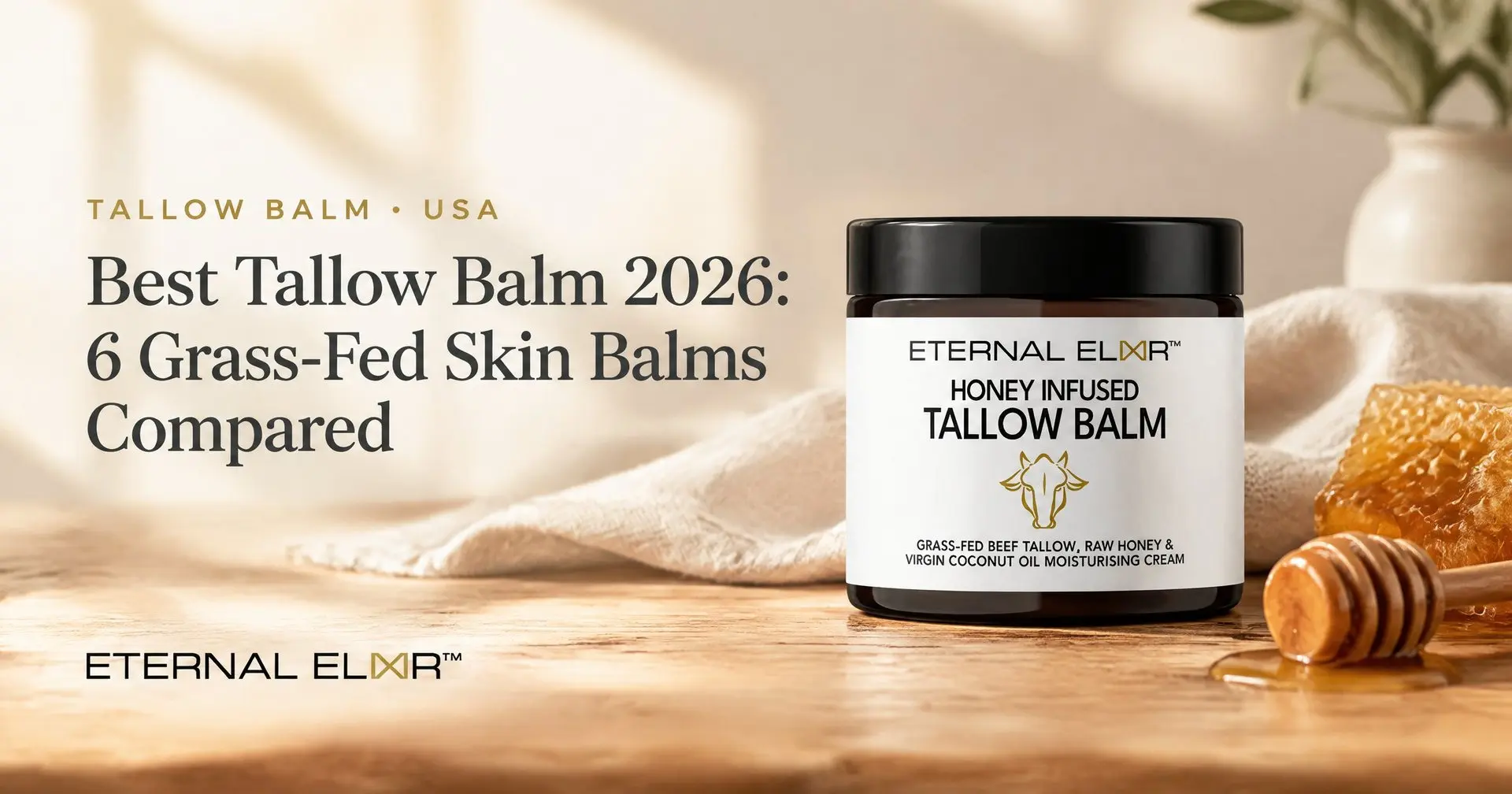
The Eternal Elixir Grass-Fed Tallow Balm is an anhydrous balm with five ingredients: grass-fed and finished tallow, organic virgin coconut oil, organic raw honey, organic raw beeswax and tocopherol (vitamin E). Tallow and coconut oil are the emollient base that softens the skin surface. Beeswax gives the balm its structure and leaves a film that slows moisture loss. Tocopherol helps slow oxidation of the oils.
Honey is the ingredient that sets it apart. Lipids and waxes slow water loss but do not attract water. A humectant does, and a review of honey in skin care lists humectant action among its effects in cosmetic formulas (Burlando and Cornara, Journal of Cosmetic Dermatology, 2013). Vintage Tradition’s balm is tallow and olive oil only, and both Toups & Co balms are tallow, olive oil and essential oils. FATCO carries vegetable glycerin as a humectant, ninth on a 13-item list.
The second point is claims. Our product page calls the balm a cosmetic moisturizer, not a treatment for any medical condition. It says ingredient amounts are not disclosed, that no finished-product clinical trial exists, and it links the 2024 tallow review that found the evidence limited.
Who it suits: people who want a short, recognizable list that still includes a humectant, from a brand that states the limits of its evidence. Who it doesn’t: vegans (it contains honey and beeswax), anyone avoiding coconut oil, and shoppers who want to compare price per ounce before buying, because we do not publish a jar size yet. It also comes in one version and one jar size.
What we would change: publish a net weight on the product page so you can work out price per ounce, and offer a bee-free version for vegans. Until we do, this entry names both gaps rather than hiding them.
Two jars save 10%, three save 15% and five save 20%. We offer a 30-day money-back guarantee, and orders ship in 24 hours.
Add Grass-Fed Tallow Balm to cart · $29.99
2. Vintage Tradition Totally Unscented Tallow Balm: shortest label
Key specs: 2 fl. oz. (59 ml) $22.95, or 9 fl. oz. (266 ml) $80.35 · 2 ingredients · free US shipping over $75 · handcrafted in Colorado Springs
The Vintage Tradition Totally Unscented Tallow Balm lists two ingredients: tallow from 100% grass-fed cows and certified organic cold-pressed extra virgin olive oil. There is no essential oil, wax or preservative. The brand says its olive oil comes from a family orchard in the valley of Sparta, Greece, and that its balm never touches plastic, aluminum or non-stick surfaces during production.
At $11.48 per fluid ounce for the small jar, and $8.93 for the 9 fl. oz. jar, it costs less than our balm per jar and far less than the premium brands here. The brand asks buyers to try a sample or the 2 fl. oz. jar before ordering the large one.
Who it suits: anyone who wants tallow and nothing else, including people who react to essential oils. Who it doesn’t: anyone who wants a humectant in the formula or dislikes the brief smell of tallow on application, which the brand says fades quickly.
3. FATCO Calming Body Butta: lowest price per ounce
Key specs: 2 oz $16.00, 4 oz $27.00, 8 oz $48.00 · 13 ingredients · shipping calculated at checkout · Willows, California
FATCO Calming Body Butta is the cheapest way into tallow here. The 2 oz jar works out to $8.00 per ounce, the 4 oz to $6.75 and the 8 oz to $6.00. FATCO’s FAQ says a 4 oz jar lasts most people 4 to 6 weeks with daily full-body use, and an 8 oz jar 3 to 4 months.
The trade-off is length. The label lists 13 ingredients: tallow from grass-fed cows, coconut oil, cocoa butter, mango butter, shea butter, almond oil, extra virgin olive oil, beeswax, vegetable glycerin, avocado oil, magnesium oil, lavender essential oil and clary sage essential oil. Its FAQ also mentions chamomile, which is not on that ingredient list, so check the jar if you react to botanicals. FATCO states that the balm is a moisturizer and is not intended to treat, cure or prevent any skin condition.
Who it suits: daily whole-body moisturizing on a budget, and anyone who wants a large jar. Who it doesn’t: people avoiding tree nuts (it has almond oil), anyone sensitive to lavender, and minimalists who came to tallow for a short label.
4. Toups & Co Tallow Balm, Original: widest scent range
Key specs: 2 oz $32.00, 4 oz $62.00 · 6 ingredients · free US shipping over $100 · 4.84 out of 5 from 1,516 reviews on its page
The Toups & Co Tallow Balm, Original lists grass-fed tallow, organic olive oil and four organic essential oils: lavender, bergamot, balsam fir and frankincense serrata. The same balm comes as Original, Vanilla + Almond, Sweet Girl and Unscented, each in 2 oz and 4 oz jars, which is the widest choice in this comparison. A subscription takes 10% off, bringing the 2 oz jar to $28.80.
At $16.00 per ounce for the 2 oz jar, it costs twice FATCO’s rate. Its benefit list goes well beyond moisturizing and names specific skin conditions, which no controlled trial of the balm supports.
Who it suits: buyers who want scent choice, or a whole routine from one tallow brand. Who it doesn’t: people sensitive to essential oils (pick the Unscented version) and buyers who prefer conservative product claims.
5. Primally Pure Everything Balm: most published reviews
Key specs: 1 oz $30.00, 2 oz $56.00 · 10 ingredients · free US standard shipping over $65 · 4.8 out of 5 from 3,680 reviews on its page · handcrafted in southern California
The Primally Pure Everything Balm lists organic tallow from grass-fed cows, organic olive oil, emu oil, unrefined beeswax, organic lavender and tea tree essential oils, organic marshmallow root, organic calendula flower, organic rosemary extract and non-GMO vitamin E. Its review count is the largest here by a wide margin.
Two things keep it fifth. At $30.00 per ounce for the 1 oz jar, it has the highest rate in this set. And its page lists cuts, wounds and burns among its uses. It backs those claims with two-week consumer perception surveys of 130 and 52 participants, which record what users felt rather than measured skin outcomes. Primally Pure also sells an Antioxidant Balm at $42.00 for 1 oz.
Who it suits: buyers who value a large review base and a botanical-heavy formula. Who it doesn’t: anyone watching price per ounce, and people who react to tea tree or lavender oil.
6. Toups & Co Frankincense Face Balm: built for faces
Key specs: 2 oz $52.00 · 4 ingredients · free US shipping over $100 · 4.81 out of 5 from 1,201 reviews on its page
The Toups & Co Frankincense Face Balm lists grass-fed tallow, organic olive oil and two organic frankincense essential oils (carterii and serrata). At $52.00 it is the most expensive jar here, and $26.00 per ounce. A face uses far less balm than a whole body, so a 2 oz jar lasts a long time at that rate. The page describes it as non-comedogenic, a claim no published study of tallow balms has tested.
Who it suits: buyers who want a dedicated face balm with a short list and are not price-sensitive. Who it doesn’t: anyone planning to use it on the body, where it is poor value next to FATCO or Vintage Tradition.
What the research says about tallow on skin
The evidence for putting rendered animal fat on skin is thin, and every brand here, including us, is selling ahead of it.
| Ingredient | Best evidence found | Evidence level |
|---|---|---|
| Tallow | A 2024 scoping review found 19 relevant studies, mostly comparative, lab and animal work | Limited, no controlled trial of a tallow balm |
| Coconut oil | Matched mineral oil for skin hydration in 34 people with dry skin over 2 weeks | One small randomized trial |
| Honey | Humectant and emollient action in cosmetic formulas | Review of formulation and lab evidence |
| Beeswax | Structure and a surface film that slows moisture loss | Formulation role, not an outcome claim |
Tallow: one scoping review
The main paper is a 2024 scoping review in Cureus (Russell and colleagues, 2024). The authors screened 147 studies and found 19 that fit, a mix of comparative, basic science and animal studies. Tallow is rich in oleic, palmitic, stearic and linoleic acids, and the review describes it as looking biocompatible with skin. Side effects were where sources disagreed most, and the authors called for controlled research on tallow as a cosmetic in humans. It does not show that tallow matches human sebum, and it does not support treatment claims for any balm.
Coconut oil: one small trial on dry skin
Most tallow balms carry a plant oil as well. In a randomized, double-blind trial, 34 people with mild to moderate dry skin applied virgin coconut oil or mineral oil to their legs twice a day for two weeks. Both improved skin hydration and surface lipids by similar amounts, water loss through the skin did not differ, and there were no adverse reactions (Agero and Verallo-Rowell, 2004). That supports coconut oil as an ordinary moisturizer. It says nothing about a finished tallow balm.
Honey and beeswax: formulation roles
Honey is used in cosmetics at around 1% to 10% of a formula for its humectant and emollient effects, according to the Burlando review. Beeswax is there for structure and a surface film. Neither needs a medical claim to justify its place in a balm, and we make none.
Grass-fed tallow: what the label claim means
Every balm in this comparison says its tallow comes from grass-fed cows. That claim is about the animal’s diet, and diet does change beef fat. A review of three decades of research found that grass-based diets raise conjugated linoleic acid (CLA), trans-vaccenic acid and omega-3 fats in beef, per gram of fat. Grass-finished beef also tends toward more stearic acid and less myristic and palmitic acid, and its fat can look yellowish from extra carotenoids, the plant pigments the body turns into vitamin A (Daley and colleagues, Nutrition Journal, 2010).
Those figures come from beef studied as food. Nobody has tested whether grass-fed tallow performs differently from grain-fed tallow on skin. The label tells you something real about the fat, and nothing proven about your skin. “Grass-finished” is the stricter phrase, because it means the animal stayed on grass until slaughter. Our balm uses grass-fed and finished tallow.
Tallow balm vs lotion: why the labels are so short
Most balms here are anhydrous, meaning they are made without added water. A lotion is an emulsion of oil and water, and the water phase needs a preservative system and an emulsifier to stay stable. A balm made only of fats, oils and wax can skip both, which is how Vintage Tradition sells a two-ingredient jar with no preservative.
The trade-off is feel. A balm is denser than a lotion and takes longer to sink in, and a little goes a long way. FATCO tells you to warm a small amount between your palms first. If you want a lighter texture, a lotion will suit you better. If you want the shortest list, a plain balm wins.
Why some dermatologists push back on tallow
A 2025 study in the Journal of Cosmetic Dermatology looked at 200 social media posts promoting beef tallow for skin across YouTube, Instagram and TikTok (Almatroud and colleagues, 2025). Claims that tallow helps skin conditions were common, but only 9 of the 200 posts cited any evidence. Over half showed financial bias, and most came from people without healthcare credentials.
The authors also flagged a real concern for acne-prone skin. Oleic and palmitic acid, two of tallow’s main fats, may promote inflammation in the skin’s oil glands, based mostly on lab studies, so the “non-comedogenic” label seen online has not been shown. That is the fair core of the pushback: tallow can be a pleasant, rich moisturizer, and the bigger promises have no trials behind them. If you have a diagnosed skin condition, talk to your dermatologist before you swap a prescribed routine for a balm.
How to choose a tallow balm: 6 checks
- Find the jar size before the price. A $22.95 jar and a $30.00 jar only compare once you know whether you get 2 ounces or 1. A brand that does not publish a size, us included, makes that math impossible.
- Count the ingredients. If you came to tallow for a short label, a 13-item list may not be what you wanted.
- Look for a humectant. Tallow, plant oils and beeswax slow water loss. Honey or glycerin also draws water in.
- Screen for your allergens. Almond oil, honey, beeswax, lavender, tea tree and emu oil all appear in this comparison. Patch test a small area first with any balm.
- Read the claims. “Moisturizer” and “heals skin conditions” are very different statements about a jar of fat and wax.
- Check shipping. Free-shipping thresholds here run from $65 to $100, and FATCO calculates shipping at checkout.
Using a tallow balm on face, body and older skin
A balm is heavy and occlusive. On the face, start with a thin layer at night, and patch test on the jaw or inner arm for a week if you break out easily. On the body, apply it to slightly damp skin after a shower, which is how FATCO suggests using its Body Butta. No trial has tested tallow balm on older skin specifically. Any benefit there comes down to what a rich moisturizer does on dry skin, which is to soften the surface and slow water loss.
How to patch test a new tallow balm
- Put a small amount on a patch of skin you can watch, such as the inner forearm or just below the jaw.
- Repeat once or twice a day for several days, using the balm the way you plan to use it.
- Check for redness, itching, bumps or breakouts. Stop at the first sign of any of them.
- If the patch stays calm, move to the full area. Start on the face with a thin layer every other night.
Essential oils are the most likely trigger in this comparison, so an unscented balm is the safer first test. If you know you react to bee products, skip balms with honey or beeswax, ours included.
Storing tallow balm so it stays fresh
Tallow and plant oils oxidize over time, which is what makes fat smell rancid. Keep the jar tightly capped at room temperature, as Vintage Tradition’s directions say, and use a clean finger or a scoop. Our balm includes tocopherol to slow oxidation of its oils. A balm that smells sharp or sour has gone off, and it is time for a new jar.
Pairing a tallow balm with an inside-out routine
A balm works on the outer skin surface only. If you also want to support skin from the inside, our skin supplement comparison compares the options. Our Reduced L-Glutathione 2000mg gives 2,000 mg per two-capsule serving at $39.99 for 30 servings, and our glutathione supplement comparison lists other brands. None of these changes what a balm does on your face. Each should be judged on its own evidence.
For the wider routine, see our guides to supplements for women over 40, supplements for men over 40 and the best longevity supplements in the US. Our single-ingredient comparisons cover trans-resveratrol, NMN, spermidine and pterostilbene, with our own Trans-Resveratrol 600mg, NMN 500mg and Spermidine 10mg. Our ginseng evidence guide, nootropic supplement comparison and shilajit comparison apply the same test of what trials measured against what labels imply.
Tallow balm FAQ
Which tallow balm is the best-rated?
Our pick is the Eternal Elixir Grass-Fed Tallow Balm, for its honey humectant, five-ingredient label and moisturizer-only claims. On published review counts, Primally Pure’s Everything Balm has the most, at 3,680 reviews averaging 4.8 out of 5 on its page in September 2026.
Add Grass-Fed Tallow Balm to cart · $29.99
Why are dermatologists against tallow?
The pushback in the medical literature is mostly about claims, not about tallow as a moisturizer. A 2025 study of 200 social media posts found that only 9 cited evidence, and some of tallow’s fats may not suit acne-prone skin. No controlled trial has tested a tallow balm for skin conditions.
Is tallow balm worth the hype?
As a rich, short-label moisturizer, it can be worth trying. As a remedy, the evidence is not there. Buy it for texture and ingredient simplicity, patch test first, and ignore promises that go beyond moisturizing.
Is tallow balm good for older skin?
No trial has tested tallow balm in older adults. A rich balm softens dry skin and slows water loss from the surface, which is what any moisturizer is for. Start with a small amount and stop if you see irritation or breakouts.
Does tallow balm clog pores?
There is no reliable published data on tallow and clogged pores. Oleic and palmitic acid, two main fats in tallow, may promote inflammation in oil glands, based mostly on lab studies. If you break out easily, test a small area for a week or two first.
How much should a tallow balm cost?
In this comparison, jars run from $16.00 to $52.00, and price per ounce from $6.00 for FATCO’s 8 oz jar to $30.00 for Primally Pure’s 1 oz. Three of the five balms with a published size cost $8.00 to $16.00 per ounce in their smallest jar.
What is the difference between tallow balm and tallow body butter?
The names are used loosely. A balm is usually tallow with oil or wax, while a body butter often adds plant butters for a softer texture. FATCO’s Body Butta adds cocoa, mango and shea butters, while Vintage Tradition’s balm is tallow and olive oil only.
Is tallow balm safe for babies?
Some brands here market their balms for babies. No trial has tested tallow balm on infant skin, and baby skin is more sensitive. Ask your pediatrician before using any balm on a baby, and avoid versions with essential oils.
Where can you buy tallow balm in the US?
All six balms here sell direct from their own US websites, which is the surest way to get the current formula and price. Many tallow balms are also listed on Amazon. Our balm ships from eternalelixir.com, with free US shipping over $100 and a 30-day money-back guarantee.
How long does a jar of tallow balm last?
It depends on size and use. FATCO says a 4 oz jar lasts most people 4 to 6 weeks of daily full-body use, and an 8 oz jar 3 to 4 months. A 2 oz jar used only on the face lasts much longer. Keep it capped at room temperature.
The bottom line on the best tallow balm
Our pick is the Eternal Elixir Grass-Fed Tallow Balm at $29.99: five ingredients, raw honey as a humectant, and a product page that calls it a moisturizer and nothing more. We do not publish a jar size yet, so it cannot be compared on price per ounce. If you want the shortest possible label, Vintage Tradition Totally Unscented is tallow and olive oil. If price per ounce matters most, FATCO’s larger jars go down to $6.00 per ounce. Whichever you choose, patch test first and judge it as a moisturizer. You can also browse the full Eternal Elixir range, more guides on the Eternal Elixir blog and our supplement guides.
Sources
- Russell MF, Sandhu M, Vail M, et al. Tallow, rendered animal fat, and its biocompatibility with skin: a scoping review. Cureus, 2024. PubMed 38910727
- Agero AL, Verallo-Rowell VM. A randomized double-blind controlled trial comparing extra virgin coconut oil with mineral oil as a moisturizer for mild to moderate xerosis. Dermatitis, 2004. PubMed 15724344
- Burlando B, Cornara L. Honey in dermatology and skin care: a review. Journal of Cosmetic Dermatology, 2013. PubMed 24305429
- Daley CA, Abbott A, Doyle PS, Nader GA, Larson S. A review of fatty acid profiles and antioxidant content in grass-fed and grain-fed beef. Nutrition Journal, 2010. PubMed 20219103
- Almatroud L, Choi S, Libson K, Ashack K. Beef tallow-based skincare claims in social media: a cross-sectional analysis. Journal of Cosmetic Dermatology, 2025. PubMed 41312576
- Product pages for Vintage Tradition, FATCO, Toups & Co, Primally Pure and the Eternal Elixir Grass-Fed Tallow Balm, read September 2026.