Last updated: · Originally published September 20, 2026 · Published by Eternal Elixir
Edited by Elaine Fletcher, Researcher
The best skin supplements for 2026 depend on what you want to change. Dry, tight skin, fine lines, loss of firmness and general antioxidant support are different problems, and the ingredients with human evidence for each are different too. This guide compares seven products US buyers can order today, six you swallow and one you apply, on the dose each label declares, the cost per day, and what the human research on each ingredient actually measured.
One note before the list. Our Hyaluronic Acid 200mg, which used to lead this page, is currently unavailable, and we don’t want to recommend something you can’t buy. Our pick for dry skin is now our Grass-Fed Tallow Balm, which works from the outside. If you want an oral supplement, the entries below cover the best-supported options, including three from other brands that we rank above our own glutathione.
Quick answer
- Our pick for dry skin: Eternal Elixir Grass-Fed Tallow Balm, a five-ingredient topical balm (not a supplement) at $29.99.
- Best-supported oral ingredients: hydrolyzed collagen (a meta-analysis of 19 trials) and oral hyaluronic acid (a 28-day trial at 200 mg a day).
- Lowest daily cost at a trial dose: Double Wood Hyaluronic Acid, 200 mg per serving at $0.22 a day.
- Simplest ceramide capsule: Life Extension Skin Restoring Ceramides, one capsule a day, $0.62 a day.
- Give it time: the trials ran 28 to 90 days. Judge any oral product after two to three months, not two weeks.
What skin supplements can and can’t do
Oral skin supplements work from the inside, slowly, and the evidence is ingredient by ingredient. A few points hold across the category:
- The best-studied ingredients are collagen and hyaluronic acid. Both have randomized, placebo-controlled trials that measured skin outcomes such as hydration, elasticity and wrinkle depth.
- Many popular ingredients have no skin trial at all. Oral glutathione, for example, has good evidence that it raises the body’s glutathione stores, but the main long-term trial didn’t measure skin.
- Results are modest and take weeks. The trials below ran 28 days to 90 days, and the changes were measured with instruments, not dramatic before-and-after photos.
- Nothing replaces the basics. Sunscreen, not smoking, sleep and a moisturizer do more for most people’s skin than any capsule.
The 7 best skin supplements compared
Prices are each brand’s own one-time price, as of Sep 2026. “Cost per day” uses one label serving a day.
| Rank | Product | Format | Key active per serving | Price | Cost per day | Buy |
|---|---|---|---|---|---|---|
| 1 | Eternal Elixir Grass-Fed Tallow Balm | Topical balm (not a supplement) | Tallow, coconut oil, raw honey, beeswax, tocopherol | $29.99 | Not calculable (no net weight stated) | View Tallow Balm |
| 2 | Life Extension Skin Restoring Ceramides | Liquid capsule | 350 mg wheat oil extract (ceramides), 1 capsule | $18.75 / 30 capsules | $0.62 | Life Extension |
| 3 | Double Wood Hyaluronic Acid | Capsule | 200 mg sodium hyaluronate, 2 capsules | $19.95 / 180 capsules | $0.22 | Double Wood |
| 4 | Vital Proteins Collagen Peptides Advanced | Powder | Collagen peptides with hyaluronic acid and vitamin C, 1 scoop | $29.99 / 13 servings | $2.31 | Vital Proteins |
| 5 | Thorne Collagen Plus | Powder | 13 g collagen, 20 mg ceramides, 125 mg NR, 1 scoop | $67.00 / 30 scoops | $2.23 | Thorne |
| 6 | NOW Foods Hyaluronic Acid 50 mg | Capsule | 100 mg hyaluronic acid + 900 mg MSM, 2 capsules | $19.99 / 60 capsules | $0.67 | NOW Foods |
| 7 | Eternal Elixir Reduced L-Glutathione 2000mg | Capsule | 2,000 mg reduced glutathione, 2 capsules | $39.99 / 60 capsules | $1.33 | View Glutathione |
Three things stand out. Daily cost varies roughly tenfold across products sold under the same heading. The two cheapest per day are single-ingredient capsules, not powders. And the most expensive to run is the $29.99 collagen tub, not the $67 one, because of how few servings the smaller tub holds.
1. Eternal Elixir Grass-Fed Tallow Balm: our pick for dry skin (topical, not a supplement)
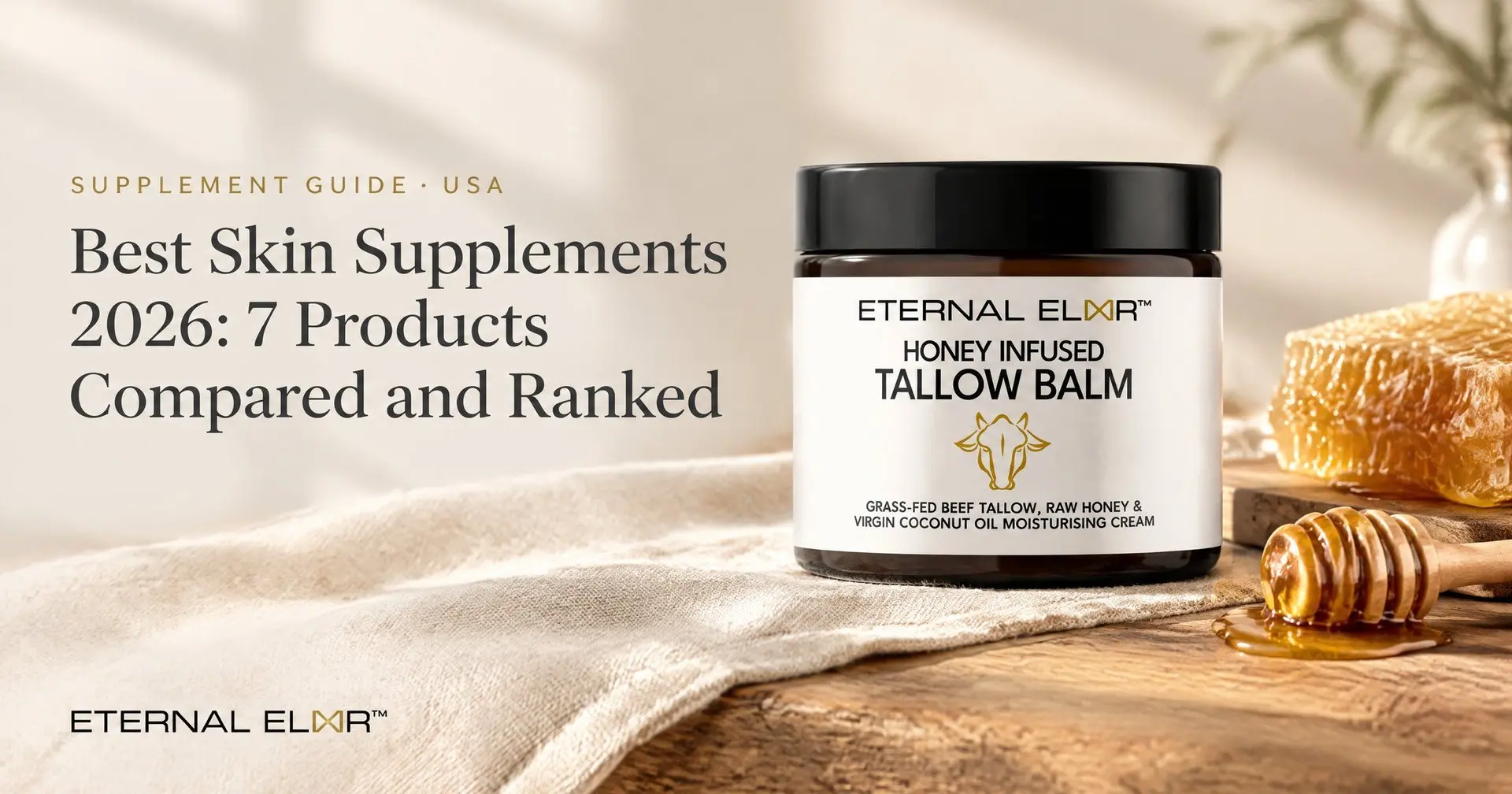
Label facts: a five-ingredient balm made with grass-fed and finished tallow, organic virgin coconut oil, organic raw honey, organic raw beeswax and tocopherol (vitamin E). $29.99. Directions: patch test first, then apply a small amount to clean skin as needed, and stop if irritation occurs. The product page doesn’t state a net weight.
Eternal Elixir makes this balm, and it is our pick. We are putting a topical product first on a supplements page on purpose, and we want to be clear about why. Our Hyaluronic Acid 200mg is currently unavailable. A large share of people searching for skin supplements want relief for dry skin, and this is what we make for that goal. Tallow and coconut oil form a rich emollient base that softens the skin surface, honey attracts moisture, and beeswax leaves a thin film that helps slow water loss. Every ingredient is named, and there is no fragrance blend.
The evidence, honestly: a 2024 scoping review of topical tallow by Russell and colleagues screened 147 studies and included 19, a mix of comparative, lab and animal studies. It found some support on tallow’s composition and use on skin, but concluded there are significant research gaps, especially on side effects, and called for controlled human trials. Our product page says the same thing and doesn’t claim tallow is identical to human skin oils.
Who it suits: anyone who wants something to put on dry skin, on its own or alongside any oral pick below.
Who it doesn’t suit: strict vegans (it contains beef tallow, honey and beeswax), anyone who wants an oral supplement, and anyone who wants to compare price per ounce, since the net weight isn’t published. Our tallow balm comparison ranks six balms, including several that beat ours on specific points.
2. Life Extension Skin Restoring Ceramides: the simplest ceramide capsule
Label facts: one liquid vegetarian capsule a day with food, supplying 350 mg of Ceratiq wheat oil extract, which provides glycolipids, phytoceramides and glycosylceramides. 30 capsules for $18.75 ($0.62 a day), or $17.25 on AutoShip ($0.57 a day). Other ingredients: rice bran oil, vegetable cellulose capsule, silica and rosemary extract. It contains wheat and is labeled gluten-free.
Ceramides are the fats between skin cells that help hold water in, so an oral ceramide has a clear rationale: you are supplying the kind of lipid the skin barrier is built from. Life Extension says its wheat ceramides are clinically studied. We didn’t review those studies for this guide, and the ceramide research is smaller and newer than the collagen and hyaluronic acid research below. What the product offers is simplicity: one capsule, one job, a real 30-day bottle at a low price.
Who it suits: buyers who want a once-a-day capsule for skin hydration without a powder. Our Life Extension review covers the wider catalog.
Who it doesn’t suit: anyone avoiding wheat, and anyone who wants the ingredient with the deepest human evidence.
3. Double Wood Hyaluronic Acid: the trial dose at the lowest daily cost
Label facts: 200 mg of sodium hyaluronate per two-capsule serving, 180 capsules, 90 servings, $19.95, or $0.22 a day. Directions: one to two capsules a day on an empty stomach, and no more than four capsules a day.
Double Wood posts a lot test on the product page. For lot AHQVG, made in January 2025 and tested by Canyonside Labs, it reports 200.4 mg of sodium hyaluronate per serving against a claim of at least 200 mg, with heavy metal and microbial results in the same table. A 200 mg serving is the daily dose used in the hyaluronic acid trial described below, although that trial used a specific branded preparation, not this one. Double Wood markets the product for joints and skin.
Who it suits: buyers who want oral hyaluronic acid at the trial dose, with a visible lot result, for the lowest daily cost here. Our Double Wood review covers the brand.
Who it doesn’t suit: anyone who wants a one-capsule serving, or collagen or ceramides in the same product.
4. Vital Proteins Collagen Peptides Advanced: collagen from a store shelf
Label facts: collagen peptides with added hyaluronic acid and vitamin C, as a powder. The 9.33 oz tub is $29.99 for 13 servings ($2.31 a serving), and the 20 oz tub is $49.99 for 28 servings ($1.79). The per-scoop amounts are on the label image rather than in the page text.
Collagen peptides are the most-studied oral ingredient in this category, which counts in their favor even though we don’t sell one. Vital Proteins is also one of the easiest collagen brands to find in US stores. The catch is cost: even on the larger tub, a day costs several times more than the capsules above, because you are paying for grams of protein rather than milligrams of an active. It is bovine collagen, so it doesn’t suit vegetarians or vegans.
Who it suits: buyers who already want collagen, like mixing a powder into coffee or a smoothie, and want to buy it in person.
Who it doesn’t suit: cost-focused buyers and anyone avoiding animal products.
5. Thorne Collagen Plus: several ingredients in one scoop
Label facts: per scoop, 13 g of bovine collagen peptides, 500 mg of MitoHeal redcurrant and blackcurrant extract, 20 mg of HydroPeach ceramides, 125 mg of nicotinamide riboside and 50 mg of betaine. 30 scoops for $67.00, or $2.23 a day. Mix one scoop with 8 to 12 ounces of water daily. The label advises checking with a practitioner in pregnancy.
This is the most complete formula in the comparison, with every amount declared and no proprietary blend. The trade-off is dose. The 20 mg of ceramides is far below the 350 mg of ceramide extract in the Life Extension capsule, and 125 mg of nicotinamide riboside is low by the standards of the NAD+ category, as our nicotinamide riboside comparison explains. Combination products trade dose for convenience.
Who it suits: buyers who want one scoop to cover collagen and a few extras. Our Thorne review looks at where the brand’s premium is worth paying.
Who it doesn’t suit: cost-focused buyers, and anyone who wants a full dose of each ingredient.
6. NOW Foods Hyaluronic Acid 50 mg: easy to find, but sold for joints
Label facts: per two-capsule serving, 100 mg of hyaluronic acid and 900 mg of MSM. 60 capsules (30 servings) for $19.99, or 120 capsules for $37.99. Directions: two capsules one to two times a day with food. NOW lists the product under joint support and describes hyaluronic acid as a component of joint fluid.
This is the hyaluronic acid most buyers will find on a shelf, and it is a solid joint product. For skin, read the label carefully: one serving holds 100 mg of hyaluronic acid, half the 200 mg daily dose in the trial below, unless you take the upper end of the directions. The MSM is a bonus if joints are also on your list. NOW says the product is made and quality tested in the USA and lists an Intertek GMP supplement certification. Our NOW Foods review covers the brand’s dosing more broadly.
Who it suits: buyers who want hyaluronic acid from a familiar brand today and also care about joints.
Who it doesn’t suit: buyers who want a skin-focused product at the trial dose in one serving.
7. Eternal Elixir Reduced L-Glutathione 2000mg: highest dose, no skin trial
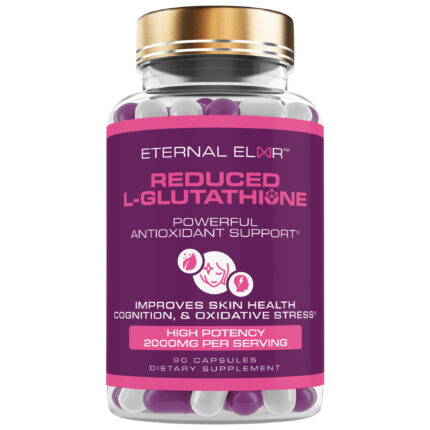
Label facts: 2,000 mg of reduced L-glutathione per two-capsule serving, 60 capsules, 30 servings, $39.99, or $1.33 a day. Other ingredients: rice flour and a cellulose capsule.
Eternal Elixir makes this glutathione, and we rank it last on a skin page because the evidence is about something else. Glutathione is the body’s main antioxidant inside cells. In a six-month randomized trial by Richie and colleagues, 54 adults took 250 mg or 1,000 mg a day, and glutathione levels in blood cells, plasma and lymphocytes rose 30% to 35% at the higher dose. That trial measured glutathione stores and immune markers. It didn’t measure skin, so we don’t claim a skin result. Our serving holds twice the high dose from that trial.
Who it suits: buyers who want a high oral glutathione dose for antioxidant support and understand what the research does and doesn’t show. Our glutathione comparison covers six products and which forms have human data.
Who it doesn’t suit: anyone buying specifically for skin tone or appearance, since no trial here supports that.
The cost-per-day audit: which labels let you compare
To compare two products on price, you need three numbers from the product page: the price, the amount of active per serving, and the servings per container. Here is how the seven pages did:
- Life Extension Ceramides: price, one capsule a day, 30 capsules. Complete.
- Double Wood Hyaluronic Acid: price, 200 mg per serving, 90 servings. Complete.
- Thorne Collagen Plus: price, every amount per scoop, 30 servings. Complete.
- NOW Foods Hyaluronic Acid: price, amounts per serving, 30 servings. Complete.
- Eternal Elixir Glutathione: price, 2,000 mg per serving, 30 servings. Complete.
- Vital Proteins Collagen Peptides Advanced: price and servings are on the page, but the per-scoop amounts are only on the label image. Partly complete.
- Eternal Elixir Tallow Balm: price only. There is no net weight, so cost per ounce can’t be calculated. Incomplete, and it is ours.
We could have filled that last gap from a label photo, but a comparison built on a number you can’t check on the page is worse than an honest gap. The general lesson: when a product page leaves out servings per container or the amount per serving, it is hard to compare, and that is worth noticing.
What the human research on skin supplements shows
- Hydrolyzed collagen: de Miranda and colleagues, International Journal of Dermatology, 2021. A meta-analysis of 19 randomized, double-blind, controlled trials with 1,125 participants aged 20 to 70 (95% women) found better skin hydration, elasticity and wrinkles with hydrolyzed collagen than with placebo, with trials typically around 90 days. Evidence level: moderate, the largest body of skin-outcome trials in this category, though made up of many different collagen products.
- Oral hyaluronic acid: Michelotti and colleagues, European Journal of Dermatology, 2021. 60 women with mild to moderate signs of skin aging took 200 mg a day of a specific full-spectrum hyaluronan (ExceptionHYAL Star) or a placebo for 28 days. Hydration rose 10.6%, wrinkle depth fell 18.8%, wrinkle volume fell 17.6%, and elasticity and firmness rose 5.1%. Evidence level: one well-designed but short trial of one branded preparation.
- Oral glutathione: Richie and colleagues, European Journal of Nutrition, 2015. Six months, 54 adults, 250 mg or 1,000 mg a day. Glutathione stores rose and returned to baseline after a one-month break. No skin measures. Evidence level: good for raising glutathione stores, none for skin.
- Topical tallow: Russell and colleagues, Cureus, 2024. A scoping review of 19 mixed studies that found significant research gaps. Evidence level: limited.
- Oral ceramides: brands cite clinical studies, but we didn’t review them for this guide. Evidence level: not assessed here.
Matching a skin product to your goal
Dry or tight skin. Start from the outside with a balm or moisturizer, such as our Grass-Fed Tallow Balm. For an oral option, a ceramide capsule or oral hyaluronic acid at 200 mg a day are the most direct choices. If you want to go deeper on hyaluronic acid specifically, our hyaluronic acid supplement comparison covers molecular weight and dose.
Fine lines and firmness. Collagen peptides have the most trials measuring wrinkles and elasticity, and the hyaluronic acid trial found changes at 200 mg a day over four weeks. Pick one, take it for about three months, and take photos in the same light at the start and end.
Antioxidant support. Our Reduced L-Glutathione 2000mg is the highest dose here, with the caveat that its trials measured glutathione stores rather than skin. Polyphenols are another route, and our resveratrol comparison and our Trans-Resveratrol 600mg cover that option, again without direct skin-outcome data.
One product for several goals. Thorne Collagen Plus is the only real all-in-one here, with modest amounts of each extra.
Healthy aging more broadly. If your interest is aging beyond appearance, our longevity supplement comparison and NMN 500mg are where most readers start, and our guide to supplements for women over 40 covers a wider routine.
What almost nobody needs is all seven. Taking three oral skin products at once is the fastest way to spend a lot each month and never know which one helped. Choose one that fits your goal, run it for 8 to 12 weeks, and change one thing at a time.
How to read a skin supplement label
Skin products are marketed heavily, and the label is where you find out what you are actually buying. Five checks cover most of it:
- Find the amount of each active per serving. “Collagen with hyaluronic acid” tells you nothing about how much hyaluronic acid is in a scoop. Look for milligrams or grams next to each ingredient in the facts panel.
- Check servings per container before the price. A cheap tub with few servings can cost more per day than an expensive one. Divide the price by the servings to get a daily cost you can compare.
- Know the source. Collagen is usually bovine or marine. Ceramides can come from wheat, rice or konjac. That matters if you have allergies or eat a plant-based diet.
- Be wary of proprietary blends. A “beauty blend” listed under one total weight can hide very small amounts of the ingredients on the front of the pack.
- Look for a lot test. A batch result for the main active, such as the one Double Wood posts for its hyaluronic acid, is the best sign the capsule holds what the label says.
Popular skin ingredients we left out, and why
Several ingredients are widely sold for skin but didn’t make this list, usually because the human evidence is thin or because they solve a different problem:
- Biotin. Often sold for hair, skin and nails. It mostly helps people who are short of it, which is uncommon. High doses can also interfere with some blood tests, so tell your doctor if you take it before any lab work.
- Vitamin C on its own. The body needs it to make collagen, and many collagen powders add it. Most people who eat fruit and vegetables get enough, and topical vitamin C is a separate product category.
- Fish oil and other omega-3s. Often recommended for skin, but most of the trials are in specific skin conditions rather than everyday dryness or aging, so we didn’t rank a fish oil here.
- Multi-ingredient “hair, skin and nails” gummies. These usually contain small amounts of many ingredients, often with added sugar, and rarely state amounts that match the trials above.
If you already take a multivitamin and eat reasonably well, adding one of the targeted ingredients above is more likely to be worth the money than adding another general formula.
Safety notes
- Tallow balm: patch test first, stop if irritation occurs, and avoid it if you are allergic to honey or beeswax.
- Collagen powders: most are bovine or marine, so check the source if you have allergies or dietary limits.
- Ceramide capsules: the Life Extension product contains wheat.
- Hyaluronic acid, collagen and glutathione: generally well tolerated in trials, but talk to your doctor before starting any supplement if you are pregnant, nursing or take prescription medicine.
A simple 12-week plan for trying a skin supplement
- Week 0: set a baseline. Take two or three photos in the same spot, in daylight, without makeup. Note how dry or tight your skin feels on a scale of 1 to 10, morning and evening, for a few days.
- Pick one oral product that matches your goal. Collagen or oral hyaluronic acid for hydration and fine lines, a ceramide capsule for dryness, and a balm for the skin surface. Keep your cleanser, moisturizer and sunscreen the same throughout.
- Weeks 1 to 12: take it every day as the label directs. Missed days matter more for slow-acting products than the brand you choose.
- Week 12: compare. Retake the photos in the same place and light, and look at your notes. If you can’t see or feel a difference, stop and put the money toward sunscreen and a good moisturizer instead.
This approach won’t give you lab-grade results, but it keeps you from paying for months of a product that isn’t doing anything for you, and it stops you from adding a second product before you know whether the first one helped.
How we ranked these skin supplements
Eternal Elixir makes Grass-Fed Tallow Balm, and it is our pick. It sits first as our in-stock choice for dry skin while our Hyaluronic Acid 200mg is unavailable, and as a topical balm it sits outside the cost-per-day comparison. The other six are ordered on the strength of the human evidence for their main ingredient, how completely the label states the dose, cost per day at one serving, and US availability. Our own glutathione sits last because its research doesn’t cover skin. We did not test the products ourselves, and every study is linked below.
Verdict: which skin product should you buy?
- Our pick for dry skin: Eternal Elixir Grass-Fed Tallow Balm, $29.99, a topical balm.
- A once-daily ceramide capsule: Life Extension Skin Restoring Ceramides, $0.62 a day.
- Oral hyaluronic acid at the trial dose for the least money: Double Wood Hyaluronic Acid, $0.22 a day.
- Collagen: Vital Proteins if you want it off a store shelf, Thorne Collagen Plus if you want collagen plus extras in one scoop.
- Hyaluronic acid from a shelf, with joint support: NOW Foods Hyaluronic Acid 50 mg.
- A high antioxidant dose, with clear expectations: Eternal Elixir Reduced L-Glutathione 2000mg.
For more, see our ginseng evidence guide (which covers ginseng in skincare), our Pure Encapsulations review, our supplement guides and blog, the Eternal Elixir home page or the shop. US orders over $100 ship free, every order has a 30-day money-back guarantee, and buying two of the same product saves 10%, three save 15% and five save 20%.
Frequently asked questions about skin supplements
What is the best supplement for skin?
Our pick for dry skin is Eternal Elixir Grass-Fed Tallow Balm, a topical balm rather than a supplement, while our Hyaluronic Acid 200mg is unavailable. For an oral supplement, hydrolyzed collagen and oral hyaluronic acid have the most human trials measuring skin outcomes, and Double Wood Hyaluronic Acid offers the 200 mg trial dose for $0.22 a day.
Add Tallow Balm to cart · $29.99
What is the most effective supplement for skin?
On the current evidence, hydrolyzed collagen has the largest body of trials, with a meta-analysis of 19 randomized trials finding better hydration, elasticity and wrinkles than placebo. Oral hyaluronic acid has a smaller but direct trial showing better hydration and shallower wrinkles at 200 mg a day over 28 days.
What vitamin tightens saggy skin?
No vitamin has been shown to tighten sagging skin on its own. Vitamin C is needed for the body to make collagen, which is why some collagen powders add it. The oral ingredients with trials measuring elasticity and firmness are collagen peptides and hyaluronic acid, and the changes were modest.
What helps crepey skin after 60?
There is no single vitamin for it. Daily sunscreen, a good moisturizer and not smoking matter most. Among supplements, collagen trials included adults up to 70, and the hyaluronic acid trial enrolled women with visible signs of skin aging. Talk to your doctor if you take prescription medicines before adding anything.
Do skin supplements actually work?
Some ingredients do, modestly. Collagen and oral hyaluronic acid have placebo-controlled trials with measured skin changes. Glutathione raises the body’s glutathione stores but hasn’t been tested for skin in the main trial. Topical tallow’s research is limited. Treat any blanket promise with caution.
Is collagen or hyaluronic acid better for skin?
Collagen has more trials; hyaluronic acid is cheaper per day. A 200 mg daily serving of hyaluronic acid costs $0.22 a day in the Double Wood capsule, while collagen powders here cost $1.79 to $2.31 a day. There is no known reason not to take both, but start with one so you can tell what is helping.
How long do skin supplements take to work?
The hyaluronic acid trial measured results at 28 days, and collagen trials typically ran about 90 days. Give any oral product two to three months, take photos in the same light at the start, and change one thing at a time.
Sources
- de Miranda RB, Weimer P, Rossi RC. Effects of hydrolyzed collagen supplementation on skin aging: a systematic review and meta-analysis. International Journal of Dermatology. 2021. PMID 33742704
- Michelotti A, et al. Oral intake of a new full-spectrum hyaluronan improves skin profilometry and ageing: a randomized, double-blind, placebo-controlled clinical trial. European Journal of Dermatology. 2021. PMID 34933842
- Richie JP Jr, et al. Randomized controlled trial of oral glutathione supplementation on body stores of glutathione. European Journal of Nutrition. 2015. PMID 24791752
- Russell MF, et al. Tallow, rendered animal fat, and its biocompatibility with skin: a scoping review. Cureus. 2024. PMID 38910727
- Product pages read September 2026: Life Extension Skin Restoring Ceramides, Double Wood Hyaluronic Acid, Vital Proteins Collagen Peptides Advanced, Thorne Collagen Plus, NOW Foods Hyaluronic Acid 50 mg, and Eternal Elixir Grass-Fed Tallow Balm and Reduced L-Glutathione 2000mg.
These statements have not been evaluated by the Food and Drug Administration. This product is not intended to diagnose, treat, cure, or prevent any disease.