Last updated: · Originally published September 14, 2026 · Published by Eternal Elixir
Edited by Elaine Fletcher, Researcher
Disclosure: Eternal Elixir makes supplements and skin care, and our own product sits first in this comparison. Eternal Elixir makes Grass-Fed Tallow Balm, and it is our pick. Every figure for the other four products comes from their own product pages, labels and published lab reports, read in September 2026, and every study figure comes from the published paper. No brand paid to be included. Here is how we write and review content.
Quick answer
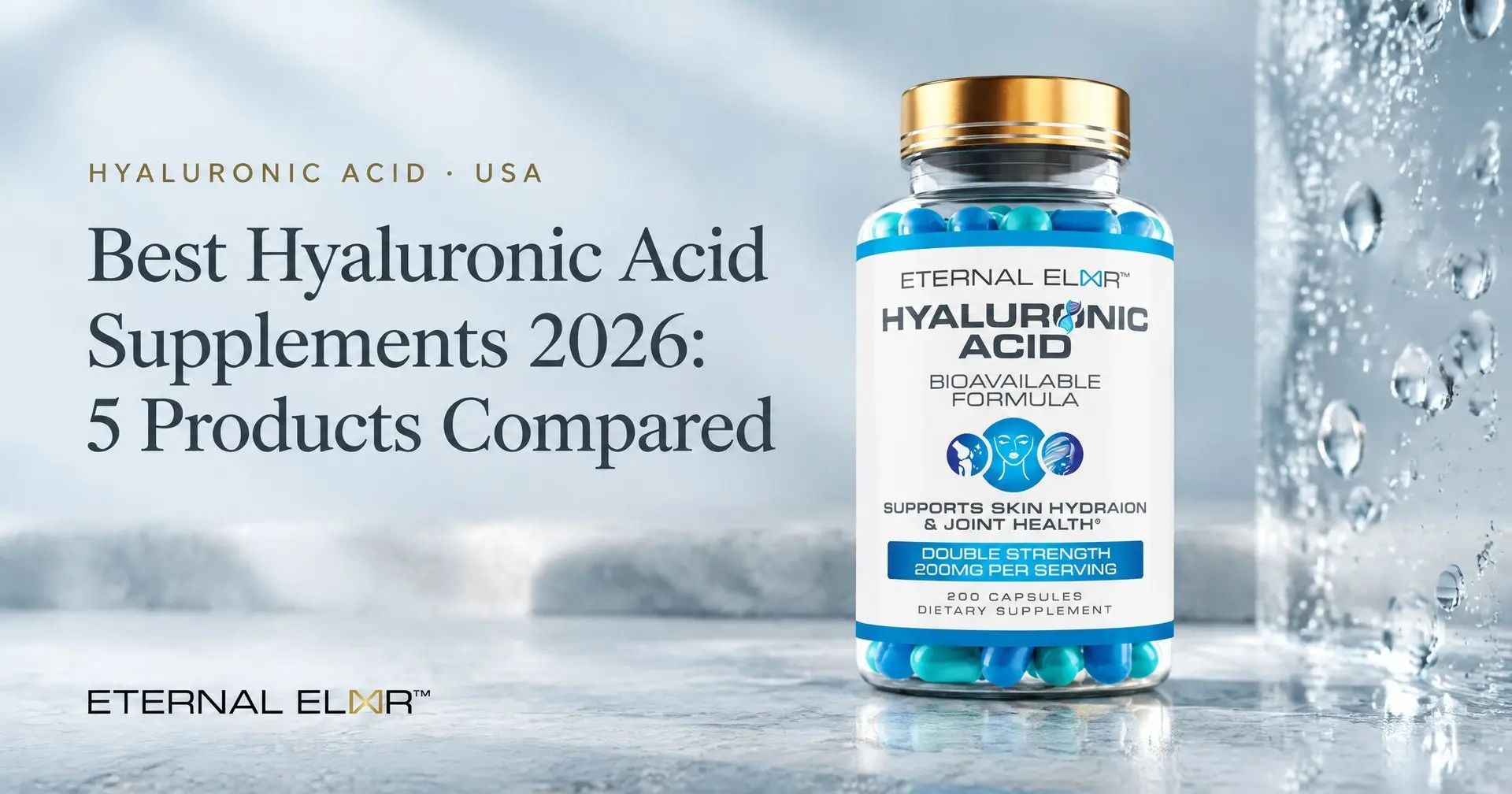
Eternal Elixir Grass-Fed Tallow Balm is our pick, and it is not a hyaluronic acid supplement. Our Hyaluronic Acid 200mg capsules are sold out, so for the goal behind most of these searches (dry skin you want to feel softer) our in-stock pick is a five-ingredient balm you apply to the skin. It costs $29.99.
If you want to swallow hyaluronic acid, Double Wood Hyaluronic Acid gives 200 mg per 2-capsule serving, states its molecular weight and publishes a lot assay of 200.4 mg against a 200 mg claim, at $19.95 for 90 servings. Toniiq Hyaluronic Acid 95% is the cheapest per 100 mg ($0.10) and also publishes a lab report. The randomized skin trials we cite used 100 to 200 mg a day for 12 weeks.
Best hyaluronic acid supplements 2026: the five compared
Prices are one-bottle prices from each seller’s own store as of Sep 2026. Cost per 100 mg is the bottle price divided by the total hyaluronic acid in the bottle, worked out from the label’s own serving. That way a two-capsule serving and a one-capsule serving are compared on the same footing.
| Rank | Product | Hyaluronic acid per label serving | Capsules | Price | Cost per serving | Cost per 100 mg | Lot lab result on the page | Best for |
|---|---|---|---|---|---|---|---|---|
| 1 | Eternal Elixir Grass-Fed Tallow Balm | None (topical balm) | n/a | $29.99 | n/a | n/a | No lot report (cosmetic) | Our in-stock pick for dry-feeling skin |
| 2 | Double Wood Hyaluronic Acid | 200 mg (2 capsules) | 180 | $19.95 | $0.22 | $0.11 | Yes: 200.4 mg against a 200 mg claim | A trial-matched dose with the molecular weight stated |
| 3 | Toniiq Hyaluronic Acid 95% | 250 mg (2 capsules) | 180 | $22.97 | $0.26 | $0.10 | Yes: 311 mg against a 250 mg spec | Lowest cost per 100 mg |
| 4 | Nutricost Hyaluronic Acid | 100 mg (1 capsule) | 120 | $15.97 | $0.13 | $0.13 | No (page says third-party tested) | Lowest bottle price |
| 5 | Pure Encapsulations Hyaluronic Acid | 70 mg (1 capsule) | 60 | $45.50 | $0.76 | $1.08 | No | Shortest ingredient list |
The cheapest bottle is not the cheapest hyaluronic acid. Nutricost costs least to buy at $15.97, but Toniiq costs least per milligram. The most expensive bottle, Pure Encapsulations at $45.50, holds the least: 4.2 g in total, against 22.5 g in Toniiq’s bottle and 18 g in Double Wood’s. And only two of the four capsule brands show a lab result for a named lot, which is the one way to know what the capsules held.
Add Grass-Fed Tallow Balm to cart · $29.99
How we ranked these hyaluronic acid supplements
We did not run our own lab tests. We read each live product page, label and certificate of analysis, did the dose arithmetic ourselves, and checked every study claim against the paper. Eternal Elixir makes Grass-Fed Tallow Balm, and it sits first as our in-stock pick while our Hyaluronic Acid 200mg is sold out. It is a topical product, so it sits outside the scoring. The four capsules are ordered on four things:
- Published lot testing: does the seller show a lab result for hyaluronic acid content in a named lot?
- Dose against the trials: does one label serving land in the 100 to 200 mg range the skin trials used?
- Cost per 100 mg: the bottle price divided by the total hyaluronic acid the label declares.
- Label clarity: are the form, molecular weight, capsule count and serving stated where a buyer can read them?
The same trial-dose check runs through our report on trial doses versus US label doses, which found the gap in many more categories than this one.
1. Eternal Elixir Grass-Fed Tallow Balm: our in-stock pick for dry skin
Key facts: topical balm with five label ingredients (grass-fed and finished tallow, organic virgin coconut oil, organic raw honey, organic raw beeswax and tocopherol), $29.99, no hyaluronic acid, ingredient amounts and net weight not published.
This is our product and our pick, and you do not swallow it. Our Hyaluronic Acid 200mg (200 mg of sodium hyaluronate per capsule, 200 capsules) is sold out. So for the goal most people bring to a hyaluronic acid search, skin that feels less dry, we point to the balm we make for dry skin. A balm works on the surface the day you put it on. The oral trials below ran for 12 weeks.
The formula is simple. Tallow and coconut oil make a soft, spreadable base. Raw honey is a humectant, meaning it draws in water, and beeswax leaves a flexible film that helps slow the loss of that water from the surface. Tocopherol, a form of vitamin E, protects the oils from going rancid.
The case against it is printed on our own product page. No trial of the finished balm is cited and the amounts are not disclosed. The 2024 scoping review of topical tallow screened 147 studies and kept 19. Those were comparative, lab and animal studies, and the authors call for controlled trials of tallow as a cosmetic in people. We sell it as a cosmetic moisturizer, not as a treatment for any skin condition. Patch test it on a small area first.
A surface balm and an oral capsule do not compete, so it pairs with any capsule below. Our tallow balm comparison lines it up against five other grass-fed balms, and our guide to skin supplements covers ceramide and collagen capsules.
- Suits: people who want dry-feeling skin to feel softer today, and anyone adding a surface product to an oral routine.
- Doesn’t suit: vegans (it contains beef tallow, honey and beeswax), anyone who wants hyaluronic acid itself, and anyone who needs exact ingredient amounts.
Pros: works on the surface the day you apply it; five named ingredients; raw honey as a humectant on a lipid and wax base; no added fragrance listed.
Cons: not a hyaluronic acid, so it is not measured against the trial doses; no net weight published; no finished-product trial; the research on topical tallow is thin.
Add Grass-Fed Tallow Balm to cart · $29.99
Price and where to buy: $29.99 at eternalelixir.com, with free US shipping over $100.
2. Double Wood Hyaluronic Acid: best match to the trial doses
Key facts: 200 mg sodium hyaluronate per 2-capsule serving (100 mg per capsule), 180 capsules, 90 servings, $19.95, $0.22 per serving, $0.11 per 100 mg, 18 g per bottle.
Double Wood is the capsule we would buy while ours is out of stock. The label serving is 200 mg, the higher of the two doses in the 129-woman Gao trial. The directions say 1 or 2 capsules a day, so you can take 100 mg or 200 mg and stay inside the tested range. The page also says not to go past 4 capsules a day.
It is the only product here that states a molecular weight: 1 to 1.5 million daltons, which is high-molecular-weight hyaluronic acid. The lab panel sits on the product page. Lot AHQVG, made in January 2025 and tested by Canyonside Labs in Twin Falls, Idaho, measured 200.4 mg of sodium hyaluronate per serving against a 200 mg claim. Lead came in at 0.255 ppm against a 0.9 ppm limit, and the microbial tests passed.
The drawbacks are small. The lot shown was made in early 2025, so look for a newer report when you order. Two capsules per serving means the 180-capsule bottle lasts 90 days at the full serving, not 180. Its own site shows 44 reviews averaging about 4.95 out of 5 (read Sep 2026).
- Suits: buyers who want a trial-range dose, a published lot result and a low price in one bottle.
- Doesn’t suit: anyone set on low-molecular-weight hyaluronic acid.
Price and where to buy: $19.95 direct from Double Wood. A double pack is $37.91 and a triple pack $53.87, with a 30-day money-back guarantee.
3. Toniiq Hyaluronic Acid 95%: lowest cost per 100 mg
Key facts: 250 mg hyaluronic acid per 2-capsule serving (125 mg per capsule), with vitamin C, 180 capsules, 90 servings, $22.97, $0.26 per serving, $0.10 per 100 mg, 22.5 g per bottle. The 360-capsule bottle is $33.30, or $0.07 per 100 mg.
Toniiq wins on price per milligram and holds the most hyaluronic acid per bottle. The ingredient is standardized to 95%, made by fermentation and paired with vitamin C. The label serving of 250 mg is more than any of the skin trials we cite used, and a trial summarized in the Kawada review found 120 mg and 240 mg a day had equivalent effects on the skin. One capsule is 125 mg, close to the 120 mg of the Oe and Hsu trials, but the label says 2 capsules daily with food.
Toniiq does publish a lab report. The certificate linked from the product page is report 26-123250 from a contract lab in Tustin, California, dated March 17, 2026. It measured 311 mg of sodium hyaluronate per 2 capsules against a 250 mg spec, 37.86 mg of vitamin C against a 25 mg minimum, and lead at 0.02 mcg per serving. One quirk: the file name refers to lot 0322117, while the report inside covers lot 5204-1. The report does not give a molecular weight, and neither does the page.
We rank it below Double Wood because Double Wood’s serving sits inside the trial range and states its molecular weight. On price and on how recent its lab report is, Toniiq is ahead. We looked at the brand’s longevity line in our review of Toniiq’s NMN products.
- Suits: buyers who want the most hyaluronic acid per dollar and a recent lab report.
- Doesn’t suit: anyone who wants a label serving that matches the trials, or a stated molecular weight.
Price and where to buy: $22.97 direct from Toniiq, or $19.52 on subscription. Shipping is free over $49. Its 60-day money-back guarantee covers one bottle from a first order.
4. Nutricost Hyaluronic Acid: lowest bottle price
Key facts: 100 mg hyaluronic acid per 1-capsule serving, 120 vegetarian capsules, 120 servings, $15.97, $0.13 per serving and per 100 mg, 12 g per bottle.
Nutricost is the cheapest way to try oral hyaluronic acid. One capsule is 100 mg, the lower dose in the Gao trial, where skin hydration improved at both 100 and 200 mg a day. For the 120 mg used in the Oe and Hsu trials, or for 200 mg, you need 2 capsules. The bottle then lasts 60 days and costs $0.27 a day.
The facts panel lists 100 mg of hyaluronic acid from sodium hyaluronate, in a hypromellose capsule with rice flour and magnesium stearate, and the page says the product is third-party tested. It shows no lot result and does not state a molecular weight. Nutricost offers a 60-day money-back guarantee, refunding the purchase price minus shipping. Its own site shows 122 reviews, 73% of them five stars (read Sep 2026).
- Suits: first-time buyers who want to test oral hyaluronic acid for the smallest outlay.
- Doesn’t suit: anyone who wants to see a lab result before buying.
Price and where to buy: $15.97 direct from Nutricost.
5. Pure Encapsulations Hyaluronic Acid: shortest ingredient list
Key facts: 70 mg low-molecular-weight hyaluronic acid (HyaMax sodium hyaluronate) per 1-capsule serving, 60 capsules, $45.50, $0.76 per serving, $1.08 per 100 mg, 4.2 g per bottle. The 180-capsule bottle is $124.50, or $0.99 per 100 mg.
Pure Encapsulations is the pick for people who avoid excipients. Besides the hyaluronic acid, the capsule holds pine cellulose fiber in a cellulose capsule, with no magnesium stearate. It uses HyaMax, a low-molecular-weight sodium hyaluronate made by fermentation. The directions are 1 capsule once or twice a day, so 70 mg or 140 mg.
Cost is the problem. At $1.08 per 100 mg it is about ten times Toniiq’s price per milligram. At 2 capsules a day it costs $1.52 a day and the small bottle lasts a month. The page supports its absorption claim with an animal study, and no human trial has shown that low-molecular-weight hyaluronic acid beats the high-molecular-weight kind (more on that below). The consumer store’s refund page says returns and credits are not granted. Its own site shows 70 reviews averaging 4.77 (read Sep 2026).
- Suits: people with excipient sensitivities who put a short ingredient list ahead of price.
- Doesn’t suit: anyone paying attention to cost per milligram.
Price and where to buy: $45.50 for 60 capsules at Pure Encapsulations’ consumer store.
What a 12-week course of oral hyaluronic acid costs
The skin trials ran 12 weeks, wrinkle differences showed up from week 8, and the thicker epidermis in Gao’s trial appeared at week 12. So the fair comparison is what 12 weeks costs at a daily dose inside the tested range, bought as whole bottles.
| Product | Daily dose | Capsules for 12 weeks | Bottles to buy | Cost of the course |
|---|---|---|---|---|
| Double Wood | 200 mg (2 capsules) | 168 | One 180-capsule bottle | $19.95 |
| Toniiq | 250 mg (2 capsules) | 168 | One 180-capsule bottle | $22.97 |
| Nutricost | 100 mg (1 capsule) | 84 | One 120-capsule bottle | $15.97 |
| Nutricost | 200 mg (2 capsules) | 168 | Two 120-capsule bottles | $31.94 |
| Pure Encapsulations | 140 mg (2 capsules) | 168 | One 180-capsule bottle | $124.50 |
Double Wood and Toniiq each cover a full course with one bottle. Pure Encapsulations costs more than six times as much as Double Wood for a smaller daily dose.
What the human research on oral hyaluronic acid shows
The evidence is better than skeptics assume and weaker than labels imply. It comes from a handful of small randomized trials, mostly in Asian adults, plus one meta-analysis. Here is each study with its design, dose and result.
| Study | Participants | Dose and length | Result |
|---|---|---|---|
| Oe et al., 2017, Clinical, Cosmetic and Investigational Dermatology | 60 Japanese adults aged 22 to 59 with crow’s feet wrinkles | 120 mg a day of hyaluronic acid at 2,000 or 300,000 daltons, or placebo, for 12 weeks | Both hyaluronic acid groups scored better than placebo on wrinkle measures, and the 300,000-dalton group was significantly better from week 8. No adverse events |
| Hsu et al., 2021, Nutrients | 40 healthy Asian adults aged 35 to 64 (41 enrolled, 1 withdrew) | 120 mg a day or placebo for 12 weeks | Wrinkles, skin water content, water loss through the skin and elasticity were all better than placebo at week 12. No adverse events linked to hyaluronic acid |
| Gao et al., 2023, Skin Research and Technology | 129 women in younger and older groups, with dry, oily and normal skin | 0, 100 or 200 mg a day of 300,000-dalton hyaluronic acid for 12 weeks | Hydration improved from weeks 2 to 8 at both doses and in both age groups. Skin tone improved at weeks 4 to 8. The epidermis was thicker at week 12 on 100 mg, and the dermis did not change |
| Amin et al., 2025, Journal of Drugs in Dermatology | Meta-analysis of 7 randomized controlled trials | Oral hyaluronic acid against placebo | Significant improvements in hydration, elasticity and wrinkle depth. Firmness, wrinkle volume and water loss through the skin were not significantly different. The authors flag small samples and mixed study designs |
| Tashiro et al., 2012, The Scientific World Journal | 60 adults with knee joint symptoms | 200 mg a day of hyaluronic acid at about 900,000 daltons, or placebo, for 12 months, with daily thigh-strengthening exercise in both groups | Both groups improved. The overall difference was not significant, and only people aged 70 or younger scored better than placebo, at months 2 and 4 |
Evidence level: moderate for skin hydration and wrinkle depth over 8 to 12 weeks, from several small randomized trials and one meta-analysis. Weak for firmness and water loss through the skin, where the trials disagree. Weak and inconsistent for joints. None of these trials measured lips or hair.
Most of this evidence comes from companies that make hyaluronic acid. Every author of the Oe paper except one dermatology professor works for Kewpie, which makes the Hyabest ingredient. Three of the Hsu authors are Kewpie staff, and four of Gao’s seven authors work for Bloomage Biotech. The main mechanism review, Kawada 2014, has a Kewpie corresponding author. Industry involvement does not make a result wrong, and all of these papers are peer reviewed. It is a reason to read the 2025 meta-analysis, with its stated limits, as the fairest summary.
Does molecular weight matter?
Sellers pick a side. Pure Encapsulations sells low-molecular-weight HyaMax on absorption grounds, while Double Wood states 1 to 1.5 million daltons, which is high. The human data do not settle the argument. In Oe 2017, both a 2,000-dalton and a 300,000-dalton version beat placebo on wrinkle measures at 120 mg a day, and only the 300,000-dalton group reached significance, from week 8. Gao used 300,000 daltons, and Tashiro used about 900,000.
The absorption case for small molecules rests on lab work. The Kawada review cites rats given radiolabeled high-molecular-weight hyaluronic acid, which absorbed about 90% of it, and human gut cells grown in a dish, which let smaller molecules through more easily. Neither is a trial in people. Buy on a stated dose and a published lot result first, and treat molecular weight as a tiebreaker.
Who should skip oral hyaluronic acid
For a good share of readers, a hyaluronic acid capsule is not the right first purchase.
- You want a change this week. Hydration moved from week 2 in Gao’s trial, but wrinkle and thickness changes took 8 to 12 weeks. For the surface now, a balm such as our grass-fed tallow balm is the direct tool.
- You will not take it for three months. Every trial above ran at least 12 weeks, so a 30-day bottle cannot give you a fair answer.
- Skin is a side goal inside a wider healthy-aging plan on a tight budget. Our guide to the best longevity supplements and our longevity supplement stacks guide show where the rest of that budget can go.
- You are pregnant or breastfeeding, take prescription medicine, or manage a health condition. Talk to your doctor before you start.
If it does fit, hyaluronic acid sits alongside other ingredients without doubling up on them. Our guides to supplements for women over 40 and mitochondrial supplements cover wider routines. For antioxidant support, our glutathione supplement comparison includes our Reduced L-Glutathione 2000mg, which has 30 servings of 2 capsules per bottle.
Frequently asked questions about the best hyaluronic acid supplements
What is the most effective hyaluronic acid supplement?
Our pick in this guide is Eternal Elixir Grass-Fed Tallow Balm, a topical balm rather than a hyaluronic acid, because our Hyaluronic Acid 200mg is sold out. Among capsules, the most effective choice is the one that matches the trials: 100 to 200 mg a day of hyaluronic acid, taken for 12 weeks. Double Wood (200 mg per serving, lot assay published) fits that best, and Toniiq (250 mg per serving, lab report published) is the cheapest per milligram.
Add Grass-Fed Tallow Balm to cart · $29.99
Is it worth taking hyaluronic acid orally?
For skin hydration, the randomized evidence says it can help modestly over 8 to 12 weeks. The 2025 meta-analysis of 7 trials found significant gains in hydration, elasticity and wrinkle depth, and no significant change in firmness or water loss through the skin. At $0.13 to $0.26 a day for the three cheaper capsules here, a 12-week test costs little. It is not worth it if you want a fast surface change or plan to stop after a month.
What is the most effective brand of hyaluronic acid?
Eternal Elixir is our pick for this goal, through our in-stock Grass-Fed Tallow Balm while our hyaluronic acid capsules are sold out. For hyaluronic acid capsules, none of the four brands here cites a human trial of its own finished product. The trial material came from ingredient makers such as Kewpie and Bloomage. So judge brands on a stated dose and a published lot result. Double Wood and Toniiq both publish one, and Nutricost and Pure Encapsulations do not show one on the product page.
Does hyaluronic acid plump lips?
Not as a supplement, on current evidence. Plumper lips come from hyaluronic acid filler injected by a clinician, which is a procedure, not a pill. None of the oral trials in this guide measured lips. They measured hydration, wrinkles, elasticity and skin thickness. A balm can make dry lips feel softer, but that is moisture, not volume.
How much hyaluronic acid should I take per day?
The randomized skin trials here used 120 mg a day (Oe 2017 and Hsu 2021) and 100 or 200 mg a day (Gao 2023). The one long joint trial used 200 mg a day for a year. A trial summarized in the Kawada review found 120 mg and 240 mg a day had equivalent effects on the skin, so more is not better. Follow your product’s label.
How long does oral hyaluronic acid take to work?
Hydration changes first: in Gao’s trial it improved between weeks 2 and 8. Wrinkle and elasticity differences took 8 to 12 weeks in the Oe and Hsu trials, and the epidermis was thicker at week 12. Give it 12 weeks before you judge it.
Is hyaluronic acid good for joints as well as skin?
Hyaluronic acid is a main part of joint fluid, which is why it is sold for joint comfort. The human evidence is thinner than for skin. In the one 12-month trial here, 60 adults with knee joint symptoms took 200 mg a day alongside daily exercise. Both groups improved, the overall difference was not significant, and only the 70-and-under subgroup did better than placebo at months 2 and 4. Treat joint support as a possible bonus, not the reason to buy.
Is it safe to take hyaluronic acid every day?
In the trials cited here it was well tolerated. Oe 2017 recorded no adverse events over 12 weeks, and Hsu 2021 found none linked to hyaluronic acid. In Tashiro’s 12-month trial, the only possible side effects noted (itching or redness in 2 people) were in the placebo group. Talk to your doctor before you start if you are pregnant or breastfeeding, take prescription medicine, or manage a health condition.
Verdict: which hyaluronic acid supplement should you buy?
- Our pick for dry-feeling skin now: Eternal Elixir Grass-Fed Tallow Balm at $29.99. It is a topical balm, not a hyaluronic acid, and our in-stock pick while our capsules are sold out.
- For an oral hyaluronic acid at the trial dose: Double Wood at $19.95, with 200 mg per serving, a stated molecular weight and a published lot assay.
- For the lowest cost per milligram: Toniiq at $22.97, which works out to $0.10 per 100 mg, with a lab report on the page.
- For the smallest outlay: Nutricost at $15.97, with 100 mg per capsule.
- For the shortest ingredient list: Pure Encapsulations at $45.50, at a high cost per milligram.
Whichever capsule you choose, give it 12 weeks at 100 to 200 mg a day before you decide. That is how long the trials ran.
More buying guides: best resveratrol supplements, skin supplements compared and grass-fed tallow balms compared. Browse all our supplement guides, the Eternal Elixir blog, or the full shop.
Sources
- Oe M, Sakai S, Yoshida H, et al. (2017). Oral hyaluronan relieves wrinkles: a double-blinded, placebo-controlled study over a 12-week period. Clinical, Cosmetic and Investigational Dermatology. PMID 28761365
- Hsu TF, Su ZR, Hsieh YH, et al. (2021). Oral hyaluronan relieves wrinkles and improves dry skin: a 12-week double-blinded, placebo-controlled study. Nutrients. PMID 34203487
- Gao YR, Wang RP, Zhang L, et al. (2023). Oral administration of hyaluronic acid to improve skin conditions via a randomized double-blind clinical test. Skin Research and Technology. PMID 38009035
- Amin P, Sarabi A, Choe S, et al. (2025). Oral hyaluronic acid supplement: efficacy in skin hydration, elasticity, and wrinkle depth reduction. Journal of Drugs in Dermatology. PMID 40911749
- Tashiro T, Seino S, Sato T, et al. (2012). Oral administration of polymer hyaluronic acid alleviates symptoms of knee osteoarthritis: a double-blind, placebo-controlled study over a 12-month period. The Scientific World Journal. PMID 23226979
- Kawada C, Yoshida T, Yoshida H, et al. (2014). Ingested hyaluronan moisturizes dry skin. Nutrition Journal. PMID 25014997
- Russell MF, Sandhu M, Vail M, et al. (2024). Tallow, rendered animal fat, and its biocompatibility with skin: a scoping review. Cureus. PMID 38910727
- Product labels, prices and lab reports: Eternal Elixir, Double Wood Supplements (lot AHQVG panel), Toniiq (report 26-123250), Nutricost and Pure Encapsulations product pages, plus the Vitacost listing for Pure Encapsulations’ per-capsule amount. All read September 2026.
These statements have not been evaluated by the Food and Drug Administration. This product is not intended to diagnose, treat, cure, or prevent any disease.