Last updated: · Originally published August 20, 2026 · Published by Eternal Elixir
Edited by Elaine Fletcher, Researcher
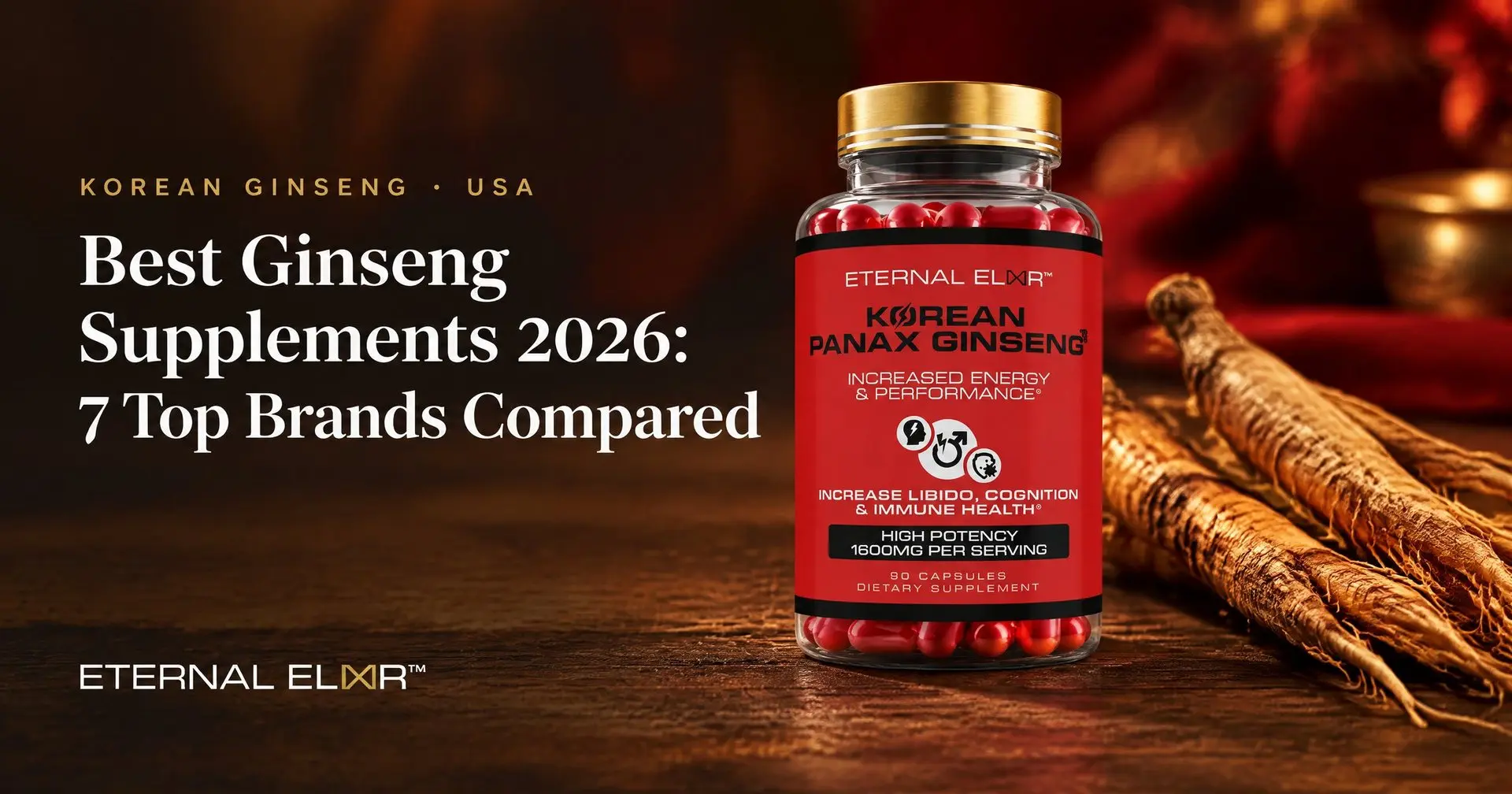
Quick answer: Of the best ginseng supplements in 2026, our pick is Eternal Elixir Korean Panax Ginseng 1600mg. Each two-capsule serving gives 1,600 mg of Korean red Panax ginseng root extract standardized to at least 5% ginsenosides, so at least 80 mg of ginsenosides, and a bottle of 90 capsules costs $44.99, or $1.00 per serving. If you want the most ginsenosides for the money, Double Wood Korean Panax Ginseng declares 100 mg per serving from a 10% extract, posts a lot test that measured 103.9 mg, and costs $0.21 per serving, though its extract comes from leaf and stem rather than root. Four of the seven products below declare no ginsenoside content at all.
Eternal Elixir makes Korean Panax Ginseng 1600mg, and it is our pick. That makes us one of the brands in this comparison, so read it as a comparison written by a seller. We did not lab-test any of these products. Every figure for the other six comes from their own product pages and lab reports, read in September 2026, and where a brand does not publish a number we say so rather than estimate it. No brand paid to be included. Here is how we write and review content.
Best ginseng supplements 2026: at-a-glance comparison
Every row uses one serving as each brand directs it, not one capsule. “Ginsenosides declared” comes from the brand’s own standardization figure. Prices are one-time US prices as of Sep 2026.
| Rank | Product | Ginseng per serving | Source and standardization | Ginsenosides declared per serving | Bottle | Price | Price per serving | Buy |
|---|---|---|---|---|---|---|---|---|
| 1 | Eternal Elixir Korean Panax Ginseng 1600mg | 1,600 mg extract (2 capsules) | Korean red root extract, at least 5% | At least 80 mg | 90 capsules (45 servings) | $44.99 | $1.00 | Shop Eternal Elixir |
| 2 | Double Wood Korean Panax Ginseng | 1,000 mg extract (2 capsules) | Korean red extract from leaf and stem, 10% | 100 mg (lot test: 103.9 mg) | 240 capsules (120 servings) | $24.95 | $0.21 | Double Wood store |
| 3 | JungKwanJang Everytime Original Extract | 3,000 mg liquid extract (1 stick) | Korean red root extract | 11.6 mg of three marker ginsenosides (Rg1, Rb1, Rg3) | 10 sticks | $44.99 | $4.50 | JungKwanJang store |
| 4 | Nutricost Korean Red Ginseng | 1,000 mg (2 capsules) | Plant part and standardization not stated | Not declared | 240 capsules (120 servings) | $21.97 | $0.18 | Nutricost store |
| 5 | NOW Foods Panax Ginseng 500 mg | 1,000 mg root powder (2 capsules) | Panax ginseng root, not standardized | Not declared | 250 capsules (125 servings) | $34.49 (sale) | $0.28 | NOW store |
| 6 | Swanson Premium Korean Ginseng 500 mg | 500 mg root powder (1 capsule) | Panax ginseng root, not standardized | Not declared | 100 capsules (100 servings) | $13.19 | $0.13 | Swanson store |
| 7 | Solaray Korean Ginseng Root 550mg | 550 mg root (1 capsule) | Korean ginseng root, not standardized | Not declared | 100 capsules (100 servings) | $36.19 | $0.36 | Solaray store |
Add Korean Panax Ginseng 1600mg to cart · $44.99
Two things stand out. Price per serving tells you little here, because the servings hold very different things: 500 mg of plain root powder in one product, 1,600 mg of standardized extract in another. And the cheapest way to buy declared ginsenosides is not our product. Eternal Elixir’s ginseng costs $1.25 per 100 mg of declared ginsenosides, and Double Wood costs $0.21. We rank ours first for the reasons in its entry below, and price is not one of them.
How we ranked these ginseng supplements
Eternal Elixir makes the first product on this list, and it sits first because it is our pick. We ranked the other six on four questions, in this order:
- Does the label declare ginsenosides? Ginsenosides are the saponins that ginseng researchers measure and standardize. A product that states a percentage lets you check what you are buying.
- Has anyone measured it? A posted lab result for a named lot counts for more than a claim on the label.
- Is the plant part stated? Root, leaf and stem are all sold as “ginseng,” and the trials below used root preparations.
- What does a serving cost? We divided each one-time price by the servings in the bottle.
Three limits are worth stating plainly. We did not run our own lab tests. Prices change, and NOW’s price above is a sale price. And a milligram figure for root powder cannot be compared with one for a concentrated extract, so rows with “Not declared” are not ranked on potency at all.
Why ginsenosides matter more than the milligrams on the front
The big number on a ginseng bottle is the weight of plant material or extract, not the weight of the compounds anyone studied. Two products from the table show why this matters. Double Wood’s two-capsule serving holds 1,000 mg of extract standardized to 10%, which is 100 mg of ginsenosides. Our two-capsule serving holds 1,600 mg of extract standardized to at least 5%, which is at least 80 mg. The product with the smaller headline number declares more ginsenosides.
Plant part matters too. Double Wood’s label says its extract comes from leaf and stem. Ours, JungKwanJang’s and the root powders all come from root. The trials in the evidence section below used root preparations, so a root extract is closer to what was studied, even though Double Wood declares more ginsenosides per serving. Our Jung Kwan Jang review covers that brand’s formats and cost in more detail.
And more is not shown to be better. The G115 trial described below used 200 mg or 400 mg of standardized extract a day, and a 2025 trial used 200 mg a day of root powder containing 24 mg of ginsenosides. Several products here give far more than that in one serving, ours included. No trial we found compared a large serving with a small one on the same outcomes.
Korean red, American or Siberian ginseng: which type to buy
Three different things are sold as “ginseng” in the US, and they are not interchangeable.
- Panax ginseng, also called Asian or Korean ginseng, is the species in every trial cited in this guide and in all seven products above. Korean red ginseng is Panax ginseng root that has been steamed and dried, which changes its color and its ginsenoside profile.
- American ginseng (Panax quinquefolius) is a related but different species. Its trials should not be read as evidence for Panax ginseng products, and the reverse is also true.
- Siberian ginseng, or eleuthero, is a different plant altogether, not a Panax species, so Panax ginseng research does not apply to it.
If you want what the research in this guide studied, buy Panax ginseng, check that the label names the species, and look for root on the label.
How to check a ginseng label in five steps
- Find the species. “Panax ginseng” should be on the supplement facts. “Korean ginseng” alone usually means the same plant, but a named species removes the doubt.
- Find the plant part. Root, or leaf and stem? Both are sold, and the trials here used root.
- Find the ginsenoside figure, and read what it counts. A percentage of total ginsenosides (5% or 10%) is not the same as the milligrams of two or three marker ginsenosides.
- Look for a lot test. A certificate that names a lot and gives a measured result, like Double Wood’s, is stronger than a label claim alone. Ask any brand for the report that matches your bottle, us included.
- Work out the cost per serving, not per capsule. Divide the price by the servings in the bottle, then check what one serving holds.
The 7 best ginseng supplements in 2026, ranked
1. Eternal Elixir Korean Panax Ginseng 1600mg (our pick)
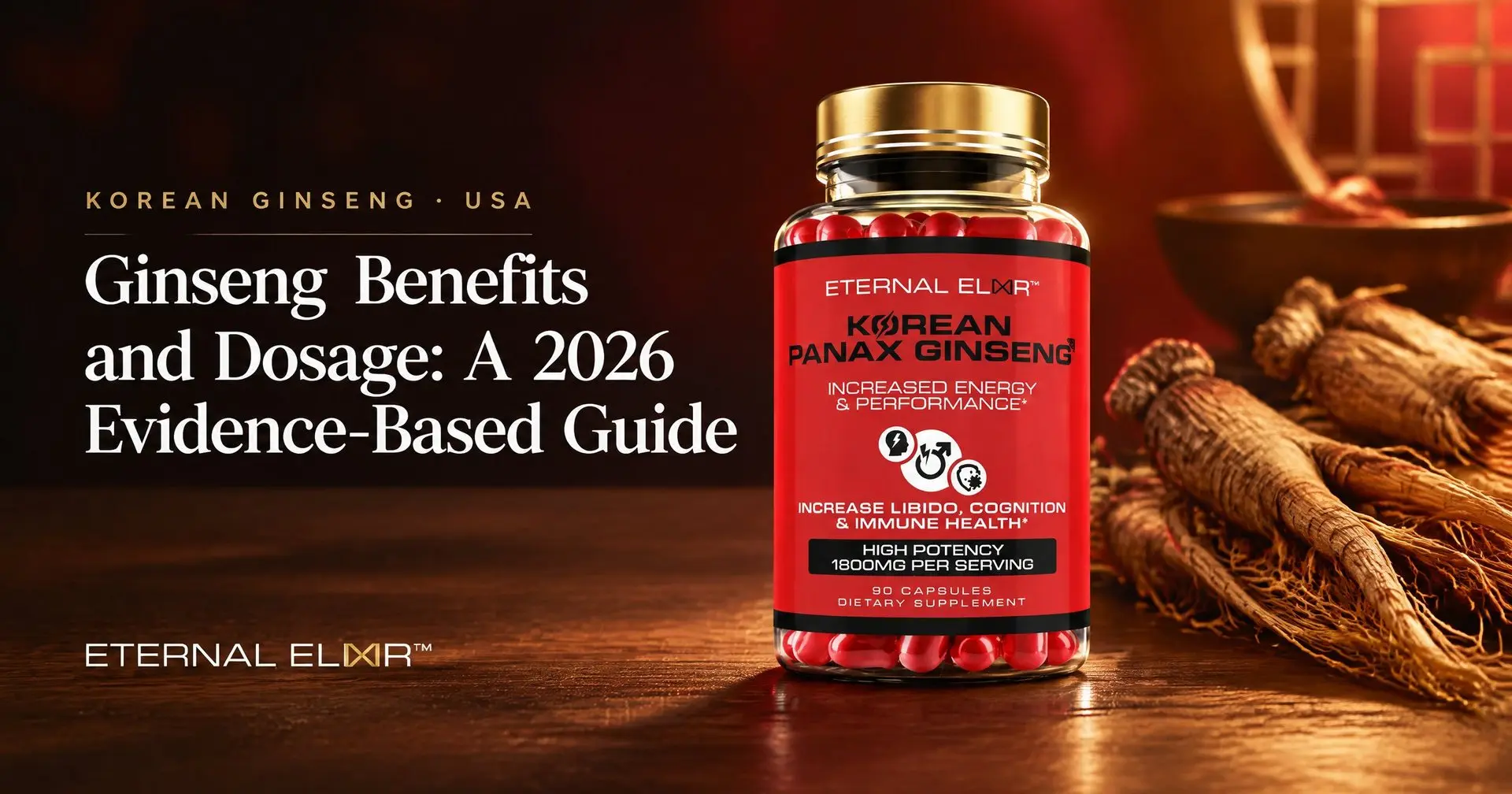
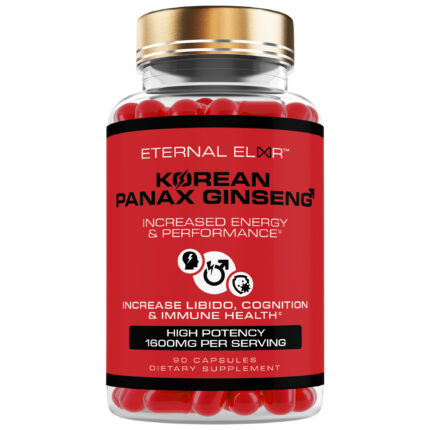
Key specs: Korean red Panax ginseng root extract (Panax ginseng C.A. Meyer), 1,600 mg per two-capsule serving, standardized to at least 5% ginsenosides, 90 capsules, 45 servings, $44.99 ($1.00 per serving). Other ingredients: rice flour and a cellulose capsule.
We make this one, so weigh that as you read. It is our pick because it pairs a root extract with a declared standardization. Of the products here that come from root, it declares the most total ginsenosides per serving, at least 80 mg. JungKwanJang declares 11.6 mg, but that figure covers only three marker ginsenosides, and the four root powders declare nothing. The label names the species and plant part, and it lists every other ingredient, with no proprietary blend.
It has clear weak points. At $1.00 per serving it is the second most expensive product here. Its 5% standardization is half Double Wood’s 10%. A bottle lasts 45 days, the shortest capsule supply in the table. And we do not post a lot-specific lab report on the product page, which Double Wood does.
How our serving compares with the research: 1,600 mg of extract is four to eight times the 200 mg to 400 mg used in the G115 trial, and our 80 mg or more of ginsenosides is over three times the 24 mg in the 2025 stress trial. No trial below tested 1,600 mg a day, so we cannot tell you it works better than a smaller amount. Follow the directions on your bottle.
Best for: buyers who want a root extract with a declared ginsenoside content, from a brand that also sells Tongkat Ali 200:1, Tongkat Ali + Fadogia, Shilajit 1000mg and NMN 500mg, so you can combine an order and clear the free-shipping threshold of $100.
2. Double Wood Korean Panax Ginseng (most ginsenosides per dollar)
Key specs: 1,000 mg of Korean red Panax ginseng extract per two-capsule serving, standardized to 10% ginsenosides (from leaf and stem), 240 capsules, 120 servings, $24.95 ($0.21 per serving). Double Wood product page.
Double Wood leads this comparison on documentation and on value per milligram of ginsenosides. Its product page shows the test results for lot 2513900, made in August 2025 and tested by Brand Nutraceuticals: 1,039 mg of extract against a 900 mg to 1,250 mg range, and 103.9 mg of ginsenosides against a 90 mg to 125 mg range. It also lists heavy metals per serving, including lead at 0.284 mcg against a limit of 0.5 mcg, and microbial results. That is a measured lot, not only a label claim.
The directions call for two to four capsules a day, with a stated ceiling of six capsules (3,000 mg). The page says to take it on an empty stomach and not in the evening, because it can cause sleep problems in some people. The store offers a 30-day money-back guarantee, and the product showed a 4.9 rating from 19 reviews on its own page.
The trade-off: the supplement facts say the extract is from leaf and stem. Leaf and stem extracts are a legitimate product, but they are not the root preparations used in the trials below.
Best for: buyers who want the most declared, lot-tested ginsenosides for the money and don’t mind a leaf and stem source. Our Double Wood Supplements review covers the rest of the brand.
3. JungKwanJang Everytime Original Extract (best liquid format)
Key specs: 3,000 mg of Korean red ginseng root extract per stick (just extract and purified water), 11.6 mg of ginsenosides Rg1, Rb1 and Rg3 per stick, one stick a day, $44.99 for 10 sticks ($4.50 each) or $129.99 for 30 ($4.33 each). JungKwanJang product page.
JungKwanJang is the US store of Korea Ginseng Corporation, which also sells red ginseng roots and extract jars. The Everytime stick is a ready-to-drink root extract you sip or stir into water. The brand says it uses four-year cultivated Korean red ginseng, and the listing showed 427 reviews.
The 11.6 mg figure needs care. It counts three marker ginsenosides, not total ginsenosides, so it cannot be set against the 5% or 10% totals above. It is still more disclosure than the four root powders give. The catch is cost: at $4.33 to $4.50 a stick, it is by far the most expensive serving here.
Best for: people who dislike capsules and want a traditional Korean red ginseng extract from the maker most associated with it.
4. Nutricost Korean Red Ginseng (lowest price per 1,000 mg serving)
Key specs: 1,000 mg per two-capsule serving (500 mg per capsule), 240 capsules, 120 servings, $21.97 ($0.18 per serving). Nutricost product page.
Nutricost is the cheapest 1,000 mg serving in this comparison. The bottle is large, the store offers a 60-day money-back guarantee, and the product showed 83 reviews on its page.
The catch is the one that runs through half this list: the product page states no ginsenoside standardization and no plant part. That means the 1,000 mg figure can’t be turned into a ginsenoside figure or compared with Double Wood’s 100 mg or our 80 mg. It may be good material. There is simply no published number to check. Our Nutricost review covers the brand’s testing and wider range.
Best for: budget buyers who want a big bottle of Korean red ginseng and are not aiming for a specific ginsenoside amount.
5. NOW Foods Panax Ginseng 500 mg (largest bottle)
Key specs: 1,000 mg of Asian ginseng (Panax ginseng) root per two-capsule serving, not standardized, veg capsules, 250 capsules for $34.49 on sale ($0.28 per serving) or 100 capsules for $16.49 on sale ($21.99 regular). The directions say two capsules once or twice a day. NOW product page.
NOW’s 250-capsule bottle is the largest count here, and the brand is sold through its own store and other retailers, including Swanson. The supplement facts list plain root, not an extract, and give no ginsenoside figure. Some older roundups describe this product as standardized to 5% ginsenosides, but the current supplement facts show no such claim. Our NOW Foods review looks at the brand’s testing in more detail.
Best for: buyers who want a large bottle of Panax ginseng root from a familiar brand.
6. Swanson Premium Korean Ginseng 500 mg (lowest price per labeled serving)
Key specs: 500 mg of Panax ginseng root per one-capsule serving, not standardized, gelatin capsule, 100 capsules, $13.19 ($0.13 per serving). The directions say one capsule once or twice a day with food. Swanson product page.
Swanson has the lowest price per labeled serving here, but its serving is half the size of Nutricost’s or NOW’s. Two capsules, to match their 1,000 mg, cost $0.26. The label warns against use during pregnancy or nursing. The capsule is gelatin, so it does not suit vegetarians. Our Swanson review covers the brand.
Best for: anyone who wants to try Panax ginseng root at the lowest outlay.
7. Solaray Korean Ginseng Root 550mg (one vegetarian capsule a day)
Key specs: 550 mg of Korean ginseng root per VegCap, one capsule a day with a meal or a glass of water, 50 capsules for $20.69 ($0.41 per serving) or 100 for $36.19 ($0.36). Solaray product page.
Solaray’s product is whole root in a vegetarian capsule, taken once a day. The page lists the ingredient as “Korean Ginseng (root)” without naming the species, and it gives no ginsenoside figure. Solaray says it triple-tests every lot and runs 15,000 tests a month across its range, but it posts no lot result for this product. The listing showed a 4.8 rating from 5 reviews. Our Solaray review covers the company.
Best for: buyers who want a simple one-a-day root capsule that is suitable for vegetarians.
What the human research on Panax ginseng found
Three papers give a fair picture, and all three are more measured than the marketing around ginseng.
Calmness and mental arithmetic. In a randomized, double-blind, placebo-controlled crossover trial in Human Psychopharmacology (Reay and colleagues, 2010), 30 healthy young adults with an average age of 22.87 took 200 mg or 400 mg of the standardized Panax ginseng extract G115, or a placebo, for 8 days each. The 400 mg dose improved calmness ratings on day 1 and mental arithmetic on days 1 and 8. The 200 mg dose slowed a fall in mood but also slowed responses on the arithmetic task. Taking it for 8 days added no benefit beyond the first dose.
Perceived stress. In a 3-week randomized, double-blind, placebo-controlled trial in Nutrients (Dormal and colleagues, 2025), 149 moderately stressed adults took 200 mg a day of hydroponically grown red Panax ginseng root powder containing 24 mg of ginsenosides (72 people) or a placebo (77 people). Perceived stress scores and negative mood scores fell more in the ginseng group, and responses on a spatial planning task were faster. The funder took part in designing the study.
Fatigue. A 2023 meta-analysis in the Journal of Integrative and Complementary Medicine (Li and colleagues) pooled 19 randomized trials of ginseng and ginseng herbal formulas. Across all trials, ginseng did not significantly reduce fatigue severity compared with controls (standardized mean difference −0.36, 95% CI −0.82 to 0.11, p = 0.13). For general fatigue that was not tied to a specific illness, the reduction was significant (SMD −0.48, p < 0.0001). The authors called the effect sizes small, and ginseng did not increase adverse events.
What these trials do not show. None of them lasted longer than a few weeks, none tested any of the seven products above, and none measured aging or lifespan. The stress trial used a hydroponically grown root powder rich in rare ginsenosides, and the calmness trial used one branded extract, G115, so their results describe those preparations. The fatigue meta-analysis mixed plain ginseng with multi-herb formulas, and the significant result for general fatigue came from a subgroup.
Evidence level: small to mid-sized randomized trials lasting days to weeks, with modest effects on calmness, some mental tasks and perceived stress, and a small possible effect on general fatigue. Ginseng preparations differ, so results from one extract do not carry over automatically to another. We found no trial of any finished product in this comparison, ours included. Our ginseng benefits and dosage guide covers the wider evidence, and our guide to ginseng benefits for men covers the studies in men.
Shop Korean Panax Ginseng 1600mg · $44.99
How much ginseng should you take, and who should avoid it?
Follow the label on the product you buy, since the servings above range from one capsule of plain root to one stick of liquid extract. Three practical points come out of the research and the labels:
- Trial doses were modest. The G115 trial used 200 mg to 400 mg of standardized extract a day, and the 2025 stress trial used 200 mg of root powder with 24 mg of ginsenosides. Most capsule products here give more than that per serving.
- Take it earlier in the day. Double Wood’s directions advise against evening doses because ginseng can disturb sleep in some people, and trouble sleeping is the most commonly reported side effect.
- Compare servings, not capsules. A 500 mg capsule taken once and an 800 mg capsule taken twice are very different amounts.
On safety, the National Center for Complementary and Integrative Health says short-term oral use of Asian ginseng, up to 6 months, appears to be safe for most people, while long-term safety is less clear. It notes that ginseng may lower blood sugar and may interact with some medicines, so if you take any prescription medicine, including medication for diabetes or a blood thinner, talk to your doctor before using it. It also says ginseng may be unsafe during pregnancy, so avoid it if you are pregnant or breastfeeding, and it advises against it for children.
Best ginseng supplements FAQ
What is the best ginseng supplement in 2026?
Our pick is Eternal Elixir Korean Panax Ginseng 1600mg, which we make: 1,600 mg of Korean red Panax ginseng root extract per serving, standardized to at least 5% ginsenosides (at least 80 mg), for $1.00 per serving. For the most declared ginsenosides per dollar, Double Wood Korean Panax Ginseng offers 100 mg per serving from a leaf and stem extract at $0.21 per serving, with a posted lot test.
Add Korean Panax Ginseng 1600mg to cart · $44.99
What is the best type of ginseng to take?
The trials in this guide used Panax ginseng, also called Asian or Korean ginseng, so that is the type the evidence here covers. Korean red ginseng is Panax ginseng root that has been steamed and dried. American ginseng (Panax quinquefolius) is a different species, and results from one should not be applied to the other. So-called Siberian ginseng, or eleuthero, is a different plant altogether.
Why can’t you take ginseng every day?
You can. The trials above gave it daily, for up to 3 weeks in the stress trial, and the National Center for Complementary and Integrative Health says short-term use of up to 6 months appears to be safe for most people. What is less clear is long-term daily use beyond that. Some people take breaks, but we found no trial comparing breaks with daily use. If you take prescription medicines, talk to your doctor first.
How many milligrams of ginsenosides do I need?
No agreed target exists. The 2025 stress trial used 24 mg of ginsenosides a day in 200 mg of root powder, and the G115 trial used 200 mg to 400 mg of standardized extract. A published percentage tells you what you are getting, but no trial has shown that more ginsenosides produce better results.
Is a 10% ginsenoside extract better than a 5% extract?
A 10% extract holds twice the ginsenosides per milligram of extract, so it is more concentrated. Whether that gives a better result has not been tested. The source matters too: Double Wood’s 10% extract comes from leaf and stem, while our 5% extract comes from root, the part used in the trials above.
How much should a good ginseng supplement cost?
In this comparison, prices run from $0.13 to $4.50 per serving, but the servings differ widely. Per 100 mg of declared ginsenosides, Double Wood costs $0.21 and ours costs $1.25, and the four root powders cannot be compared on that measure because they declare no ginsenosides.
Is ginseng worth taking?
It depends on what you expect. The better trials found modest effects: calmer mood ratings and better mental arithmetic after 400 mg of G115, lower perceived stress after 3 weeks of 200 mg of root powder, and a small possible effect on general fatigue across 19 trials. Those are real but small results, and they came from specific preparations. If you try it, pick a product that tells you what is in it, take it earlier in the day, and judge it over a few weeks.
How long does ginseng take to work?
In the G115 trial, effects on calmness and mental arithmetic showed up within hours of the first dose, and 8 days of dosing added nothing extra. The stress trial measured its results after 3 weeks. Responses vary, and both trials studied healthy adults.
The verdict: which ginseng supplement should you buy?
Our pick is Eternal Elixir Korean Panax Ginseng 1600mg, for a root extract with a declared ginsenoside content of at least 80 mg per serving. We make it, and it costs more per serving than every other capsule here. The alternatives depend on what you value:
- For the most declared, lot-tested ginsenosides per dollar: Double Wood Korean Panax Ginseng, at $0.21 per serving, from a leaf and stem extract.
- For a liquid root extract: JungKwanJang Everytime Original, at $4.33 to $4.50 a stick.
- For the lowest price per 1,000 mg serving: Nutricost Korean Red Ginseng, at $0.18, with no ginsenoside figure published.
- For the largest bottle of plain root: NOW Foods Panax Ginseng.
- For the lowest outlay: Swanson Premium Korean Ginseng, at $13.19 a bottle.
- For one vegetarian root capsule a day: Solaray Korean Ginseng Root.
The same questions, how much of the active compound is declared and whether anyone measured it, drive our comparisons of the best shilajit supplements, best tongkat ali supplements and natural testosterone boosters. For wider routines, see our guides to the best nootropic supplements, supplements for men over 40, longevity supplements, NMN supplements and spermidine supplements, or browse the full Eternal Elixir range.
Sources
- Eternal Elixir. Korean Panax Ginseng 1600mg product page. Read September 2026.
- Double Wood Supplements. Korean Panax Ginseng product page, including supplement facts and lot 2513900 test results. Read September 2026.
- JungKwanJang (Korea Ginseng Corporation). Everytime Original Extract product page. Read September 2026.
- Nutricost. Korean Red Ginseng product page. Read September 2026.
- NOW Foods. Panax Ginseng 500 mg product page. Read September 2026.
- Swanson. Premium Korean Ginseng 500 mg product page. Read September 2026.
- Solaray. Korean Ginseng Root 550mg product page. Read September 2026.
- Reay JL, Scholey AB, Kennedy DO. Panax ginseng (G115) improves aspects of working memory performance and subjective ratings of calmness in healthy young adults. Human Psychopharmacology. 2010;25(6):462-71. PubMed 20737519
- Dormal V, Jonniaux L, Buchet M, et al. Effect of hydroponically grown red Panax ginseng on perceived stress level, emotional processing, and cognitive functions in moderately stressed adults: a randomized, double-blind, placebo-controlled study. Nutrients. 2025;17(6):955. PubMed 40289951
- Li X, Yang M, Zhang YL, et al. Ginseng and ginseng herbal formulas for symptomatic management of fatigue: a systematic review and meta-analysis. Journal of Integrative and Complementary Medicine. 2023;29(8):468-482. PubMed 36730693
- National Center for Complementary and Integrative Health. Asian ginseng. Updated February 2025.
These statements have not been evaluated by the Food and Drug Administration. This product is not intended to diagnose, treat, cure, or prevent any disease.