Last updated: · Originally published August 17, 2026 · Published by Eternal Elixir
Edited by Elaine Fletcher, Researcher
The best methylene blue supplements in 2026 are easy to compare once you convert them to the same unit. A 50 mL bottle of 1% solution and a 60-count bottle of 10 mg capsules look like different products, but one holds 500 mg of methylene blue and the other 600 mg. Divide the price by the milligrams and the US market lines up in a single list.
This guide compares six methylene blue products US buyers can order today on cost per 10 mg of methylene blue, the smallest dose step each one allows, what else is in the formula, and what testing and safety information each brand publishes. Two of the six are ours, and the cheapest options per milligram are not. The table shows by how much.
Safety first: who should not take methylene blue
- Do not take it with SSRIs, SNRIs, MAOIs or any other serotonergic medicine. Methylene blue blocks an enzyme that breaks down serotonin, and the combination can cause serotonin syndrome, which can be life-threatening.
- Do not take it if you have G6PD deficiency.
- Do not take it if you are pregnant or breastfeeding.
- Not for anyone under 18.
- It can turn urine blue or green. That is expected and harmless.
- Talk to your doctor before starting if you take any prescription medicine.
Quick answer
- Our pick: Eternal Elixir Methylene Blue Liquid 1% USP. The label states 500 mcg (0.5 mg) per drop and 10 mg per full dropper, with no additives. A 50 mL bottle is $49.99.
- Lowest cost per milligram: Nutricel Blue Liquid 1%, about $0.25 per 10 mg, with a graduated dropper and a lot-specific certificate of analysis.
- Lowest-cost capsule: Nutricel Blue Boost, 12 mg per capsule, about $0.48 per 10 mg.
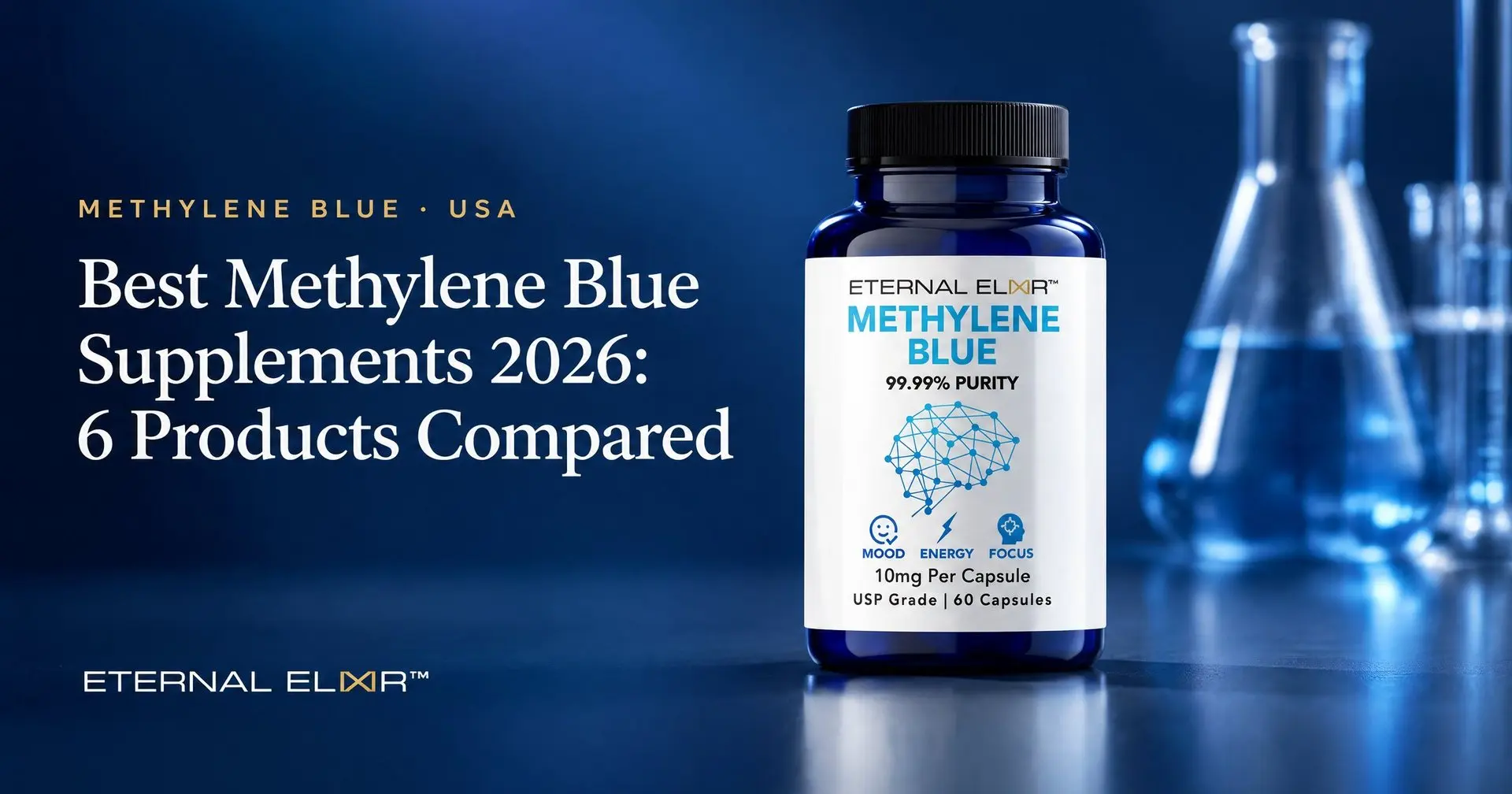
- Fixed 10 mg dose with no staining: Eternal Elixir Methylene Blue Capsules 10mg USP, 10 mg of methylene blue and 10 mg of vitamin C per capsule.
- The evidence in one line: one small randomized trial of a single low dose in healthy adults, plus lab and animal research. No long-term trial of daily supplement use exists.
How we ranked the best methylene blue supplements
We did not run lab tests on any product, and we don’t claim to have taken them. Every figure below comes from each brand’s own product page, read in September 2026. We weighed five things, the same way for every product:
- Dose control. The smallest step each product allows. With a compound that interacts with common medicines, being able to start small matters.
- Purity and testing you can check. Whether the raw material is described as USP grade, and whether the brand publishes a certificate of analysis for the finished product.
- Safety information on the page. Whether the product page warns about serotonergic medicines, G6PD deficiency and pregnancy before you buy.
- Cost per 10 mg of methylene blue. Total methylene blue in the bottle divided into the price, so liquids and capsules sit in the same column.
- Formula transparency. Whether every added ingredient is named with its amount.
Eternal Elixir makes two of these six products, and Methylene Blue Liquid 1% USP is our pick. It sits first on dose control, a single-ingredient label and the safety information on its page, not on price. The two Nutricel products are cheaper per milligram, and we rank them above our own capsules. For background on the compound itself, see our guide to what the research on methylene blue shows.
Best methylene blue supplements 2026 compared
Prices are each brand’s one-time price for a single bottle, as of Sep 2026. For liquids, a 1% solution holds 10 mg of methylene blue per mL, so a 50 mL bottle holds 500 mg. For capsules, total content is milligrams per capsule times the capsule count.
| Rank | Product | Format and strength | Methylene blue per bottle | Price | Cost per 10 mg | Smallest step | Buy |
|---|---|---|---|---|---|---|---|
| 1 | Eternal Elixir Methylene Blue Liquid 1% USP | Liquid, 1%, no additives declared | 500 mg (50 mL) | $49.99 | $1.00 | 0.5 mg (1 drop) | View Liquid 1% |
| 2 | Nutricel Blue Liquid 1% | Liquid, 1%, graduated dropper | About 1,180 mg (118 mL) | $30.00 | $0.25 | About 0.5 mg (1 drop) | Nutricel |
| 3 | Nutricel Blue Boost | Capsule, 12 mg with vitamin C ester and cacao | 720 mg (60 capsules) | $34.90 | $0.48 | 12 mg (1 capsule) | Nutricel |
| 4 | Eternal Elixir Methylene Blue Capsules 10mg USP | Capsule, 10 mg with 10 mg ascorbic acid | 600 mg (60 capsules) | $59.99 | $1.00 | 10 mg (1 capsule) | View Capsules 10mg |
| 5 | Biopharm Methylene Blue 1% USP | Liquid, 1%, glass bottle | 500 mg (50 mL) | $25.97 | $0.52 | 0.5 mg (1 drop) | Biopharm |
| 6 | Earth Harmony Ultimate Methylene Blue | Capsule, 12 mg with vitamin C, berberine, chlorophyllin, chlorophyll | 720 mg (60 capsules) | $39.95 | $0.55 | 12 mg (1 capsule) | Earth Harmony |
Three things stand out. Cost per 10 mg varies fourfold, from $0.25 to $1.00, for the same compound. Format doesn’t predict value: the cheapest product is a liquid and the second cheapest is a capsule. And the smallest dose step splits the market in two. The 1% liquids let you move in half-milligram drops, while no capsule here goes below 10 mg.
1. Eternal Elixir Methylene Blue Liquid 1% USP: our pick
Label facts: a 1% USP-grade methylene blue solution in a 50 mL bottle. The label states 500 mcg per drop and 10 mg per full dropper, with no additives declared. The bottle holds 500 mg of methylene blue. $49.99, which works out to $1.00 per 10 mg. Directions: follow the physical label exactly.
Eternal Elixir makes Methylene Blue Liquid 1% USP, and it is our pick for three reasons.
Dose control. At 0.5 mg per drop, you can start with a very small amount and change it in half-milligram steps. With a compound that interacts with common medicines, the ability to start low is a practical safety feature, not a marketing line. Our methylene blue dosage guide explains why hospital doses have nothing to do with a supplement label, which is the most misunderstood part of this category.
A single-ingredient label. The ingredient panel lists methylene blue and declares no additives. The product page also publishes a correction: it previously showed a 0.5% concentration, and it now follows the physical bottle label, which states a 1% solution.
Safety information before you buy. The product page tells you not to use methylene blue with SSRIs, SNRIs, MAO inhibitors or other serotonergic drugs unless directed by a prescriber, warns that it may be unsafe in G6PD deficiency, pregnancy or breastfeeding, and notes that the liquid can permanently stain surfaces and fabrics. Not every product in this comparison does that.
Where it loses: on raw cost per milligram, both Nutricel products and Biopharm are cheaper. Nutricel’s liquid is about a quarter of our cost per 10 mg. Drop size also varies a little, so any liquid dose is approximate.
Who it suits: first-time users who want to start with a small amount and adjust slowly, and buyers who prefer a plain solution with no added ingredients.
Who it doesn’t suit: anyone shopping purely on price per milligram, and anyone who dislikes handling a liquid dye. Bundles of two, three or five bottles are discounted in the cart, and US orders over $100 ship free.
2. Nutricel Blue Liquid 1%: lowest cost per milligram
Label facts: 4 fl oz (118 mL) of 1% methylene blue in purified water, about 1,180 mg in total, for $30.00. That is about $0.25 per 10 mg, the lowest cost per milligram in this comparison and about a quarter of ours. The amber glass bottle comes with a 0.05 mL graduated dropper, and Nutricel’s chart gives about 0.5 mg per drop and 10 mg per 1 mL.
Nutricel states purity of at least 99% by HPLC and says every batch is tested by an independent ISO/IEC 17025-accredited laboratory for identity, potency, heavy metals and microbes. A QR code on the label links to the certificate for your specific lot. The product page opens with a safety notice covering SSRIs, SNRIs, MAOIs and other serotonergic medicines, pregnancy and nursing, and children, and notes that taking it in the evening may affect sleep.
Who it suits: experienced users who want the cheapest well-documented way to dose in small steps, and who value a graduated dropper.
Who it doesn’t suit: anyone who will take a long time to use 118 mL, and anyone who wants to avoid handling a liquid dye.
3. Nutricel Blue Boost: lowest-cost capsule
Label facts: 60 capsules, each with 12 mg of USP-grade methylene blue, 35 mg of vitamin C ester (ascorbyl palmitate) and 235 mg of organic cacao powder as the carrier. $34.90, which is 720 mg of methylene blue per bottle and about $0.48 per 10 mg, the cheapest capsule here. Nutricel’s directions are to start with one capsule in the morning to assess tolerance, with or without food.
Nutricel names Eurofins, an ISO/IEC 17025-accredited lab, as its tester and publishes lot-specific certificates on its certificates page. The page carries the same safety notice as the liquid and adds that methylene blue interacts with many medicines, including common allergy medicines such as Benadryl. Nutricel says the vitamin C ester helps form the colorless reduced form of methylene blue, which may reduce blue urine and staining. We found no published human trial testing that claim.
Who it suits: buyers who already know they tolerate 12 mg and want the lowest cost per milligram in a capsule.
Who it doesn’t suit: first-time users who want to start below 12 mg. Nutricel also sells several similarly named methylene blue products with different formulas, so check that you are buying Blue Boost.
4. Eternal Elixir Methylene Blue Capsules 10mg USP: fixed 10 mg dose, no staining
Label facts: each capsule supplies 10 mg of USP-grade methylene blue and 10 mg of ascorbic acid (vitamin C), one capsule per serving, 60 capsules per bottle. The other ingredients are rice flour and a cellulose capsule. $59.99, which is 600 mg per bottle and $1.00 per 10 mg. Directions: follow the physical label exactly.
Eternal Elixir makes these capsules. They solve the two main complaints about liquids: no dropper, no staining, and the same dose every time. Both actives are declared with their amounts, and the product page carries the same serotonergic-medicine, G6PD and pregnancy warnings as our liquid.
Where it loses: it is the most expensive capsule per milligram here, about double Nutricel Blue Boost. Note that this is a 60-capsule bottle. Some of our other products come in 90-capsule bottles, and assuming 90 here would make the cost per milligram look a third lower than it is.
Who it suits: people who have settled on a fixed 10 mg serving and want a clean, repeatable routine. We compared delivery formats more broadly in our review of liposomal versus standard capsules. The format you will take consistently usually beats the one with the better delivery story.
Who it doesn’t suit: first-time users who want to start below 10 mg. Start with the liquid instead.
5. Biopharm Methylene Blue 1% USP: cheap, but sold like a lab chemical
Label facts: 1% USP-grade methylene blue in a 50 mL glass dropper bottle, 1 drop = 0.5 mg, for $25.97. That is 500 mg per bottle and about $0.52 per 10 mg. At the time of writing, Biopharm was running a limited-time offer of two 50 mL glass bottles for the same price, which halves the cost per milligram while it lasts. It also sells a 60 mL plastic bottle for $24.97. Standard shipping to the lower 48 states is free.
Biopharm says its methylene blue is made by in-house chemists and gets additional testing from third-party analysts, and its store has a product certificates section. The caution is how it is sold. The product page is categorized as a laboratory chemical, and we found no suggested use or safety warnings on it: nothing about serotonergic medicines, G6PD deficiency or pregnancy. The store also sells pH buffers and conductivity standards. If you buy it, you have to bring the safety knowledge yourself.
Who it suits: experienced users who know the interactions and want a plain 1% solution in glass at a low price.
Who it doesn’t suit: first-time users who want directions and warnings from the seller.
6. Earth Harmony Ultimate Methylene Blue: a multi-ingredient capsule
Label facts: 60 capsules for $39.95. Earth Harmony’s FAQ states each capsule contains 12 mg of methylene blue, which makes 720 mg per bottle and about $0.55 per 10 mg. The formula adds vitamin C, organic berberine, chlorophyllin and chlorophyll. The brand describes its methylene blue as 99.99% USP grade and formaldehyde-free and says all products are third-party tested.
The page carries a clear safety box: not recommended in pregnancy or while nursing, consult your healthcare provider if you have a known G6PD mutation, and don’t combine with SSRIs, antidepressants or other serotonergic medicines. Two things keep it last. The product description doesn’t give amounts for the added ingredients, so you can’t tell how much berberine you are taking, and we found no certificate of analysis on the page. Berberine is itself an active ingredient that can interact with medicines, which is another reason to check with your doctor if you take any.
Who it suits: buyers who specifically want methylene blue combined with those plant ingredients in one capsule.
Who it doesn’t suit: anyone who wants to control each ingredient separately or see a certificate before buying. If broader cellular-energy support is your aim, our mitochondrial supplement comparison and NAD+ supplement comparison cover that ground more directly.
Drops or capsules: which methylene blue format should you buy?
The honest answer depends on one question: do you already know your dose?
Choose a 1% liquid if you are starting out. At 0.5 mg per drop, you can begin with a very small amount and build slowly. No capsule in this comparison offers a step below 10 mg. Given methylene blue’s interactions, starting gradually is a sensible precaution.
Choose capsules once you are settled. Liquid methylene blue is a dye. It stains counters, clothing and, temporarily, the tongue and teeth, and some people stop taking it for that reason. A capsule removes the mess and the variation in drop size, so the dose is the same every day.
Cost doesn’t decide it. Within our range both formats cost $1.00 per 10 mg, and across the market the cheapest product is a liquid while the second cheapest is a capsule. Choose on behavior, not on price.
Who should not take methylene blue
This section matters more than the rankings above.
Methylene blue inhibits monoamine oxidase A, one of the enzymes that break down serotonin. Combined with medicines that raise serotonin, it can cause serotonin syndrome. A 2018 systematic review in Psychosomatics by Zuschlag and colleagues found 50 published cases of methylene blue-induced serotonin syndrome. Every one involved a serotonergic antidepressant taken at the same time, one was fatal, and the authors added the first reported case linked to an oral methylene blue product. Most earlier cases involved hospital doses given by injection, but the interaction is the reason every responsible label carries this warning.
Do not take a methylene blue supplement if you:
- Take SSRIs, SNRIs, MAOIs, tricyclic antidepressants, some migraine medicines (triptans), St John’s wort or any other serotonergic medicine or supplement
- Have G6PD deficiency, where methylene blue can damage red blood cells
- Are pregnant or breastfeeding
- Are under 18
- Take any prescription medicine and haven’t checked with your doctor first
Expected effects include blue or green urine, which is harmless, and sometimes a metallic taste or mild nausea. Liquids will stain fabric and many surfaces. Stop and see your doctor if you notice agitation, a fast heartbeat, muscle twitching, high temperature or confusion.
These products are dietary supplements, not medicines, and are not presented as treatments for any condition. Methylene blue is also a hospital medicine given by injection at doses far above anything on a supplement label. Hospital figures should never be used to reason about an oral supplement serving.
What the human research shows
The evidence for methylene blue as a daily supplement is much thinner than the marketing around it suggests.
Evidence level: one small randomized trial of a single dose. The study cited most often is a randomized, double-blind, placebo-controlled functional MRI trial published in Radiology in 2016 by Rodriguez and colleagues. It enrolled 26 healthy adults aged 22 to 62. One hour after a single low oral dose, methylene blue increased brain activity during attention and short-term memory tasks compared with placebo, and correct responses during memory retrieval rose by 7%. It tested one dose on one occasion. It doesn’t show that taking methylene blue every day improves memory or focus, and it wasn’t designed to.
Evidence level: reviews of lab and animal research. A 2021 review in Cells by Xue, Thaivalappil and Cao, “The Potentials of Methylene Blue as an Anti-Aging Drug”, summarizes work on cell energy, memory and skin aging. Most of it comes from cell and animal models. That research describes what is worth testing in people, not evidence that it works in people.
What hasn’t been done: a long-term, placebo-controlled trial of daily methylene blue supplements in healthy adults. Until one exists, any claim that daily use improves energy, focus or aging is ahead of the evidence. We take the same line across our longevity supplement comparison and our nootropic supplement comparison.
USP grade, third-party testing and what labels really tell you
USP grade describes a purity specification that the raw material is supposed to meet. Third-party testing means an independent laboratory has analyzed a product. They are different things. A supplement can be made from USP-grade material and never have its finished bottle tested independently.
When you compare labels, look for:
- The raw material described as USP grade.
- Milligrams of methylene blue stated per capsule, per drop or per mL.
- A certificate of analysis for the finished product, ideally matched to your lot. Of the six here, the two Nutricel products link lot-specific certificates.
- Safety warnings about serotonergic medicines, G6PD deficiency and pregnancy on the product page itself.
- Every added ingredient named with its amount.
Be wary of products that don’t state milligrams per serving, and of methylene blue sold for aquariums, laboratories or “research purposes only” rather than as a supplement with directions and warnings.
The verdict: which methylene blue supplement is right for you?
Our pick, and best for starting out: Eternal Elixir Methylene Blue Liquid 1% USP, with half-milligram drops, a single-ingredient label and the key safety warnings on the product page. It costs more per milligram than the cheapest options, at $1.00 per 10 mg.
If the lowest cost per milligram matters most: Nutricel Blue Liquid 1% at about $0.25 per 10 mg, with a graduated dropper and lot certificates.
If you want the cheapest capsule: Nutricel Blue Boost at about $0.48 per 10 mg, if 12 mg suits you.
If you want a fixed 10 mg dose with no mess: Eternal Elixir Methylene Blue Capsules 10mg USP, 10 mg of methylene blue and 10 mg of vitamin C per capsule.
If you know the interactions and want a plain liquid in glass: Biopharm 1% USP at about $0.52 per 10 mg.
If you want methylene blue combined with plant extracts: Earth Harmony Ultimate Methylene Blue, accepting that the added amounts aren’t stated on the page.
Whichever you choose, check your medication list first, read the milligrams on the label, and convert to cost per 10 mg before comparing prices. If methylene blue is one part of a wider routine, the same Eternal Elixir cart covers NMN, including our NMN 500mg and NMN Advanced Longevity Complex, and glutathione, including Reduced L-Glutathione 2000mg.
Frequently asked questions about methylene blue supplements
Can you buy methylene blue as a supplement?
Yes. In the US, methylene blue is sold as a dietary supplement in 1% liquid drops and in capsules, and all six products in this comparison are sold that way. It is also sold as a laboratory chemical and for aquariums, which are not the same thing. Choose a product sold as a supplement, with milligrams per serving, directions and safety warnings on the label.
What is the best methylene blue supplement?
Our pick is Eternal Elixir Methylene Blue Liquid 1% USP, because 0.5 mg drops let you start small, the label declares no additives, and the product page carries the key safety warnings. If the lowest cost per milligram matters most, Nutricel Blue Liquid 1% is the cheapest product in our comparison at about $0.25 per 10 mg.
What should you not mix with methylene blue?
Anything that raises serotonin. That includes SSRIs, SNRIs, MAOIs, tricyclic antidepressants, triptans for migraine and St John’s wort. Methylene blue inhibits MAO-A, and combining it with these can cause serotonin syndrome. Avoid it with G6PD deficiency, in pregnancy or breastfeeding, and under 18. If you take any prescription medicine, check with your doctor first.
Can I take methylene blue every day?
No long-term trial has established a safe daily dose for supplement use. The most-cited human trial used a single dose, not a daily routine. If you use it, follow your product’s label exactly, start at the smallest amount the product allows, and stop if you notice side effects.
Are methylene blue capsules better than drops?
Neither is better in general. Capsules give the same dose every time without staining, which suits people who have settled on a dose. Drops let you move in 0.5 mg steps, which matters when starting out. Within the Eternal Elixir range both cost $1.00 per 10 mg, so the choice comes down to precision versus convenience.
Why does methylene blue turn urine blue?
Methylene blue is a dye, and some of it leaves the body in urine, which can turn blue or green. That is expected and harmless. It can also tint the tongue and teeth for a while when taken as drops.
Does methylene blue stain your teeth?
Liquid methylene blue can temporarily tint the tongue and teeth, and it will permanently stain fabric and many surfaces. Mixing drops into water reduces the effect. Capsules avoid it, which is the main reason people switch formats.
Is USP grade the same as third-party tested?
No. USP grade describes a purity specification for the raw material. Third-party testing means an independent laboratory analyzed a product. A supplement can use USP-grade material and never have its finished bottle tested independently, so look for both.
How much does a methylene blue supplement cost in the US?
Across the six products here, single bottles run from $25.97 to $59.99. Converted to a common unit, cost ranges from about $0.25 to $1.00 per 10 mg of methylene blue. Bottle price alone is misleading, because bottles hold very different amounts.
Sources
- Rodriguez P, Zhou W, Barrett DW, et al. Multimodal randomized functional MR imaging of the effects of methylene blue in the human brain. Radiology. 2016;281(2):516-526. PubMed 27351678
- Zuschlag ZD, Warren MW, Schultz SK. Serotonin toxicity and urinary analgesics: a case report and systematic literature review of methylene blue-induced serotonin syndrome. Psychosomatics. 2018;59(6):539-546. PubMed 30104021
- Xue H, Thaivalappil A, Cao K. The potentials of methylene blue as an anti-aging drug. Cells. 2021;10(12):3379. PubMed 34943887
- Product pages for label facts, prices and safety text (September 2026): Eternal Elixir Methylene Blue Liquid 1% USP and Methylene Blue Capsules 10mg USP, plus the Nutricel, Biopharm and Earth Harmony pages linked in the comparison table.
More buying guides: spermidine supplements compared, TUDCA supplements compared, the full Eternal Elixir range, all supplement guides and the Eternal Elixir blog.