Last updated: · Originally published August 1, 2026 · Published by Eternal Elixir
Edited by Elaine Fletcher, Researcher
The right methylene blue dosage depends on which number you are looking at. Hospitals give methylene blue by IV at 1 mg per kilogram of body weight. Oral supplements come in small fixed amounts: our capsules hold 10mg each, and our 1% liquid gives 500mcg per drop. No human trial has set an ideal daily supplement dose, so the sensible start is the lowest amount on your product’s label, taken earlier in the day. If you take an antidepressant or any other serotonergic medicine, do not take methylene blue at all unless your doctor has cleared it.
Quick answer
- Supplement serving: follow the label on your bottle. Our capsule label gives 1 capsule (10mg) per serving. Our drops label gives 500mcg per drop and 10mg per full dropper.
- Hospital dose: 1 mg/kg by IV over 5 to 30 minutes, given with monitoring. It is not a guide for a supplement.
- Research dose: the best-known human study gave a single 280 mg oral dose (about 4 mg/kg) to healthy adults. It tested one dose, not daily use.
- Who should not take it: anyone on SSRIs, SNRIs, MAOIs or other serotonergic medicines, anyone with G6PD deficiency, anyone pregnant or breastfeeding, and anyone under 18. Expect blue or green urine.
Methylene Blue Dosage Chart: Where Each Number Comes From
Search for a methylene blue dosage chart and you will find three kinds of figures mixed together: hospital doses, doses from research studies, and supplement label servings. They answer different questions. The chart below sorts them by source and says how much evidence sits behind each one.
| Setting | Route | Figure | Evidence behind it | Applies to a supplement user? |
|---|---|---|---|---|
| Hospital, first dose | IV, over 5 to 30 minutes | 1 mg/kg | Clinical prescribing standard (StatPearls) | No. Given by clinicians with monitoring |
| Hospital, repeat dose | IV | 1 mg/kg once more after 1 hour, if needed | Clinical prescribing standard (StatPearls) | No |
| Brain imaging study, healthy adults | Oral, once | 280 mg (about 4 mg/kg) | One randomized trial, 26 adults | No. Context only |
| Absorption study, healthy adults | Oral, once | 500 mg | One drug-level study, 16 adults | No. Context only |
| “Hormetic” low-dose research | Mostly injected, in animals | Ranges in mg per kg | Animal and cell studies | No. Not tested as a human supplement dose |
| Eternal Elixir capsule | Oral | 10mg per capsule, 1 capsule per serving | Product label | Yes |
| Eternal Elixir liquid, 1% | Oral | 500mcg per drop, 10mg per full dropper | Product label | Yes |
The pattern is easy to spot once the rows are side by side. Every figure written in mg per kilogram comes from a hospital, a lab or a single-dose study. Every figure you can act on at home is a flat amount printed on a label. If an article gives you a body-weight formula for an oral supplement, it has borrowed a hospital number for a setting it was never meant for.
Why the IV Dose Does Not Translate to an Oral Supplement
In hospitals, methylene blue is a prescription injection. Its main use is acquired methemoglobinemia, a blood problem in which hemoglobin cannot carry oxygen properly. The StatPearls entry on methylene blue (Ostrovsky and Afzal, updated January 2026) gives the standard: 1 mg/kg by IV over 5 to 30 minutes, with one more 1 mg/kg dose after an hour if levels stay high. If two doses do not work, clinicians switch to another approach.
Put numbers on that and the gap is obvious. For an 80 kg adult, 1 mg/kg is 80 mg delivered straight into a vein in one sitting. That is eight of our 10mg capsules. The same StatPearls entry notes that single doses of 3 mg/kg or more have been linked to low blood pressure, wheezing and reduced oxygenation, and that the risk of adverse effects rises markedly above 7 mg/kg. Those thresholds exist because the hospital dose is already a large dose.
Route matters too, and here the evidence is thin and split. In a German study of 16 healthy adults, Walter-Sack and colleagues gave 50 mg by IV and 500 mg as an oral solution a week apart, and measured an absolute oral bioavailability of 72.3% in plasma (European Journal of Clinical Pharmacology, 2009). An earlier Swiss study by Peter and colleagues gave 100 mg by IV and by mouth to 7 volunteers and found much lower whole-blood levels after the oral dose (European Journal of Clinical Pharmacology, 2000). The two studies used different formulations and measured different blood fractions. Neither tested a 10mg capsule or a few drops.
Evidence level: the IV standard is well established for hospital use. How much of a small oral dose reaches the blood in a healthy adult has only been measured in small drug-level studies at much larger doses.
What Human Research Has Tested, and What It Has Not
The study behind most methylene blue dosage claims is a randomized, double-blind, placebo-controlled trial by Rodriguez and colleagues, published in Radiology in 2016. It enrolled 26 healthy adults aged 22 to 62. Half received a single oral dose of 280 mg of USP-grade methylene blue, about 4 mg/kg, and half received a placebo. The team ran functional MRI scans during attention and short-term memory tasks before the dose and 1 hour after it.
The methylene blue group showed more activity in brain regions used for those tasks, and 7% more correct answers during memory retrieval (P = .01). Every participant who took methylene blue reported blue urine afterward. That is a real finding from a well-designed study, and it is also narrow.
- What it showed: one dose changed brain imaging and one memory measure an hour later, in healthy adults.
- What it did not show: any effect from daily use, an optimal daily amount, or long-term safety.
- The dose gap: the “low dose” in this study was 280 mg. That equals 28 of our capsules. Supplement servings are far smaller, and no trial has tested whether 10mg a day does anything measurable.
Much of the “low-dose” talk online traces back to animal research. Reviews by Bruchey and Gonzalez-Lima (2008) and Rojas and colleagues (2012) describe a hormetic dose-response for methylene blue: low doses raised some measures of cell energy and memory in lab studies, while higher doses had the opposite effect. That work is the reason careful users start low. It does not give a human dose, and the mg/kg ranges in those papers come mostly from rats and mice.
Our product pages take the same line. They state that a small acute human study is not evidence of daily cognitive enhancement, and that the finished product has not been tested in a clinical trial. For a wider look at what the research does and does not support, see our guide to methylene blue benefits and the evidence behind them. Our supplement dose gap report covers the same mismatch between trial doses and label doses across other ingredients.
Methylene Blue Dosage by Format: Capsules vs Drops
Once you work from label servings rather than hospital figures, the practical question becomes which format fits how you want to measure. The unit difference between a capsule and a drop is large enough that people misjudge it all the time.
| Factor | Methylene Blue Capsules 10mg USP | Methylene Blue Liquid 1% USP |
|---|---|---|
| Methylene blue per unit | 10mg per capsule | 500mcg per drop, 10mg per full dropper |
| Other ingredients on the label | 10mg ascorbic acid, rice flour, cellulose capsule | No additives declared |
| Pack size | 60 capsules | 50mL bottle |
| Label serving | 1 capsule | Follow the bottle label |
| Price (as of Oct 2026) | $59.99 | $49.99 |
| Cost per 10mg of methylene blue | $1.00 (60 capsules) | $1.00 (about 50 full droppers) |
| Smallest step | 10mg | 500mcg |
| Staining | Sealed capsule, nothing touches the mouth | Can tint the tongue and teeth, and stains fabric and surfaces |
| Suits | A fixed, repeatable amount with no measuring | Starting below 10mg and stepping up in small increments |
| Buy | View the capsules | View the drops |
The number worth slowing down for is the drop. One drop of our 1% liquid holds 500mcg, which is one twentieth of a capsule. Twenty drops make a full dropper and match one capsule. Anyone who assumes a drop and a capsule are roughly the same can be out by a factor of twenty.
Both products use USP-grade methylthioninium chloride. USP is a quality specification for the raw ingredient, not a test of the finished product, but it matters with this compound. Methylene blue is also sold as an aquarium product and a lab stain, and those grades are not made to be swallowed.
How Many Drops of Methylene Blue Should I Take?
Start with whatever your bottle’s label says, and use the fewest drops it allows. For our liquid, the label gives 500mcg per drop and 10mg per full dropper, so the conversion is simple:
| Drops of our 1% liquid | Methylene blue | Compared with one capsule |
|---|---|---|
| 1 drop | 500mcg | One twentieth |
| 2 drops | 1 mg | One tenth |
| 4 drops | 2 mg | One fifth |
| 10 drops | 5 mg | Half |
| 20 drops (a full dropper) | 10 mg | The same |
This table only fits a product labeled at 500mcg per drop. Other brands sell different concentrations and droppers, so the same number of drops can hold a different amount. Drop size also shifts with the angle of the dropper and how hard you squeeze. Count slowly, hold the dropper upright, and mix the drops into a glass of water rather than onto your tongue.
Drops suit people who want to start well below 10mg. If you would rather not count at all, the capsule gives the same 10mg every time.
How to Take Methylene Blue: Timing, Water and Consistency
Beyond the amount itself, a few practical choices shape how a serving goes.
Start low and hold steady. Begin at the lowest amount your label allows. With drops, that can mean a few drops instead of a full dropper. With capsules, 10mg is already a small fixed amount, and there is no reason to take more than the label serving. Stay at one amount for a few weeks before you judge it.
Take it earlier in the day. After an IV dose, Peter and colleagues measured a terminal half-life of about 5.25 hours. A morning serving leaves less in your system at bedtime than an evening one. No trial has compared morning and evening use, so treat this as a practical choice, not a research finding.
Use water and a glass. Mix drops into water, drink it from a glass you do not mind tinting, and rinse your mouth afterward. The drops can stain fabric, countertops and skin, so keep a paper towel nearby.
Expect blue or green urine. StatPearls describes blue-green urine as expected and benign. It is a sign the dye is being cleared, not a sign you took too much.
Change one thing at a time. Do not start methylene blue in the same week as another new supplement, and keep it away from other products that act on monoamine oxidase. If you change two things at once, you cannot tell which one caused what you notice. We use the same one-change rule in our comparison of NMN and resveratrol.
Methylene Blue Safety: Who Should Not Take It
This section matters more than any dosage figure. The main risk with methylene blue is a drug interaction, and it does not depend on dose in any way that has been shown to be safe.
Do not take methylene blue if any of these apply
- You take an SSRI, SNRI, MAOI or any other serotonergic medicine. The combination carries a risk of serotonin syndrome.
- You have G6PD deficiency.
- You are pregnant or breastfeeding.
- You are under 18.
Methylene blue can turn urine blue or green. If you take any prescription medicine, talk to your doctor before you start.
Why serotonergic medicines are the key interaction. Ramsay and colleagues tested methylene blue against purified human monoamine oxidase and found it to be a potent, reversible inhibitor of MAO-A (British Journal of Pharmacology, 2007). MAO-A is one of the main enzymes that breaks down serotonin. At the blood levels reported after IV dosing, the authors calculated that MAO-A would be completely inhibited. That explains the serotonin toxicity reported in patients taking SSRIs who were given methylene blue. StatPearls notes that fatal cases have been described and that methylene blue should not be combined with serotonergic agents or opioids.
The medicines in this group include SSRIs, SNRIs, tricyclic antidepressants, MAO inhibitors, some pain medicines such as tramadol, triptans and St John’s wort. The published cases involve hospital doses, and nobody has shown that a small oral amount is safe alongside these medicines. Treat the rule as applying at any dose and ask the doctor who prescribes your medicine.
G6PD deficiency and pregnancy. StatPearls lists G6PD deficiency and pregnancy as contraindications. People with G6PD deficiency can develop hemolysis, a breakdown of red blood cells, after methylene blue.
Grade. Only use methylene blue sold for oral use with its grade stated on the label. Aquarium and laboratory grades are not made for people and should never be swallowed.
Our Methylene Blue Capsules and Drops
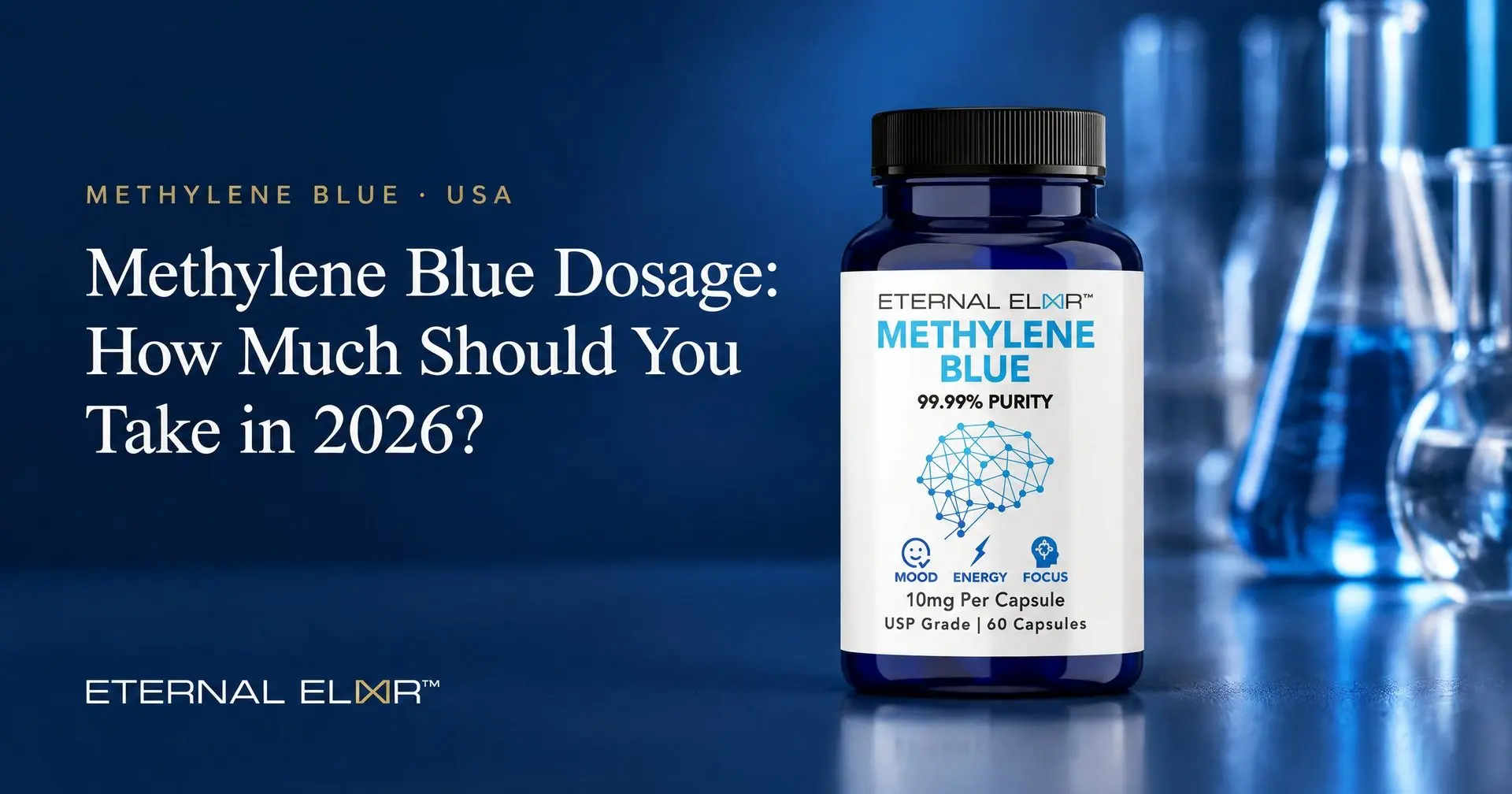
Eternal Elixir makes both products in this guide, and the capsules are our pick for most people who have cleared methylene blue with their doctor. The reason is on the label. Each capsule holds 10mg of USP-grade methylene blue with 10mg of ascorbic acid, the label serving is one capsule, and the bottle holds 60 capsules. That is two months at one capsule a day for $59.99, or $1.00 a capsule. There is nothing to measure and nothing to spill, and the dose is the same every morning.
The drops suit a different buyer: someone who wants to start below 10mg and move up in 500mcg steps. The 50mL bottle holds a 1% USP-grade solution with no additives declared, at $49.99. Measured per 10mg of methylene blue, the two formats cost the same.
Both products come with multi-bottle savings: 10% off two bottles, 15% off three and 20% off five. Both product pages state the evidence level for each ingredient and say plainly what has not been shown.
Want to see how our products compare with other brands on dose and price? Our methylene blue supplement comparison lines them up. You can also browse the full Eternal Elixir range.
Frequently Asked Questions
What is the methylene blue dosage per day for adults?
No trial has set a daily supplement dose for healthy adults. Follow the label on the product you have and start at the lowest amount it allows. Our capsule label gives one 10mg capsule per serving, and our liquid gives 500mcg per drop. Do not convert a hospital mg/kg figure into a daily supplement amount.
How many drops of methylene blue should I take?
Use the fewest drops your label allows and hold that amount steady. With our 1% liquid, 2 drops give 1 mg and a full dropper of 20 drops gives 10mg. Drop size varies with the dropper angle, so count slowly or switch to capsules if you want the same amount every time.
How much methylene blue is in one drop?
It depends on the product’s concentration and dropper. Our 1% liquid is labeled at 500mcg per drop and 10mg per full dropper. Check your own bottle’s label, because other products use different strengths.
Is 10mg of methylene blue a lot?
For a 70 kg adult, 10mg works out to about 0.14 mg/kg. That is a seventh of the 1 mg/kg hospital dose and a twenty-eighth of the 280 mg single dose used in the brain imaging study. It is still an active amount of a drug-like compound, so the safety rules apply in full.
Is a methylene blue dosage chart based on body weight reliable?
Not for oral supplements. Body-weight formulas such as 1 mg/kg come from IV hospital dosing given with monitoring. Applying that formula to a supplement can produce an amount many times larger than any label serving.
Can I take methylene blue with antidepressants?
No, not unless the doctor who prescribes your medicine has cleared it. Methylene blue is a potent inhibitor of MAO-A, and combining it with SSRIs, SNRIs or other serotonergic medicines has been linked to serotonin syndrome, including fatal cases.
Why does methylene blue turn urine blue or green?
Methylene blue is a dye, and the body clears part of it in urine. Blue-green urine is expected and harmless. In the 2016 imaging study, every participant who took methylene blue reported it.
Can you take methylene blue every day?
Supplement labels give a daily serving, but no study has tested the long-term safety of daily low-dose use in healthy adults. If you take a serotonergic medicine, the answer is no. If you do not, stay at the lowest label serving and hold it steady rather than raising it each week.
How long does it take for methylene blue to start working?
No study has timed how quickly a 10mg serving takes effect, so there is no reliable answer for a supplement amount. The closest data point is the 2016 brain imaging trial in Radiology described above, which scanned volunteers 1 hour after a single oral dose at a research amount and found higher activity in brain regions used for attention and memory tasks at that point. That was one large dose, not a daily serving. Peter and colleagues, writing in the European Journal of Clinical Pharmacology, measured a terminal half-life of about 5.25 hours after an IV dose, which is why a morning serving is the usual suggestion. If you track how you feel, judge it over a few weeks at one steady amount rather than in the first hour.
How do you take methylene blue drops?
Check the concentration on your label first, because brands differ. For our 1% liquid, each drop holds 500mcg and a full dropper holds 10mg. Hold the dropper upright, count the drops slowly into a glass of water and drink it, rather than putting them straight onto your tongue. Start with the fewest drops the label allows and stay at that amount for a few weeks.
What should you not take with methylene blue?
Avoid anything serotonergic: SSRIs, SNRIs, tricyclics, MAO inhibitors, triptans, tramadol and St John’s wort. Keep it away from other supplements that act on monoamine oxidase, and clear it with your doctor if you take any prescription medicine.
The Bottom Line
The methylene blue dosage that applies to you is the one on your bottle, not a hospital formula or a research dose. Start at the lowest serving the label allows, take it in the morning, hold it steady for a few weeks, and skip methylene blue entirely if you take a serotonergic medicine. If our capsules fit your routine, they give a fixed 10mg in every capsule with no measuring.
If methylene blue is ruled out for you, ask your doctor about other options. Our review of the Ca-AKG evidence and our NMN 500mg capsules page cover two other ingredients people look at for cellular energy, each with its own evidence and limits.
Sources
- Ostrovsky A, Afzal M. Methylene Blue. StatPearls. Updated January 2, 2026. NBK557593
- Rodriguez P, Zhou W, Barrett DW, et al. Multimodal randomized functional MR imaging of the effects of methylene blue in the human brain. Radiology. 2016;281(2):516-526. PMID 27351678
- Walter-Sack I, Rengelshausen J, Oberwittler H, et al. High absolute bioavailability of methylene blue given as an aqueous oral formulation. European Journal of Clinical Pharmacology. 2009;65(2):179-189. PMID 18810398
- Peter C, Hongwan D, Küpfer A, Lauterburg BH. Pharmacokinetics and organ distribution of intravenous and oral methylene blue. European Journal of Clinical Pharmacology. 2000;56(3):247-250. PMID 10952480
- Ramsay RR, Dunford C, Gillman PK. Methylene blue and serotonin toxicity: inhibition of monoamine oxidase A (MAO A) confirms a theoretical prediction. British Journal of Pharmacology. 2007;152(6):946-951. PMID 17721552
- Bruchey AK, Gonzalez-Lima F. Behavioral, physiological and biochemical hormetic responses to the autoxidizable dye methylene blue. American Journal of Pharmacology and Toxicology. 2008;3(1):72-79. PMID 20463863
- Rojas JC, Bruchey AK, Gonzalez-Lima F. Neurometabolic mechanisms for memory enhancement and neuroprotection of methylene blue. Progress in Neurobiology. 2012;96(1):32-45. PMID 22067440
- Eternal Elixir product labels: Methylene Blue Capsules 10mg USP and Methylene Blue Liquid 1% USP.
These statements have not been evaluated by the Food and Drug Administration. This product is not intended to diagnose, treat, cure, or prevent any disease.