Last updated: · Originally published August 7, 2026 · Published by Eternal Elixir
Edited by Elaine Fletcher, Researcher
The best glutathione supplements in 2026 state the form (plain reduced or liposomal), the milligrams per serving and the servings per bottle, so you can compare what a gram of glutathione actually costs. We compared six US products on those numbers, read from each brand’s own page in September 2026, and set them against the human trials. Our pick is Eternal Elixir Reduced L-Glutathione 2000mg: 1,000mg per capsule, $0.67 per gram. For the lowest cost per gram, Nutricost Glutathione is $0.37.
Quick answer
- Our pick: Eternal Elixir Reduced L-Glutathione 2000mg. 2,000mg per 2-capsule serving, 60 capsules, $39.99. One capsule gives the 1,000mg daily dose used in the longest human trial.
- Lowest cost per gram: Nutricost Glutathione, 500 mg per capsule, 240 capsules for $43.97.
- Best liposomal capsule: Codeage Liposomal Glutathione 1000 mg, $49.99 for a month.
- For drug-tested athletes: Thorne Glutathione-SR, with the NSF Certified for Sport mark.
- What the evidence shows: daily oral glutathione raised blood levels over months in one trial. A single dose and a 4-week trial found no change. Liposomal evidence is one 12-person pilot.
Glutathione is a small peptide made of three amino acids, and it is the most abundant antioxidant the body makes itself. The question with a supplement is whether swallowing it raises the amount in your body, because the gut breaks much of it down. The answer from human trials is “slowly, at a high enough dose”, and that is the lens for every product below.
Best glutathione supplements 2026 compared
Prices are one-time prices on each brand’s own site, as of Sep 2026. Cost per gram is the price divided by the total glutathione in the pack, which lets you compare capsules and liquids on the same basis. Cost per day uses the label serving.
| Rank | Product | Form | Glutathione per serving | Pack | Price | Cost per day | Cost per gram | Buy |
|---|---|---|---|---|---|---|---|---|
| 1 | Eternal Elixir Reduced L-Glutathione 2000mg | Reduced, capsule | 2,000mg (2 capsules) | 60 capsules | $39.99 | $1.33 | $0.67 | View product |
| 2 | Nutricost Glutathione | Reduced, capsule | 500 mg (1 capsule) | 240 capsules | $43.97 | $0.18 | $0.37 | Nutricost |
| 3 | Codeage Liposomal Glutathione 1000 mg | Liposomal, capsule | 1,000 mg (2 capsules) | One month | $49.99 | $1.67 | $1.67 | Codeage |
| 4 | NOW Glutathione 500 mg | Reduced, capsule, with milk thistle and ALA | 500 mg (1 capsule) | 120 capsules | $58.49 (sale) | $0.49 | $0.97 | NOW |
| 5 | Thorne Glutathione-SR | Sustained release, capsule | 175 mg (1 capsule, 2 to 3 a day) | 60 capsules | $54.00 | $1.80 at 2 a day | $5.14 | Thorne |
| 6 | Quicksilver Scientific Liposomal Glutathione | Liposomal, liquid | 100 mg (1 mL) | 50 mL | $45.00 | $0.90 | $9.00 | Quicksilver |
The cost per gram runs from $0.37 to $9.00, a spread of about 24 times for the same molecule. Most of that gap is the price of liposomal and sustained-release delivery. The daily cost ranking looks different because the servings differ so much: Quicksilver’s 100 mg serving is cheap per day and expensive per gram.
How we ranked these six
Eternal Elixir makes Reduced L-Glutathione 2000mg. It is our pick and sits first. The other five are ordered on the same checks, applied to each brand’s own page:
- Dose against the trials. The six-month trial that raised glutathione used 250 mg and 1,000 mg a day. A product that reaches that range in one or two capsules ranks higher.
- Cost per gram. Price divided by total glutathione in the pack.
- Form and the evidence for it. Plain reduced glutathione has the larger trial behind it. Liposomal has a smaller pilot.
- Testing marks you can check. A third-party certification shown on the product page, such as NSF Certified for Sport, counts for athletes who are drug tested.
What we did not do: we ran no lab tests on any competitor product, and nobody here compared how six glutathione products felt. For another antioxidant-adjacent comparison, our guide to the best TUDCA supplements uses the same method.
The 6 best glutathione supplements, reviewed
1. Eternal Elixir Reduced L-Glutathione 2000mg: our pick
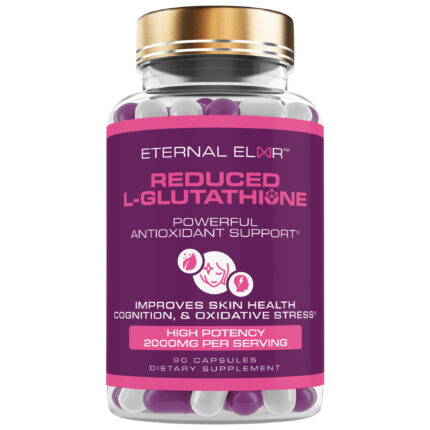
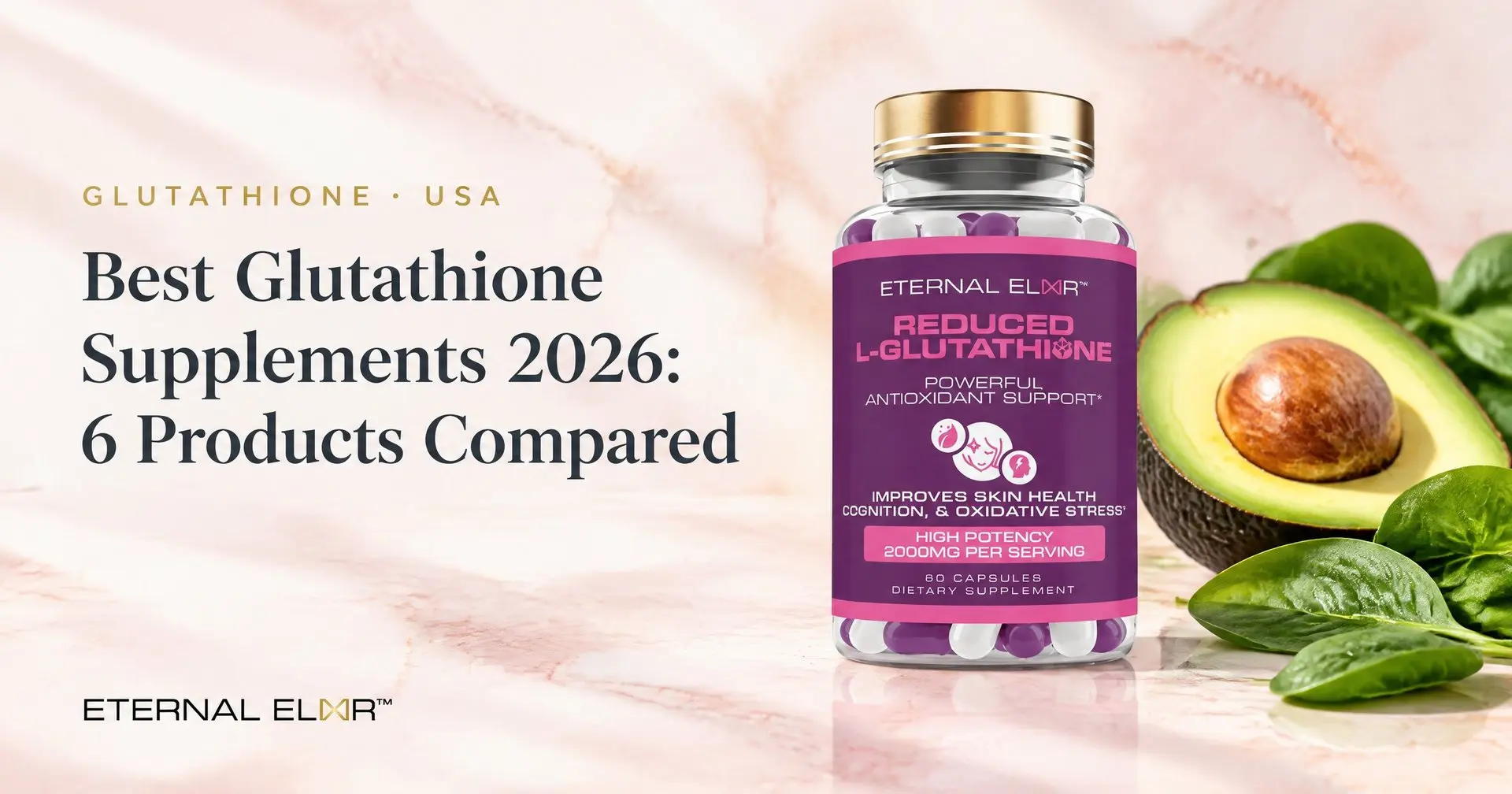
Reduced L-Glutathione 2000mg holds 2,000mg of reduced L-glutathione (GSH) per 2-capsule serving, so each capsule is 1,000mg. The only other ingredients are rice flour and a cellulose capsule. A bottle holds 60 capsules, or 30 label servings, for $39.99. That is $1.33 a serving and $0.67 per gram of glutathione.
Why it ranks first: it has the most glutathione per capsule of any product here, and the second-lowest cost per gram. One capsule matches the 1,000mg daily dose that raised blood glutathione in the six-month trial below. If you would rather stay at that studied dose, one capsule a day turns the bottle into a 60-day supply at $0.67 a day. The product page states the evidence level and says the finished product has not been tested in a clinical trial.
Who it suits: people who want plain reduced glutathione at the studied dose in one capsule, from a brand with one published price.
Who it doesn’t suit: anyone who wants liposomal delivery, and anyone chasing the lowest cost per gram, where Nutricost is cheaper. The full 2,000mg label serving is also higher than any daily dose tested over months in published trials, so it is not a dose with more evidence behind it.
Our capsule against the cheapest per gram:
| Eternal Elixir Reduced L-Glutathione 2000mg | Nutricost Glutathione | |
|---|---|---|
| Glutathione per capsule | 1,000mg | 500 mg |
| Capsules for the 1,000 mg studied dose | 1 | 2 |
| Capsules per bottle | 60 | 240 |
| Price, as of Sep 2026 | $39.99 | $43.97 |
| Cost per day at 1,000 mg | $0.67 | $0.37 |
| Days per bottle at 1,000 mg | 60 | 120 |
Nutricost wins on cost. Our capsule wins on capsule count: one a day instead of two for the same studied dose, or the full 2,000mg label serving in two. Multi-bottle orders of ours save 10% on two bottles, 15% on three and 20% on five.
2. Nutricost Glutathione: lowest cost per gram
Nutricost’s bottle holds 240 capsules, and each capsule is one 500 mg serving. At $43.97 that is 120 grams of glutathione, $0.37 per gram and about $0.18 a day. The page says the capsules are non-GMO, gluten free and third-party tested.
Who it suits: anyone who wants plain reduced glutathione at the lowest cost, and who is happy to take it for months. Two capsules a day reaches the 1,000 mg studied dose for $0.37 a day. More on the brand in our Nutricost review.
Who it doesn’t suit: anyone who wants 1,000 mg in a single capsule, or a liposomal form.
3. Codeage Liposomal Glutathione 1000 mg: best liposomal capsule
Codeage’s liposomal capsule provides 1,000 mg of reduced L-glutathione (GlutaONE) per 2-capsule serving, in a phospholipid complex from sunflower lecithin. The label says to take 2 capsules daily, and a bottle is a one-month supply for $49.99, which is $1.67 a day and $1.67 per gram. The page shows an NSF certification mark and a 30-day money-back guarantee. Codeage says the capsules are vegan and free from dairy, soy and gluten, and that a version made with Setria L-glutathione and a powder format are also available.
Who it suits: people who want liposomal delivery without a liquid, at the full 1,000 mg studied dose.
Who it doesn’t suit: buyers comparing on price per gram, where it costs about 2.5 times our capsule and 4.5 times Nutricost. The liposomal case rests on a small pilot study, described below.
4. NOW Glutathione 500 mg: glutathione with milk thistle and ALA
NOW’s capsule combines 500 mg of reduced glutathione with 100 mg of milk thistle extract and 50 mg of alpha lipoic acid, and the label says to take one capsule daily, preferably on an empty stomach. The 120-capsule bottle was $58.49 on sale ($77.99 regular), or $0.49 a day and $0.97 per gram. The 30-capsule bottle was $17.99 on sale.
Who it suits: people who want glutathione with milk thistle and ALA in one capsule from a large, long-running brand.
Who it doesn’t suit: anyone who wants glutathione alone, or the lowest cost per gram. At the regular price, the per-gram cost is higher still.
5. Thorne Glutathione-SR: for drug-tested athletes
Thorne’s Glutathione-SR holds 175 mg of reduced glutathione per capsule in a sustained-release capsule, and the label says to take one capsule two to three times daily. A 60-capsule bottle is $54.00, which is $5.14 per gram and $1.80 a day at two capsules. The product carries the NSF Certified for Sport mark, which matters if you are tested for banned substances. The capsule’s other ingredients include leucine, magnesium citrate and both high- and low-viscosity hydroxypropyl methylcellulose.
Who it suits: athletes who need a certified-for-sport product and will pay for it.
Who it doesn’t suit: anyone watching cost. At two capsules a day you get 350 mg, below the 1,000 mg studied dose, for more than our capsule costs. Sustained release is a design choice, and we found no trial comparing it with a standard glutathione capsule.
6. Quicksilver Scientific Liposomal Glutathione: liquid with fine dose control
Quicksilver’s liquid provides 100 mg of glutathione and 75 mg of phosphatidylcholine per 1 mL serving (2 pumps), with 50 servings in a 50 mL bottle for $45.00. That is $0.90 a day at 1 mL and $9.00 per gram. The label says to hold 2 to 4 pumps in the mouth for 30 to 90 seconds before swallowing, on an empty stomach, and to use the bottle within 30 days of opening. It ships with ice packs and needs refrigeration.
Who it suits: people who can’t or won’t swallow capsules, and who want to adjust the dose in small steps. Our Quicksilver Scientific review covers the brand in more detail.
Who it doesn’t suit: anyone aiming for the trial doses. Reaching 1,000 mg a day would take 10 mL, which empties the bottle in 5 days. The page also warns of an occasional sulfur taste or smell.
Does oral glutathione work? What the trials show
For years the standard answer was no, because the gut breaks glutathione down. The trials are more mixed than that, and they depend heavily on dose and time.
| Study | Who and what | Result | Evidence level |
|---|---|---|---|
| Witschi 1992 | 7 healthy volunteers, a single 3 g dose | No rise in plasma glutathione over the next 270 minutes | Human, single dose |
| Allen and Bradley 2011 | 40 healthy adults, 500 mg twice daily or placebo for 4 weeks | No change in oxidative stress markers or red blood cell glutathione | Human randomized trial, negative |
| Richie 2015 | 54 healthy non-smoking adults, 250 mg or 1,000 mg a day or placebo for 6 months | Blood glutathione rose at 1, 3 and 6 months at both doses, and fell back after stopping | Human randomized trial, positive |
| Sinha 2018 | 12 healthy adults, liposomal 500 mg or 1,000 mg a day for 1 month | Whole-blood glutathione up to 40% higher at 2 weeks | Human pilot, small |
The six-month trial: plain glutathione, given time
The strongest single study was run at Penn State and published in the European Journal of Nutrition in 2015. It randomized 54 healthy non-smoking adults to a placebo or to 250 mg or 1,000 mg of plain oral glutathione a day for six months. Blood glutathione rose at 1, 3 and 6 months compared with baseline at both doses. At 6 months, the 1,000 mg group had levels 30% to 35% higher in red blood cells, plasma and lymphocytes. Levels returned to baseline within a month of stopping.
That is the case for plain reduced glutathione, and it used the same kind of product as our capsule. It measured glutathione levels and markers, not how people felt or any health outcome.
The trials that found nothing
The evidence against deserves the same space. In 1992, Witschi and colleagues gave 7 volunteers a single 3 g dose and found no rise in plasma glutathione. In 2011, Allen and Bradley gave 40 healthy adults 500 mg twice a day or a placebo for 4 weeks, and found no change in oxidative stress markers or in red blood cell glutathione. Read with the six-month trial, the likely explanation is time: a single dose or a month may not be long enough for plain glutathione to show up.
Liposomal glutathione: faster, but a small study
The main liposomal study, by Sinha and colleagues in 2018, gave 12 healthy adults 500 mg or 1,000 mg a day of liposomal glutathione for a month. Whole-blood glutathione rose within a week and peaked at up to 40% higher at two weeks, with lower oxidative stress markers. It was a small pilot with 12 people split across two doses, and it was funded by a company that sells liposomal glutathione. It supports the idea that liposomal forms act faster. It doesn’t show they are worth several times the price per gram.
Reduced, liposomal or sustained release: the forms explained
Reduced glutathione (GSH) is the active form of the molecule, and it is what most capsules contain, including ours, Nutricost’s and NOW’s. It is the form used in the six-month trial. It is also the cheapest per gram, which is why it suits the long timelines the trials suggest.
Liposomal glutathione wraps the same molecule in tiny fat bubbles made from phospholipids, usually from sunflower lecithin. The idea is that the bubble protects glutathione from breakdown in the gut. The pilot study above supports faster results, but no trial has compared liposomal and plain glutathione directly, side by side. Liquids like Quicksilver’s add another variable: you hold them in the mouth before swallowing.
Sustained-release glutathione, like Thorne’s, uses a capsule matrix that releases glutathione over several hours. It is a formulation choice with a reasonable rationale and no head-to-head trial behind it.
Blends, like NOW’s with milk thistle and alpha lipoic acid, add other ingredients alongside glutathione. That can be convenient, but it makes the glutathione dose harder to compare and means you are paying for ingredients you may not want.
How to read a glutathione label
Milligrams per serving, and capsules per serving. Our label serving is 2 capsules for 2,000mg. Nutricost’s and NOW’s are 1 capsule for 500 mg. Thorne’s is 1 capsule for 175 mg, taken two or three times a day. Always check both numbers before you compare.
The form. “L-glutathione (reduced)” or “GSH” is the form used in the trials. If a label only says “glutathione complex” or hides the amount inside a blend, you can’t compare it with the products here.
Cost per gram. Divide the price by the total grams of glutathione in the pack. It is the only way to compare a 50 mL liquid with a 240-capsule bottle.
The phospholipid source. Liposomal products usually use sunflower or soy lecithin. Check the source if you avoid either.
Storage. Capsules keep at room temperature. Some liposomal liquids need refrigeration and have a use-by window once opened.
When and how to take glutathione
No trial has tested whether the time of day matters. Labels differ: NOW suggests one capsule on an empty stomach, Quicksilver says to take its liquid at least 10 minutes before meals, Codeage says to take 2 capsules daily with 8 ounces of water, and Thorne spreads its capsules across the day. The six-month trial gave glutathione daily for months, so consistency is the one thing the evidence clearly supports. Pick a time you will stick to.
What is the downside of taking glutathione?
- The effect fades when you stop. In the six-month trial, levels returned to baseline within a month of stopping.
- Plain capsules are slow. Trials of a single dose and of 4 weeks found no change.
- Liposomal forms cost much more per gram, and liquids need refrigeration and can taste of sulfur.
- Raised levels are not the same as a health benefit. The trials measured glutathione and lab markers in healthy adults, not outcomes you would notice.
- Safety data is short term. The trials ran from one dose to six months in healthy adults. Talk to your doctor before starting if you take prescription medication, have a health condition, or are pregnant or breastfeeding.
Matching a glutathione supplement to your goal
The studied dose in one capsule: our Reduced L-Glutathione 2000mg, one capsule a day for 1,000mg, or two for the full label serving.
The lowest cost, and you are patient: Nutricost at one or two capsules a day. Expect to think in months, as the trial did.
Faster change and cost is secondary: a liposomal product, Codeage in capsule form or Quicksilver as a liquid.
You are drug tested: Thorne Glutathione-SR for the NSF Certified for Sport mark.
Glutathione rarely sits alone in a routine. People often pair it with TUDCA, and our liver supplement comparison covers that group. If metabolic health is the main interest, our berberine supplement comparison is a better starting point. For cellular energy rather than antioxidant capacity, NMN is the usual choice, compared in our NMN supplement rankings, and our NMN vs resveratrol comparison covers trans-resveratrol. People interested in cellular ageing often look at Ca-AKG, reviewed in our Ca-AKG evidence review, and at spermidine. If mitochondrial support is the real goal, read what the research shows on methylene blue before assuming glutathione is the right tool. Start with one product and give it a fair run before adding another.
The verdict: which glutathione supplement to buy
- Our pick: Eternal Elixir Reduced L-Glutathione 2000mg, $39.99, 1,000mg per capsule, $0.67 per gram.
- Lowest cost per gram: Nutricost Glutathione, $0.37 per gram.
- Liposomal capsule: Codeage Liposomal Glutathione 1000 mg, $1.67 a day.
- With milk thistle and ALA: NOW Glutathione 500 mg.
- Drug-tested athletes: Thorne Glutathione-SR.
- Liquid: Quicksilver Scientific Liposomal Glutathione.
You can also browse the full Eternal Elixir range, or see more supplement guides on the Eternal Elixir blog.
Frequently asked questions
Which brand of glutathione is the most effective?
No brand has been shown to beat another in a head-to-head human trial, so “most effective” can’t be settled by evidence. What you can compare is dose, form and cost per gram. Our pick is Eternal Elixir Reduced L-Glutathione 2000mg: 1,000mg per capsule, the upper dose used in the six-month trial, at $0.67 per gram. Eternal Elixir makes it.
Add Reduced L-Glutathione to cart · $39.99
What is the top rated glutathione supplement?
Ratings on brand sites aren’t comparable across brands, so we rank on label facts instead. On those, our pick is Eternal Elixir Reduced L-Glutathione 2000mg for dose per capsule, Nutricost for the lowest cost per gram, and Codeage for a liposomal capsule.
Is liposomal glutathione better than regular glutathione?
It may act faster. A 12-person pilot found whole-blood glutathione up to 40% higher after two weeks on liposomal glutathione. Plain reduced glutathione has the larger six-month trial behind it and costs far less per gram. If cost matters most, plain reduced glutathione at 500 mg to 1,000 mg a day is the better-supported choice.
What is the downside of taking glutathione?
The main downsides are slow results, cost and an effect that fades. Trials of a single dose and of 4 weeks found no change, the six-month trial found levels fell back within a month of stopping, and liposomal forms cost much more per gram. The trials were short and in healthy adults, so talk to your doctor first if you take medication or are pregnant.
How much glutathione should you take per day?
Follow the label on the product you buy. The six-month trial that raised glutathione used 250 mg and 1,000 mg a day, and the liposomal pilot used 500 mg and 1,000 mg. One capsule of our Reduced L-Glutathione 2000mg gives 1,000mg.
How long does glutathione take to work?
In the six-month trial, blood levels were already higher at the first check at one month, and the increases grew with dose and time. The liposomal pilot saw changes within one to two weeks. A 4-week trial of plain glutathione found no change, so give plain capsules at least a few months.
Can you take glutathione every day?
The six-month trial gave healthy adults glutathione every day at 250 mg or 1,000 mg, and daily use is how the levels rose. That trial was in healthy non-smoking adults, so if you have a health condition, take medication, or are pregnant or breastfeeding, check with your doctor before daily use.
Should you take glutathione or an NAD+ precursor?
They do different jobs. Glutathione is an antioxidant the body makes and uses in redox reactions. NAD+ precursors such as NMN are used in energy metabolism. Pick the one that matches your goal, and start with one at a time.
Sources
- Richie JP Jr, Nichenametla S, Neidig W, et al. Randomized controlled trial of oral glutathione supplementation on body stores of glutathione. European Journal of Nutrition. 2015;54(2):251-63. PMID 24791752
- Sinha R, Sinha I, Calcagnotto A, et al. Oral supplementation with liposomal glutathione elevates body stores of glutathione and markers of immune function. European Journal of Clinical Nutrition. 2018;72(1):105-111. PMID 28853742
- Allen J, Bradley RD. Effects of oral glutathione supplementation on systemic oxidative stress biomarkers in human volunteers. Journal of Alternative and Complementary Medicine. 2011;17(9):827-33. PMID 21875351
- Witschi A, Reddy S, Stofer B, Lauterburg BH. The systemic availability of oral glutathione. European Journal of Clinical Pharmacology. 1992;43(6):667-9. PMID 1362956
- Brand product pages, read September 2026: Nutricost Glutathione, Codeage Liposomal Glutathione 1000 mg, NOW Glutathione 500 mg, Thorne Glutathione-SR, Quicksilver Scientific Liposomal Glutathione.
- Eternal Elixir product label: Reduced L-Glutathione 2000mg.
These statements have not been evaluated by the Food and Drug Administration. This product is not intended to diagnose, treat, cure, or prevent any disease.