Last updated: · Published by Eternal Elixir
Edited by Elaine Fletcher, Researcher
Wheat germ, soybeans, green peas, mushrooms and aged cheese top most lists of foods high in spermidine, yet those lists rarely say how much spermidine ends up on your plate in a normal serving. This guide does that math. It uses two published food databases to rank everyday foods by milligrams per serving, then sets those numbers against what American adults already eat, the dose used in the largest supplement trial, and what one capsule supplies.
If you are comparing capsules instead, our spermidine supplement comparison covers labels and cost. Eternal Elixir sells Spermidine 10mg, so we have a stake in the answer, and we will show you where food alone covers it.
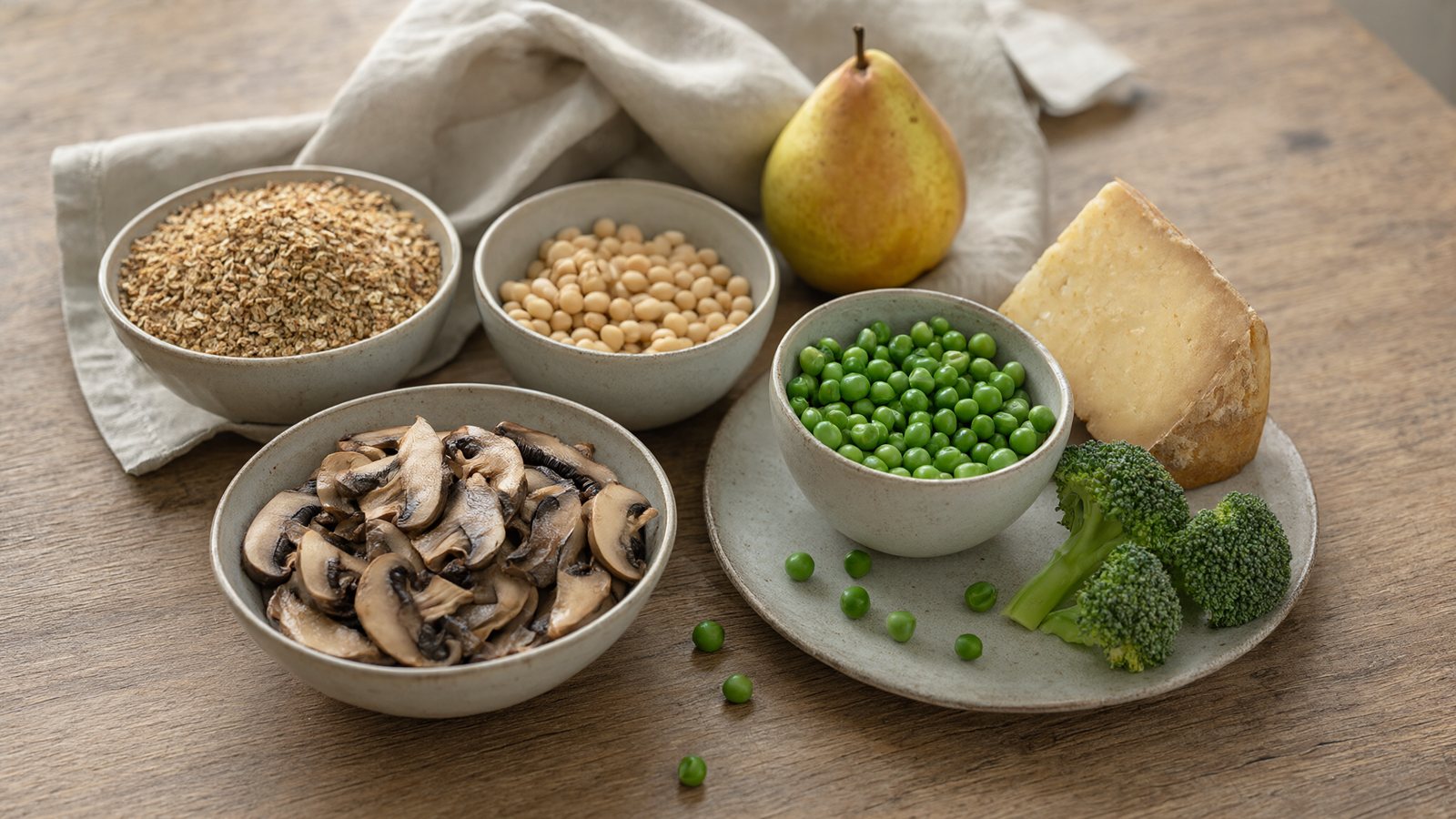
Foods high in spermidine, in short: by weight, wheat germ (about 35 mg per 100 g) and soybeans (about 21 mg per 100 g) lead the published data, while per everyday serving, cooked soybeans (9.7 mg in 190 g) and green peas (9.1 mg in 140 g) supply the most.
Key takeaways
- The foods high in spermidine that matter most per serving are legumes, green peas, mushrooms, whole grains and wheat germ.
- American adults aged 40 to 80 eat an estimated 7.9 mg of spermidine a day, so one serving of soybeans or peas can match a typical day’s intake.
- Aged cheese varies enormously: one-year cheddar tested near 200 mg per kg, while a Swedish matured cheese measured 1.2 mg per kg.
- Boiling can pull some polyamines into the cooking water, so soups, stews and steaming keep more of what you cook.
Foods High in Spermidine, Ranked by Serving
Concentration tables tell you which foods are dense in spermidine, but nobody eats 100 g of wheat germ. A serving view is more useful. In 2011, researchers at the Karolinska Institutet built a food polyamine database and published a list of the top food sources per typical portion. Their spermidine ranking appears below, with one column added: how each serving compares with the estimated US average intake of 7.9 mg a day.
| Food (as listed) | Portion | Spermidine per portion | Share of a typical US day (7.9 mg) |
|---|---|---|---|
| Soybeans, cooked | 190 g | 9.7 mg | 123% |
| Green peas | 140 g | 9.1 mg | 115% |
| Pear | 125 g | 6.6 mg | 84% |
| Lentil soup | 250 g | 5.5 mg | 70% |
| Mushrooms | 50 g | 4.4 mg | 56% |
| Red beans | 190 g | 3.7 mg | 47% |
| Broccoli | 100 g | 3.6 mg | 46% |
| Cauliflower | 100 g | 3.0 mg | 38% |
| Chicken | 125 g | 2.2 mg | 28% |
| Popcorn | 50 g | 2.1 mg | 27% |
| Cheese | 20 g | 2.0 mg | 25% |
| Potato, cooked | 150 g | 1.8 mg | 23% |
Source: portion values from Atiya Ali and colleagues in Food & Nutrition Research. The share column is our calculation against the US intake estimate discussed further down.
Two things stand out. Legumes dominate, which fits the wider data on soy and pulses. And a pear sits third, which surprises most people, because fruit is usually low in spermidine.
Values for the same food also move a lot between studies, depending on the variety, where it was grown, how long it was stored and how it was measured. Treat every figure here as a reasonable estimate, not a label value. For what the trials say spermidine does once you eat it, see our guide to what the spermidine research shows.
The Richest Sources by Weight: Wheat Germ, Soy, Mushrooms and Aged Cheese
A 2019 review of polyamines in food in Frontiers in Nutrition pulled together measurements from dozens of studies. It reported the highest spermidine values in cereals, legumes and soy products, with wheat germ at 2,437 nmol per gram and soybeans at 1,425 nmol per gram. Converted with spermidine’s molecular weight, that is roughly 35 mg per 100 g of wheat germ and 21 mg per 100 g of soybeans.
Wheat germ is the easiest of these to use in small amounts. A 15 g sprinkle over oatmeal or yogurt works out to about 5.3 mg of spermidine on those figures. It does contain gluten, so it is not an option for everyone.
Here is how other common foods compare by concentration, using the 2011 database:
- Mushrooms: 88.6 mg per kg on average in Japanese samples, with a range of 62.4 to 139.3 mg per kg.
- Green peas (frozen): 46.6 mg per kg.
- Corn: 43.2 mg per kg.
- Broccoli: 33.2 mg per kg.
- Chickpeas: 28.8 mg per kg.
- Whole grain bread: 24.4 mg per kg, against 5.1 mg per kg for white bread.
- Chicken liver: 48.7 mg per kg, though liver is better known for spermine.
Why aged cheese is a gamble
Aged cheese shows up on almost every spermidine food list, and the data behind it is the least consistent. UK samples of cheddar matured for one year measured 199.5 mg per kg, which would put about 5.6 mg in a 1 oz (28 g) slice. Fresh cheddar from the same work measured 80.8 to 109 mg per kg.
Yet when the Swedish team analyzed their own matured cheese, they found just 1.2 mg per kg. The 2019 review put most cheeses below 69 nmol per gram (roughly 10 mg per kg), with one blue cheese as an outlier near 38 mg per kg. Cheese can add spermidine, but you cannot count on a number from the label.
Foods that add very little
Fruit sits low on the whole, at about 1 to 14 mg per kg across the fruits in the review, pears being the exception noted above. Milk and yogurt come in under 1 mg per kg, and eggs are similarly low. Meat adds a modest amount of spermidine and more of its sister compound, spermine.
Trying spermidine in the US? Eternal Elixir’s Spermidine 10mg ships fast across the United States with 60 capsules per bottle. Browse the longevity range →
How Much Spermidine Do You Already Eat?
The same 2019 review gathered intake estimates from several countries. For US adults aged 40 to 80, the estimate was 54.7 µmol of spermidine a day, or about 7.9 mg. The European Union average was higher, at 87 µmol, or about 12.6 mg a day. Spain had the highest spermidine estimate of the European countries listed, at 103.1 µmol a day.
Why care about the number? The best known human data comes from the Bruneck study in northern Italy, published in the American Journal of Clinical Nutrition in 2018. It followed 829 adults aged 45 to 84 for 20 years, with diet assessed by dietitian interviews.
People who ate more spermidine had lower all-cause mortality. Each 1-standard-deviation step up in intake came with a hazard ratio of 0.74, and the gap between the top and bottom thirds of intake was similar to being 5.7 years younger. This is an observational link, so it cannot show that spermidine caused the difference, and spermidine-rich diets also tend to be rich in fiber and plants.
Animal work points the same way. In a 2016 study in Nature Medicine, oral spermidine extended lifespan in mice and helped preserve heart function in old animals, and the authors linked higher dietary spermidine with lower blood pressure in human food-questionnaire data.
Food, the trial dose and one capsule, side by side
The longest controlled human trial, SmartAge, gave 100 adults aged 60 to 90 a wheat germ extract supplying 0.9 mg of spermidine a day for 12 months. Published in JAMA Network Open, it found no change in memory performance against placebo, and side effects were similar in both groups. That trial dose is about a ninth of what the average American already eats. A single serving of peas supplies ten times as much.
The Eternal Elixir capsule contains 10 mg of spermidine trihydrochloride. The trihydrochloride is a salt form, and by molecular weight about 57% of it is spermidine itself, so one capsule supplies roughly 5.7 mg of spermidine. That is in the range of a serving of lentil soup or a handful of mushrooms and peas, and about 72% of the average US daily intake.
Easy Ways to Eat More Foods High in Spermidine
You do not need unusual ingredients. A plate of 140 g of green peas, 50 g of mushrooms and 100 g of broccoli adds up to about 17.1 mg on the database figures, a little over twice the US average intake. A few simple swaps cover most of the gap for people who eat few legumes:
- Add a portion of beans, lentils or soybeans to one meal a day. Edamame, lentil soup and chili all count.
- Choose whole grain bread over white. On the database figures, that swap alone is close to a fivefold difference.
- Sprinkle 15 g of wheat germ on breakfast if gluten is not a concern.
- Use mushrooms in place of part of the meat in sauces and stir-fries.
- Keep green peas and broccoli in the freezer for easy sides.
Does cooking destroy spermidine?
Partly, depending on the food. The 2019 review describes studies in which boiling spinach, cauliflower and potatoes lowered polyamine levels as they leached into the cooking water, with putrescine (the most water-soluble polyamine) losing the most. Boiled peppers, peas and asparagus showed no such losses, and another small study found no significant difference between raw and boiled carrots, broccoli, cauliflower and potatoes. Steaming, roasting, or eating the cooking liquid in a soup or stew is a simple way around the losses that were measured.
Food or a Spermidine Supplement?
For most people eating a varied diet, food is the main source and the cheapest. A supplement makes more sense in a few situations: you rarely eat legumes or whole grains, you avoid wheat germ for gluten reasons, or you want a fixed, measured amount every day instead of an estimate that shifts with each meal.
If that describes you, try Eternal Elixir Spermidine 10mg. It costs $49.99 for 60 capsules at one capsule per serving, or about $0.83 a serving. It is a single-ingredient formula, and every batch is third-party lab tested, with the certificate of analysis available on request. Be clear on the evidence, though: no trial has tested this exact product, and the SmartAge trial did not find a memory benefit at its dose.
Spermidine often sits alongside other compounds studied for healthy aging. Our Ca-AKG evidence review covers another single-ingredient option, and Eternal Elixir also makes Ca-AKG 500mg. For the polyphenol side, the pterostilbene benefits and dosage guide compares it with resveratrol. If you are pregnant, breastfeeding, managing a health condition or taking prescription medicine, talk with your clinician before adding any of these.
Foods High in Spermidine: Questions People Ask
What food is highest in spermidine?
By weight, wheat germ has the highest values in the published data, at about 35 mg per 100 g, followed by soybeans. Per everyday serving, cooked soybeans (9.7 mg in 190 g) and green peas (9.1 mg in 140 g) lead the portion rankings.
How can you get 20 mg of spermidine a day?
From food, 190 g of cooked soybeans, 140 g of green peas and 50 g of mushrooms add up to about 23.2 mg on the database figures. That is far above the US average of about 7.9 mg, and there is no established daily target for spermidine.
How do you increase spermidine naturally?
Eat more legumes, whole grains, mushrooms, peas and broccoli, and add wheat germ if gluten is not a problem. Keep the cooking water in soups and stews. If you are building a wider routine, our longevity supplements guide covers what else has human data.
Is spermidine hard on the liver?
The amounts in food are part of a normal diet. In the 12-month SmartAge trial, adverse events were balanced between the spermidine and placebo groups. If you have a liver condition or take medicines that affect the liver, check with your clinician before taking a supplement.
Does spermidine regrow hair?
None of the food or trial studies cited here measured hair growth. The evidence is not strong enough to recommend spermidine foods or capsules for hair regrowth.
Ready to start your longevity stack?
Full-size bottles · Fast US shipping · Third-party tested
Shop Eternal Elixir →Recommended for you
About Eternal Elixir
Eternal Elixir is a supplement company specializing in longevity and nootropic formulations. All products are third-party tested for purity, manufactured under strict quality controls, and ship fast across the United States. Browse the full range at eternalelixir.com/shop.
Sources
- Atiya Ali M, et al. Polyamines in foods: development of a food database. Food & Nutrition Research. 2011. PMID 21249159
- Muñoz-Esparza NC, et al. Polyamines in Food. Frontiers in Nutrition. 2019. PMID 31355206
- Kiechl S, et al. Higher spermidine intake is linked to lower mortality: a prospective population-based study. The American Journal of Clinical Nutrition. 2018. PMID 29955838
- Eisenberg T, et al. Cardioprotection and lifespan extension by the natural polyamine spermidine. Nature Medicine. 2016. PMID 27841876
- Schwarz C, et al. Effects of spermidine supplementation on cognition and biomarkers in older adults with subjective cognitive decline: a randomized clinical trial. JAMA Network Open. 2022. PMID 35616942