Last updated: · Originally published August 22, 2026 · Published by Eternal Elixir
Edited by Elaine Fletcher, Researcher
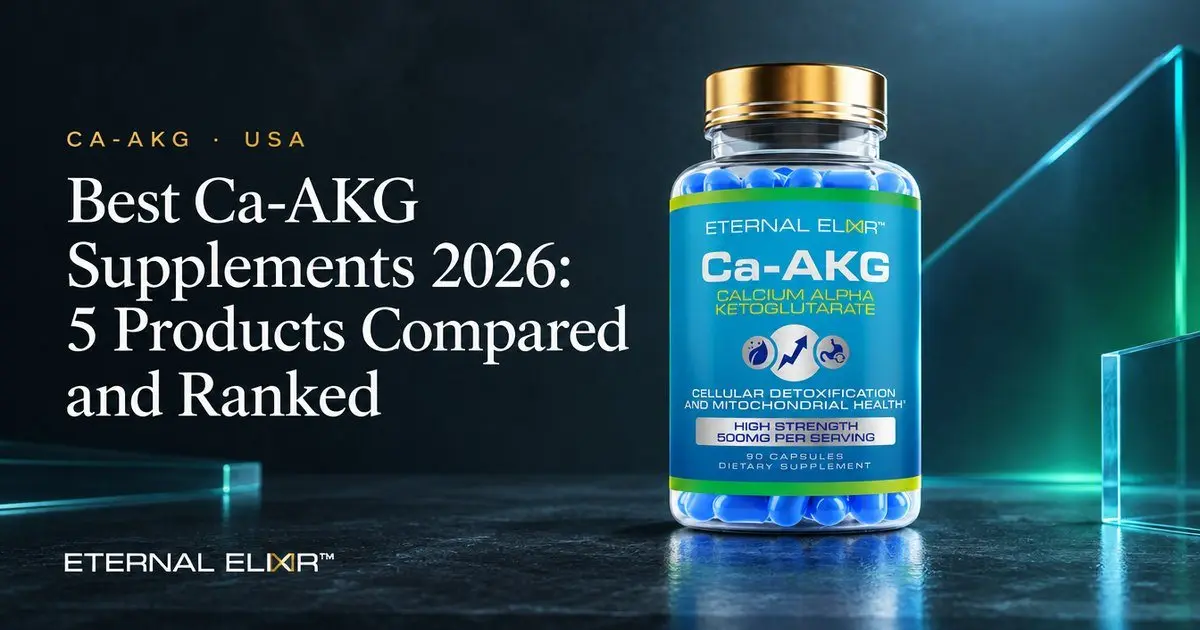
The best Ca-AKG supplements in 2026 have one thing in common: the ingredient line on the label says “calcium alpha-ketoglutarate”. That sounds obvious, but search for Ca-AKG in the US and you will find bottles of free-acid AKG and arginine AKG sold beside it under the same three letters, at doses from 300 mg to 1,500 mg and prices that differ several-fold per gram.
This guide compares five AKG products US buyers can order today. We normalize every price to cost per labeled serving and cost per 1,000 mg of the labeled active, flag the one product that uses a different form, and set out what the research on Ca-AKG actually shows in mice and in people. One of the five is our own Eternal Elixir Ca-AKG 500mg, and it is our pick for the reasons in its entry. Where a competitor beats it, on price per gram for example, we say so.
Quick answer
- Our pick: Eternal Elixir Ca-AKG 500mg. 500 mg of calcium alpha-ketoglutarate in one capsule, one capsule per serving, 60 servings for $49.99 ($0.83 per serving).
- Lowest cost per gram of true Ca-AKG: Toniiq Calcium AKG 1500, $0.42 per 1,000 mg, with a published certificate of analysis.
- Clearest calcium disclosure: ProHealth Calcium AKG Longevity, which lists 180 mg of calcium per 1,000 mg serving.
- Cheapest per gram overall: Double Wood AKG, $0.33 per 1,000 mg, but it is free-acid AKG, not the calcium salt used in the mouse lifespan study.
- The evidence in one line: strong mouse data, one small human trial on a bone marker at a much higher dose, and no completed human trial on aging outcomes yet.
Read the label first: Ca-AKG, free-acid AKG and AAKG
Before comparing prices, check which molecule is in the bottle. Three different compounds are sold as “AKG” in the US, and they are not interchangeable.
Calcium alpha-ketoglutarate (Ca-AKG)
This is alpha-ketoglutaric acid bound to calcium as a mineral salt. It is the form used in the 2020 mouse lifespan study that the whole category cites, and the form in four of the five products below. Part of its weight is calcium. The two labels here that break it out show calcium at close to a fifth of the weight: ProHealth lists 180 mg of calcium in a 1,000 mg serving, and Renue By Science lists 60 mg of calcium and 240 mg of AKG in each 300 mg capsule.
Free-acid AKG (alpha-ketoglutaric acid)
This is the unbound acid. Per milligram it delivers more AKG, because no mineral is attached, and it is more acidic than the calcium salt, which some people find harder on the stomach. Double Wood sells this form and says so on its product page. It is a reasonable product, but it is not the compound in the mouse lifespan study.
AAKG (arginine alpha-ketoglutarate)
This is AKG bound to the amino acid arginine. It comes from sports nutrition, where it is sold as a pre-workout ingredient, not from longevity research. None of the five products below is AAKG, but it shows up in the same search results. Double Wood’s page makes the same point: “Don’t confuse AKG with AAKG.”
The practical rule is simple. Turn the bottle around and read the Supplement Facts panel, not the front label. If the ingredient line doesn’t say calcium alpha-ketoglutarate, you are not buying the compound from the longevity studies. For more on the mechanism, see our Ca-AKG benefits and evidence review.
Best Ca-AKG supplements 2026 compared
Prices are each brand’s one-time price, as of Sep 2026. Two cost columns are shown. “Cost per serving” uses the serving printed on each label. “Cost per 1,000 mg” divides the bottle price by the total labeled active in the bottle, which is the fair way to compare a 300 mg capsule with a 1,500 mg serving.
| Rank | Product | Form | Labeled serving | Servings | Price | Cost per serving | Cost per 1,000 mg | Buy |
|---|---|---|---|---|---|---|---|---|
| 1 | Eternal Elixir Ca-AKG 500mg | Ca-AKG | 500 mg, 1 capsule | 60 | $49.99 | $0.83 | $1.67 | View Ca-AKG 500mg |
| 2 | Toniiq Calcium AKG 1500 | Ca-AKG, 99%+ stated purity | 1,500 mg, 3 capsules | 40 | $24.97 | $0.62 | $0.42 | Toniiq |
| 3 | ProHealth Calcium AKG Longevity | Ca-AKG | 1,000 mg, 2 capsules | 30 | $25.25 | $0.84 | $0.84 | ProHealth |
| 4 | Double Wood AKG | Free-acid AKG (not Ca-AKG) | 1,000 mg, 2 capsules | 90 | $29.95 | $0.33 | $0.33 | Double Wood |
| 5 | Renue By Science CaAKG | Liposomal Ca-AKG | 300 mg, 1 capsule | 90 | $48.95 | $0.54 | $1.81 | Renue By Science |
Three things stand out. Cost per 1,000 mg varies more than fivefold across the five. The two cheapest per gram are the products with the largest servings, Toniiq and Double Wood. And Double Wood’s low figure is for a different molecule, so it isn’t directly comparable with the Ca-AKG rows. Because Ca-AKG carries calcium weight, 1,000 mg of Ca-AKG holds less AKG than 1,000 mg of the free acid.
How we ranked these Ca-AKG supplements
We weighed five things, the same way for every product:
- Form. Calcium alpha-ketoglutarate, the compound in the lifespan research, ranks ahead of other forms.
- Dose per labeled serving and daily routine. How many capsules a serving takes, and how long a bottle lasts at the label serving.
- Cost. Per labeled serving and per 1,000 mg of labeled active, from live prices and label panels.
- Label and testing transparency. Whether the calcium fraction is disclosed, and whether a batch certificate of analysis is published on the product page.
- How honestly the evidence is presented. Whether the product page separates mouse data from human data.
Eternal Elixir makes Ca-AKG 500mg, and it is our pick. The other four are ordered on the criteria above. Every figure for them comes from their own labels and product pages, and each is linked in the table so you can check it. Toniiq beats our product on cost per gram, and we say so in both entries.
What the Ca-AKG research shows, and what it doesn’t
This is where most Ca-AKG roundups get vague, so here are the specifics, with the evidence level for each.
Evidence level: preclinical (mouse lifespan study)
The study everyone cites is Asadi Shahmirzadi and colleagues, Cell Metabolism, 2020. Researchers switched 182 mice at 18 months of age, roughly middle age for a mouse, to a diet with 2% calcium alpha-ketoglutarate by weight. In the first group of female mice, median lifespan rose by 16.6% and survival at the 90th percentile by 19.7%. A second group of females showed smaller gains. The lifespan effect was seen in females. Frailty improved in both sexes: the share of life spent frail fell by 46% in females and 41% in males.
Two caveats deserve more attention than they usually get. First, this is a mouse study, and mouse lifespan results often don’t carry over to people. Second, the authors list among their own limitations that the control diet lacked calcium. Because the intervention was a calcium salt, part of the effect can’t be cleanly separated from the calcium. Several authors held shares in Ponce de Leon Health, the company behind the Rejuvant AKG formula, and several are named on a related patent application.
Evidence level: one small human trial, on a bone marker, at a high dose
The only randomized human trial of the calcium salt we found with results is older and narrower. Filip and colleagues (International Journal for Vitamin and Nutrition Research, 2007) gave 76 postmenopausal women with low bone density either 6 g of AKG with 1.68 g of calcium a day or calcium alone, for six months. The AKG group showed a significant fall in CTX, a blood marker of bone breakdown. Bone mineral density in the AKG group rose 1.6% from baseline, but the difference between groups (0.9%) was not significant. The daily AKG dose was also many times what any capsule below provides.
Evidence level: retrospective, uncontrolled human data
The most-quoted human figure comes from a 2021 paper in Aging by Demidenko and colleagues. It looked back at DNA methylation tests from 42 people taking Rejuvant, a commercial formula of alpha-ketoglutarate plus vitamins, for an average of seven months, and reported an average fall in estimated biological age of 8 years. There was no placebo group, the analysis was retrospective, one author sat on the board of the company that sells the formula, and a methylation clock is an estimate, not a health outcome. The authors themselves say placebo-controlled testing is needed.
Evidence level: a randomized trial under way
The ABLE trial in Singapore is the first proper test in healthy middle-aged people. It randomized 120 adults aged 40 to 60 whose DNA methylation age was higher than their calendar age to 1 g a day of sustained-release Ca-AKG or a placebo for six months, with three months of follow-up. Enrollment is complete (59 on Ca-AKG and 61 on placebo, half of them women), but we found no published main results as of September 2026.
The honest summary: Ca-AKG has a clear role in cell metabolism, one strong mouse lifespan result with a calcium caveat the authors flagged themselves, a small human trial on a bone marker at a much higher dose, and a proper human trial whose results aren’t out yet. It has not been shown to extend human lifespan. Our own product page says exactly that.
1. Eternal Elixir Ca-AKG 500mg: our pick
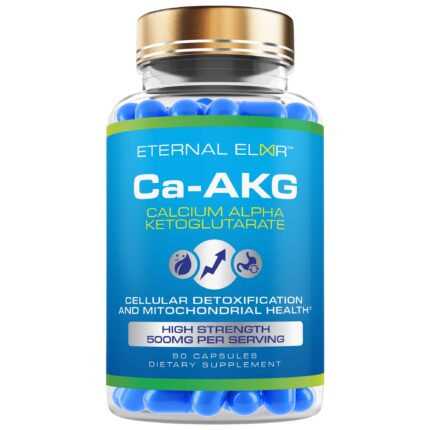
Label facts: 500 mg of calcium alpha-ketoglutarate per capsule, one capsule per serving, 60 capsules and 60 servings per bottle. $49.99, which is $0.83 per serving and $1.67 per 1,000 mg. The ingredient list is calcium alpha-ketoglutarate, rice flour and a cellulose capsule.
Eternal Elixir makes Ca-AKG 500mg, and it is our pick for three reasons.
One capsule is the whole serving. Every other Ca-AKG product here asks for two or three capsules per serving, apart from Renue’s much smaller 300 mg capsule. Ours puts a full 500 mg in a single capsule, so the daily routine is one capsule and one bottle lasts two months. For people who already take several supplements, fewer capsules a day is a real, practical difference.
The form is stated plainly. The label names calcium alpha-ketoglutarate, the compound from the mouse lifespan study, rather than an unspecified “AKG”.
The product page doesn’t oversell. It says, on the sales page itself, that “Human longevity benefit has not been established” and that the research “was conducted in mice; extrapolating its lifespan or frailty findings directly to people would be inappropriate.” It labels the evidence as preclinical. That is unusual for a page whose job is to sell a capsule, and it is the standard we hold across our longevity range.
Where it loses: it is not the cheap option. At $1.67 per 1,000 mg it costs about four times Toniiq’s figure and about twice ProHealth’s, so if cost per gram is your only criterion, Toniiq is the better buy. We don’t publish a downloadable batch certificate on the product page the way Toniiq and ProHealth do.
Who it suits: anyone who wants a one-capsule daily routine with the studied form, and anyone building a longevity stack from one supplier. Bundles of two, three or five bottles are discounted in the cart, and US orders over $100 ship free.
Who it doesn’t suit: buyers shopping purely on price per gram, and anyone who wants a 1,000 mg or 1,500 mg serving from a single product’s label.
2. Toniiq Calcium AKG 1500: lowest cost per gram of true Ca-AKG
Label facts: 120 capsules at $24.97, with directions to take three capsules daily for a 1,500 mg serving. That makes 40 servings, $0.62 per serving and $0.42 per 1,000 mg, the lowest cost per gram of any calcium AKG product in this comparison.
Toniiq states a purity of 99%+ for its calcium alpha-ketoglutarate and publishes a certificate of analysis on the product page. It describes a five-point testing program for each lot: microbiology and heavy metals in the raw material and in the finished product, plus an assay of the active ingredient at both stages and a fill-weight check. For a bulk ingredient where raw-material quality varies between suppliers, that documentation is worth having. Toniiq offers free US shipping on orders over $49 and a 60-day money-back guarantee.
Who it suits: anyone who wants the studied compound at the lowest price per gram and values a published lab certificate.
Who it doesn’t suit: anyone who doesn’t want three capsules a day, and anyone who wants a smaller daily serving than 1,500 mg from the label.
3. ProHealth Calcium AKG Longevity: clearest calcium disclosure
Label facts: 60 capsules at $25.25, two capsules per serving for 1,000 mg of calcium alpha-ketoglutarate, 30 servings. That is $0.84 per serving and $0.84 per 1,000 mg.
ProHealth earns its place with the label. Its Supplement Facts panel lists 180 mg of calcium (14% of the daily value) alongside the 1,000 mg of calcium alpha-ketoglutarate. That is the mineral fraction most brands leave you to work out, and it matters if you already take a calcium supplement or a multivitamin. The product page also links a certificate of analysis. The other ingredients are just a hypromellose capsule and rice flour.
Who it suits: buyers who want the clearest label and a simple one-month bottle at a 1,000 mg serving.
Who it doesn’t suit: anyone comparing on cost per gram, where it costs twice Toniiq’s figure, and anyone who wants more than a month per bottle.
4. Double Wood AKG: cheapest per gram, but not calcium AKG
Label facts: 180 capsules at $29.95, two capsules per serving for 1,000 mg of AKG, 90 servings. That is $0.33 per serving and per 1,000 mg, and a three-month bottle. Double Wood’s page recommends two capsules a day as a daily supplement and advises not going over four a day.
Double Wood sells the cheapest AKG here, and it still sits fourth for one reason: it is alpha-ketoglutaric acid, the free acid, not calcium alpha-ketoglutarate. The brand is open about this and warns buyers not to confuse AKG with AAKG. Its own description adds that the longevity effect “has been established in multiple animal studies but there has yet to be any human trials to see if this benefit is also true for humans”. That is a fair summary.
Free-acid AKG gives you more AKG per milligram because no calcium is attached, and it adds no calcium to your day. The trade-off is acidity, which some people find harder to tolerate than the calcium salt. Double Wood offers free US shipping on orders over $30. We cover the brand in more depth in our Double Wood Supplements review.
Who it suits: buyers who specifically want free-acid AKG, understand the form difference, and want the lowest price per gram.
Who it doesn’t suit: anyone buying because of the calcium AKG mouse data, and anyone with a sensitive stomach.
5. Renue By Science CaAKG: the liposomal option
Label facts: 90 capsules at $48.95, 300 mg of calcium alpha-ketoglutarate per capsule in a powdered liposomal format, one capsule per serving, 90 servings. That is $0.54 per serving but $1.81 per 1,000 mg, the highest cost per gram here. The page breaks each capsule down as 60 mg of calcium and 240 mg of AKG, and lists third-party testing.
Renue competes on delivery rather than milligrams. Liposomal encapsulation is a reasonable idea in principle, but we found no published human study comparing liposomal Ca-AKG with a standard capsule, so the absorption advantage is a hypothesis you pay extra for, not an established fact. The 300 mg serving is also the lowest here, well below the 1 g a day used in the ABLE trial. We looked at the brand’s wider range in our Renue By Science NMN review.
Who it suits: buyers committed to liposomal formats who want a low daily dose in one capsule.
Who it doesn’t suit: anyone comparing on cost per gram or looking for a dose closer to the human trials.
How much Ca-AKG per day?
There is no established human dose. Here is what the research and the labels use:
- Mouse study: 2% of the diet by weight. Mouse diet doses don’t convert neatly into a human milligram figure.
- ABLE trial (results pending): 1 g a day of a sustained-release Ca-AKG.
- Filip 2007 bone-marker trial: 6 g of AKG with 1.68 g of calcium a day, far above any capsule here.
- Labels in this comparison: 300 mg (Renue), 500 mg (Eternal Elixir), 1,000 mg (ProHealth and Double Wood) and 1,500 mg (Toniiq) per labeled serving.
The common 1,000 mg figure on US labels comes from market convention, not from a dose-finding trial in people. Whichever product you choose, take it as its own label directs and don’t go above the labeled serving. Our label is one 500 mg capsule per serving.
Calcium and safety: count the total
Ca-AKG adds calcium to your day. A 1,000 mg serving of ProHealth adds 180 mg, for example, and a Renue capsule adds 60 mg. If you already take a calcium supplement or a multivitamin with calcium, add the Ca-AKG contribution to your total.
Talk to your doctor before taking Ca-AKG if any of these apply:
- You take prescription medicine, or you have been told to limit calcium.
- You have kidney problems or a history of kidney stones.
- You are pregnant, trying to conceive or breastfeeding. Ca-AKG hasn’t been studied in pregnancy.
- You notice stomach upset or other new symptoms after starting it. Stop and check with your doctor.
Ca-AKG is a structure-and-function supplement that supports normal cell metabolism. It is not a substitute for medical care.
Building a Ca-AKG stack without doubling up
Most people take Ca-AKG as one part of a longevity stack rather than on its own. Two practical cautions come first. Watch your total calcium, as above. And don’t start several new products in the same week, or you won’t know which one did what.
On the pairings themselves: NAD+ precursors work on a different pathway, which is why our NMN 500mg is the most common partner. Our NMN supplement comparison covers that category in the same cost-normalized format, and if you are weighing NMN against nicotinamide riboside, start with our NAD+ booster comparison or our nicotinamide riboside comparison.
For the autophagy pathway, Spermidine 10mg is the usual addition, compared in our spermidine roundup. For polyphenols, Trans-Resveratrol 600mg and Trans-Pterostilbene 500mg are the two most often stacked, covered in our resveratrol guide and pterostilbene comparison. Our guide to longevity stacks works through sensible combinations.
The verdict: which Ca-AKG supplement should you buy?
Our pick: Eternal Elixir Ca-AKG 500mg. It is the only product here with a full 500 mg of calcium alpha-ketoglutarate in a one-capsule serving, it gives 60 servings per bottle, and its product page states the evidence level plainly. It costs more per gram, at $1.67 per 1,000 mg.
If you want the lowest price on the studied compound: Toniiq Calcium AKG 1500, at $0.42 per 1,000 mg with 99%+ stated purity and a published certificate of analysis.
If you want the clearest label: ProHealth Calcium AKG Longevity, which declares the calcium fraction and gives a clean 30-day bottle.
If price per gram is all that matters and you understand the form difference: Double Wood AKG at $0.33 per 1,000 mg, with the caveat that free-acid AKG is not the compound in the mouse lifespan study.
If you are committed to liposomal formats: Renue By Science CaAKG, accepting the highest cost per gram for a delivery claim that hasn’t been tested head to head in people.
Whichever you choose, buy on the Supplement Facts panel rather than the front label, and hold the category to the evidence that exists: one strong mouse study with a calcium caveat, one small human trial on a bone marker, and a human aging trial whose results are still to come.
Frequently asked questions about Ca-AKG supplements
What is the best Ca-AKG supplement?
Our pick is Eternal Elixir Ca-AKG 500mg, because it puts a full 500 mg of calcium alpha-ketoglutarate in a one-capsule serving, gives 60 servings per bottle, and states plainly that the lifespan evidence comes from mice. If cost per gram matters most, Toniiq Calcium AKG 1500 is the cheapest true Ca-AKG in our comparison at $0.42 per 1,000 mg.
What is Ca-AKG used for?
Ca-AKG is taken as a healthy-aging supplement that supports normal cell metabolism. Alpha-ketoglutarate is a central step in the citric acid cycle, the pathway cells use to produce energy. Interest in it comes from a 2020 mouse study in which a Ca-AKG diet extended lifespan in female mice and reduced frailty in both sexes. In people, it has not been shown to extend lifespan.
What is the difference between AKG and Ca-AKG?
Ca-AKG is alpha-ketoglutarate bound to calcium, and it is the form used in the mouse lifespan study. Free-acid AKG has no mineral attached, so it delivers more AKG per milligram, but it is more acidic. AAKG is AKG bound to arginine, a sports-nutrition ingredient. Check the Supplement Facts panel to see which one you are buying.
How much Ca-AKG should I take per day?
There is no established human dose. US labels range from 300 mg to 1,500 mg per serving, and the ABLE trial is testing 1 g a day. Take any product as its own label directs and don’t exceed the labeled serving. Our Ca-AKG 500mg label is one capsule per serving.
Is there any human evidence for Ca-AKG?
A little. A 2007 trial in 76 postmenopausal women found that a high dose of AKG with calcium lowered a blood marker of bone breakdown compared with calcium alone, without a significant difference in bone density. A 2021 study of 42 people taking an AKG formula reported a lower estimated biological age, but it had no placebo group. The randomized ABLE trial in 120 middle-aged adults has finished enrolling, and its results aren’t published yet.
Does Ca-AKG contain calcium?
Yes. Calcium is part of the salt’s weight. ProHealth’s label lists 180 mg of calcium in a 1,000 mg serving, and Renue’s lists 60 mg in a 300 mg capsule. If you already take a calcium supplement, count the Ca-AKG contribution toward your total, and talk to your doctor if you have been told to limit calcium.
Does Ca-AKG need to be liposomal?
We found no published human study showing liposomal Ca-AKG is absorbed better than a standard capsule. A standard Ca-AKG capsule is the better-evidenced default, and it costs much less per gram.
Is Ca-AKG or NMN the better first purchase?
They work on different pathways. NMN is a NAD+ precursor with several human trials behind it. Ca-AKG’s longevity evidence is mostly from mice. If you want the ingredient with more human data, most buyers start with NMN. If you already take a NAD+ precursor and want to add something that works on a different pathway, Ca-AKG is a reasonable second product.
Where can I buy Ca-AKG in the US?
All five products here ship within the US from their brands’ own sites. Eternal Elixir sells direct, ships in 24 hours, and offers free shipping on US orders over $100. Buying direct from a brand usually gives clearer batch traceability than a third-party marketplace listing.
Sources
- Asadi Shahmirzadi A, Edgar D, Liao CY, et al. Alpha-ketoglutarate, an endogenous metabolite, extends lifespan and compresses morbidity in aging mice. Cell Metab. 2020;32(3):447-456. PubMed 32877690
- Filip RS, Pierzynowski SG, Lindegard B, et al. Alpha-ketoglutarate decreases serum levels of C-terminal cross-linking telopeptide of type I collagen (CTX) in postmenopausal women with osteopenia: six-month study. Int J Vitam Nutr Res. 2007;77(2):89-97. PubMed 17896582
- Demidenko O, Barardo D, Budovskii V, et al. Rejuvant, a potential life-extending compound formulation with alpha-ketoglutarate and vitamins, conferred an average 8 year reduction in biological aging, after an average of 7 months of use, in the TruAge DNA methylation test. Aging (Albany NY). 2021;13(22):24485-24499. PubMed 34847066
- Sandalova E, Goh J, Lim ZX, et al. Alpha-ketoglutarate supplementation and BiologicaL agE in middle-aged adults (ABLE): intervention study protocol. Geroscience. 2023;45(5):2897-2907. PubMed 37217632
- Lu JK, Wang W, Chew YE, et al. Optimizing accelerometer implementation in a gerotherapeutic trial: feasibility, adherence, and operational insights of ABLE. PLOS Digit Health. 2026;5(9):e0001691. PubMed 42789532
- Product pages for label facts and prices (September 2026): Eternal Elixir Ca-AKG 500mg, plus the Toniiq, ProHealth, Double Wood and Renue By Science pages linked in the comparison table.
More buying guides: our Nutricost review, mitochondrial supplements compared, the full Eternal Elixir range, all supplement guides and the Eternal Elixir blog.