Last updated: · Originally published August 7, 2026 · Published by Eternal Elixir
Edited by Elaine Fletcher, Researcher
Most pages on ginseng benefits and dosage list energy, focus, immunity, blood sugar and libido, then stop. They rarely say which species was tested, how much, for how long, or whether the result held up. This 2026 guide does that work. It separates the plants sold as “ginseng”, sets out what the human trials measured, gives each benefit an evidence level, and explains how to turn a label into a dose you can compare with the research.
Quick answer
- Best-supported benefits: less mental fatigue and lower perceived stress in small randomized trials, and a pooled result for men’s sexual function built from low-quality trials. Each has a real but modest evidence base.
- Mixed or weak: memory and focus, blood sugar, colds, athletic performance. Some trials are positive, pooled results are small or inconsistent.
- Typical dose in trials: 200 mg to 400 mg of a concentrated extract, or 1 g to 2 g of root extract or red ginseng a day, for 3 to 12 weeks. The ginsenoside content matters more than the milligram figure.
- Safety: 2 g a day of Korean red ginseng for 24 weeks was well tolerated in a 1,000-person trial. Ginseng can weaken warfarin and may lower blood sugar, so check with your doctor if you take any medicine.
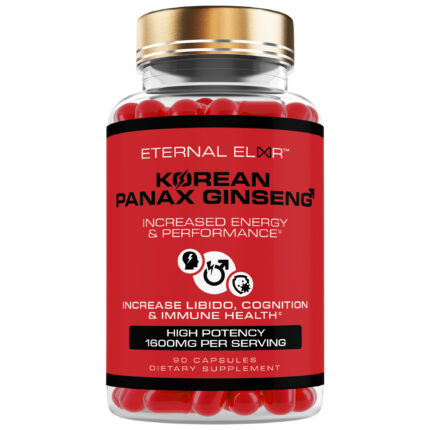
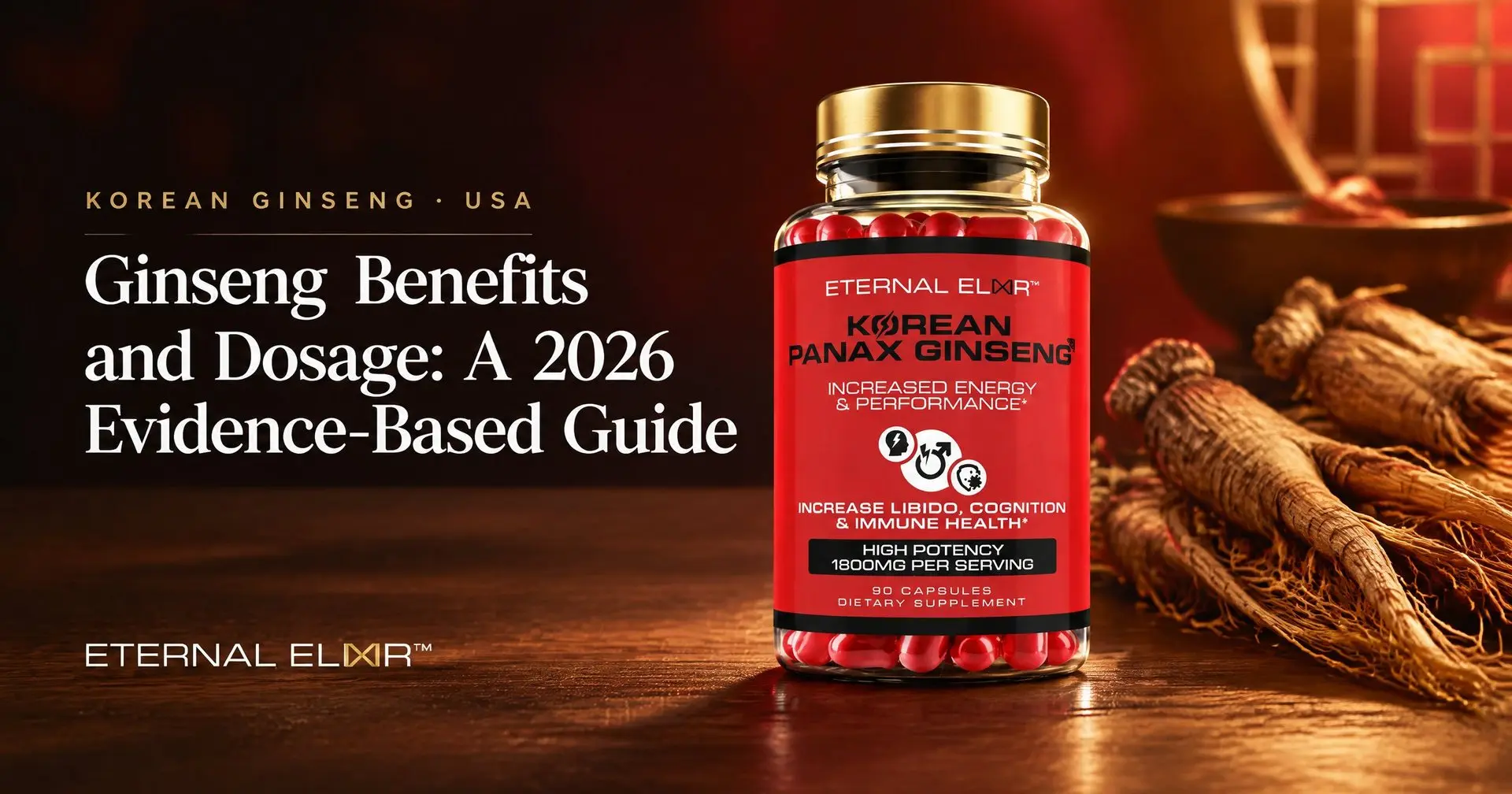
- Our pick: Eternal Elixir Korean Panax Ginseng 1600mg, a Korean red Panax ginseng extract standardized to at least 5% ginsenosides, 1,600 mg per two-capsule serving.
Ginseng benefits at a glance: what the evidence supports
Here is the short version before the detail. Each row names the strongest human evidence we found and how much weight it can carry. “Evidence level” is our summary of the study type, size and consistency, not a verdict on whether ginseng will work for you.
| Benefit | Strongest human evidence | Evidence level | Doses studied |
|---|---|---|---|
| Fatigue and energy | Systematic review of 10 studies (2018), plus randomized trials | Moderate, mixed: some trials positive, a 2024 trial missed its main goal | 1 g to 2 g a day for 4 to 12 weeks |
| Perceived stress and mood | Randomized trial in 149 stressed adults (2025) | Limited but clean: one good 3-week trial | 200 mg a day of a rare-ginsenoside root powder |
| Memory and focus | Cochrane review (2010) and a meta-analysis of 15 trials (2024) | Weak to modest: small memory effect, no effect on overall cognition | Varied widely between trials |
| Men’s sexual function | Meta-analysis of 6 placebo-controlled trials, 349 men (2008) | Moderate effect, low-quality trials | Varied between trials |
| Blood sugar | Meta-analysis of 16 trials (2014) | Modest: small drop in fasting glucose only | Varied, for 30 days or more |
| Colds | Randomized trial of an American ginseng extract, 323 adults (2005) | Limited: one product, one season | 2 capsules a day for 4 months |
| Physical performance | Assorted small trials | Weak: little effect on objective measures | Varied |
| Skin and hair (taken by mouth) | Mostly lab and topical studies | Very limited | Not established |
What ginseng actually is
True ginseng is the root of slow-growing plants in the genus Panax. The name comes from the Greek panakes, “all-healing”, which says a lot about the expectations placed on it long before anyone ran a controlled trial. The roots spend several years in the ground before harvest, which is why genuine ginseng is expensive and why the market has a long history of underdosed and mislabeled products.
The four plants sold as “ginseng”
Only two of the four plants sold as ginseng are true ginseng. Mixing them up is one of the most common reasons people decide ginseng “did nothing”.
| Common name | Species | True Panax? | Most studied for |
|---|---|---|---|
| Korean, Asian or red ginseng | Panax ginseng | Yes | Fatigue, sexual function, stress |
| American ginseng | Panax quinquefolius | Yes | Blood sugar, colds, focus |
| Siberian “ginseng” | Eleutherococcus senticosus | No | Endurance (a separate literature) |
| Indian “ginseng” | Withania somnifera (ashwagandha) | No | Stress and sleep |
Siberian ginseng and ashwagandha are useful plants in their own right. They simply aren’t ginseng, and no ginseng trial result carries over to them.
Red vs white ginseng
Red and white ginseng come from the same species. The difference is processing. White ginseng is peeled and air-dried. Red ginseng is steamed with the skin on and then dried, which darkens the root and converts some of its ginsenosides into smaller forms that are absorbed more easily. Korean red ginseng dominates the clinical literature, so when a study reports a result for “Korean red ginseng”, it usually tested a steamed extract, not raw root powder.
Ginsenosides: the compounds behind the benefits
Ginsenosides are saponins, a group of plant compounds, and they are the markers used to standardize ginseng extracts. Dozens have been identified. A handful, including Rb1, Rg1, Rg3 and Rd, account for most of the research interest. Steaming and gut bacteria convert the larger ginsenosides into smaller “rare” ones such as compound K, which the body absorbs more readily.
The practical point is simple. Two bottles that both say “1,600 mg ginseng” can deliver very different amounts of ginsenosides. The standardization percentage on the label is the number that lets you compare products with each other and with the research.
Ginseng forms: capsules, tea, extract and powder
The same root reaches you in quite different formats, and they are not interchangeable on dose. This is the second most common reason for an underwhelming result.
| Format | Ginsenoside content | Dose control | Best for |
|---|---|---|---|
| Standardized extract capsules | Stated on the label | Precise | Following a research-based dose |
| Root powder capsules | Usually unstated, often low | Poor | Traditional use at low strength |
| Ginseng tea | Low and variable | Very poor | Taste and ritual |
| Liquid extract or tincture | Sometimes stated | Moderate | People who dislike capsules |
| Sliced dried root | Depends on preparation | Poor | Traditional simmered preparations |
Why ginseng tea is mostly a drink
Ginseng tea is one of the most searched forms, and it deserves a straight answer. Most tea bags hold a small amount of root, often blended with other herbs. Ginsenosides don’t dissolve readily in water, so a short steep pulls out only part of what is in the root. Traditional preparations simmer sliced root for hours for exactly that reason. Enjoy ginseng tea as a drink, but don’t expect it to match the doses used in the trials.
Where powders fit
Bulk root powder is cheap, and that is most of the argument for it. Without standardization you can’t know the ginsenoside content, and natural products vary from batch to batch. If you want to follow the dose from a published trial, a standardized extract is the format that lets you do it with some confidence.
Ginseng dosage: how much to take
There is no single correct ginseng dose. Trials have used anything from 200 mg of a concentrated preparation to 2 g a day of red ginseng or root extract. What follows is a way to reason from the research to a sensible dose, rather than copying a number from a forum.
Step 1: Check the extract ratio or standardization
An extract ratio such as 20:1 means 20 parts of raw root went into 1 part of extract, so 200 mg of a 20:1 extract is not comparable to 200 mg of plain root powder. If a label gives no ratio and no standardization, treat it as root powder and expect to need more of it.
Step 2: Work out the ginsenosides per serving
A stated minimum ginsenoside percentage is the most useful number on a ginseng label. Multiply it by the serving. A 1,600 mg serving standardized to 5% gives at least 80 mg of ginsenosides. The 2025 stress trial described below used 200 mg of a root powder that supplied 24 mg of ginsenosides a day, so concentration, not raw milligrams, is what lines up across studies.
Step 3: Match the dose to the outcome
| Research area | Daily dose in trials | Duration | Species used |
|---|---|---|---|
| Fatigue | 1 g to 2 g of extract or red ginseng | 4 to 12 weeks | Asian (Korean) |
| Perceived stress | 200 mg of a rare-ginsenoside root powder | 3 weeks | Red Panax ginseng |
| Mental performance | 200 mg to 400 mg of extract, single doses | Same day | Asian |
| Men’s sexual function | Varied between trials | Varied | Korean red |
| Blood sugar | Varied between trials | 30 days or longer | Asian and American |
| Long-term safety | 2 g of Korean red ginseng | 24 weeks | Korean red |
These are the ranges the published trials used, not a prescription for any individual. Follow the label on the product you buy.
Step 4: Time it for the day, not the evening
Many people find red Panax ginseng mildly stimulating. Trouble sleeping is the side effect reported most often, so take it in the morning or early afternoon. Taking it with food can ease the stomach upset some people notice.
Step 5: Give it long enough
Most trials that found an effect ran for at least three to four weeks. Judging ginseng after three days tells you almost nothing. Give a fixed dose four to six weeks, change one thing at a time, and write down what you are tracking before you start.
Ginseng benefits for energy and fatigue
Fatigue is where ginseng has its longest record and its most consistent, if modest, results. It is also where study quality varies most.
- Arring and colleagues, 2018 systematic review. The review looked at Asian and American ginseng for fatigue in people living with long-term illness. Ten studies met its criteria. The authors found a low risk of adverse events and modest evidence of benefit, and called for larger, better-designed trials.
- Kim and colleagues, 2013 randomized trial. 90 adults (21 men and 69 women) with long-lasting fatigue of no known cause took 1 g or 2 g a day of a Panax ginseng extract or a placebo for four weeks. The total fatigue score didn’t differ significantly from placebo. The mental fatigue score improved with both doses, and only 2 g significantly reduced fatigue on a visual scale.
- Cho and colleagues, 2024 randomized trial. 120 patients with long-term autoimmune joint and gland conditions (97.5% women, average age about 51) took 2 g a day of Korean red ginseng or a placebo for 12 weeks. More people improved on ginseng (38.3% vs 26.7%), but the difference was not statistically significant (p = 0.242). Both groups reported less fatigue.
Evidence level: moderate and mixed. The better signal is for how tired people feel, especially mentally, not for objective endurance. The 2024 trial, one of the better-designed in the area, did not beat placebo.
What that means in practice
Ginseng is not a stimulant in the caffeine sense, and it doesn’t produce a sharp lift. People who respond usually describe less background tiredness after a few weeks. If daytime energy is your main complaint, rule out the usual causes first. Sleep debt, low iron and thyroid problems all cause fatigue that no herb will fix, and a doctor can check them.
If you are approaching energy from the cellular side instead, our comparison of NMN and resveratrol covers a different mechanism aimed at the same complaint.
Physical performance vs perceived effort
Ginseng is often sold to athletes, but the endurance research is weaker than the fatigue research. Controlled trials of objective measures such as time to exhaustion or oxygen uptake have mostly not shown consistent gains. What turns up more often is a change in how hard the same workload feels. That can be useful, but it is not the same as getting fitter.
Ginseng for stress, mood, focus and memory
This is the area ginseng marketing oversells most, and one of the most debated in the research. Both things are true, so the evidence is set out in full, weaker results included.
Stress and mood: one clean recent trial
Dormal and colleagues published a randomized, double-blind, placebo-controlled trial in Nutrients in 2025. 149 moderately stressed adults took either 200 mg a day of a hydroponically grown red Panax ginseng root powder, supplying 24 mg of ginsenosides, or a placebo for three weeks (72 in the ginseng group, 77 on placebo).
- Perceived stress, measured on a validated scale, fell significantly more in the ginseng group than on placebo.
- Negative mood scores also fell more with ginseng.
- The ginseng group responded faster on a spatial planning task.
Evidence level: limited but clean. It is one three-week trial of one specific rare-ginsenoside preparation, and the funder helped design the study. The result may not apply to every ginseng on the shelf.
Mental performance: short-term effects in healthy adults
Reay and colleagues gave 30 healthy young adults a placebo or a single 200 mg or 400 mg dose of a standardized Panax ginseng extract (G115) in a crossover design, then had them complete demanding mental tasks. Both doses lowered blood glucose. The 200 mg dose improved a mental arithmetic task and reduced self-rated mental fatigue across most of the testing session.
Evidence level: small single-dose studies. Interesting, but they show a same-day effect in a lab setting, not a lasting change.
Memory and cognition: what the pooled evidence says
- Cochrane review, 2010. Geng and colleagues found nine randomized trials, but only five had usable data, all in healthy people, and they were too different to pool. Some measures improved and no serious side effects were found, but the authors concluded there was no convincing evidence that ginseng enhances cognition in healthy people.
- Meta-analysis, 2024. Zeng and colleagues pooled 15 randomized trials with 671 participants, a mix of healthy people and patients. Ginseng had a small but significant effect on memory, larger at higher doses. It had no significant effect on overall cognition, attention or executive function.
Evidence level: weak to modest. There may be a small memory effect. Claims that ginseng is a reliable brain booster go further than the pooled evidence.
Ginseng benefits for men
Men’s sexual function is the area with the largest pooled effect in the ginseng research, and one of the most often misdescribed.
Jang and colleagues published a systematic review in the British Journal of Clinical Pharmacology in 2008. They searched 20 databases without language limits and found seven randomized trials of red ginseng in men with diagnosed erection problems. Six compared red ginseng with placebo. Pooled, those six gave a risk ratio of 2.40 (95% CI 1.65 to 3.51) across 349 men, meaning men on red ginseng were more likely to report improvement.
The caveat the marketing leaves out
The review’s authors rated the trials’ methodological quality as low on average and said the number of trials and total sample were too small to draw firm conclusions. A strong pooled effect built from weak trials is a reason for interest, not certainty. These were also trials in men with a diagnosed condition, and erection problems can be an early sign of heart or blood-vessel problems. See a doctor about them rather than reaching for a supplement first.
Testosterone, energy and the wider picture
Ginseng is not a proven testosterone booster, and the human evidence doesn’t support selling it as one. The sexual function trials measured function directly, not hormone levels. Where ginseng may help men is through stress and energy. Our dedicated guide to ginseng benefits for men goes further into that research. Men comparing herbs often look at shilajit and tongkat ali too. Our review of shilajit for men covers a very different research base, and our Tongkat Ali 200:1 extract is the other herb most often weighed against ginseng. Our guide to ginseng benefits for women looks at the same question for women.
Ginseng benefits for women
Women buy a large share of ginseng and make up a smaller share of research participants in most areas. The clearest data for women comes from the fatigue and stress research, not from anything hormonal. The 2024 fatigue trial was 97.5% women, and the 2013 fatigue trial enrolled 69 women out of 90 participants.
Where the evidence is thin
Ginseng is widely marketed for menopause. The controlled evidence for that use is limited and inconsistent, and we won’t claim it. Pregnancy and breastfeeding are a clear no. Safety data is lacking, and some experts advise against it.
A note on iron and fatigue
Tiredness in women who still have periods is often driven by low iron stores. Ginseng contains no meaningful iron and won’t correct a shortfall. If you have persistent tiredness with heavy periods, ask your doctor to check your ferritin before spending money on herbs.
Ginseng and blood sugar
Ginseng turns up constantly in blood sugar content, usually with more confidence than the research supports.
Shishtar and colleagues pooled 16 randomized trials lasting at least 30 days in a 2014 PLOS ONE meta-analysis. Fasting blood glucose data covered 770 participants, fasting insulin 349 and HbA1c 264. Ginseng modestly but significantly lowered fasting blood glucose compared with control, by 0.31 mmol/L on average. It had no significant effect on fasting insulin, HbA1c or insulin resistance. Most trials lasted under 12 weeks, and the authors called for larger, longer trials with standardized preparations.
The 2005 Reay study adds a same-day angle: a single 200 mg or 400 mg dose lowered blood glucose in healthy young adults during mental work.
Evidence level: modest. A small effect on one measure, from short trials.
Why this section carries a warning
If you take medicine that lowers blood sugar, adding a herb that may also lower it can stack the effects. Talk to the doctor who manages your medication before you start, and never change a prescription because of anything you read here.
Readers comparing options for healthy glucose metabolism often look at berberine too, which has a larger body of trials. Our berberine supplement comparison covers that evidence, and Berberine HCl 500mg is the version we make.
Ginseng for immune health and colds
The best human data here comes from American ginseng, not Korean. Predy and colleagues ran a randomized, double-blind, placebo-controlled trial published in CMAJ in 2005. 323 adults aged 18 to 65 who had caught at least two colds in the previous year took two capsules a day of a North American ginseng extract, or a placebo, for four months over the cold and flu season.
- The ginseng group caught fewer colds on average (0.68 per person against 0.93 on placebo).
- Fewer people in the ginseng group had two or more colds (10.0% against 22.8%).
- Total symptom scores and the number of days with cold symptoms were also lower.
Evidence level: limited. It is one trial of one specific extract, rich in a particular group of sugars, over one season. It doesn’t tell you that a Korean red ginseng capsule will do the same, and the effect was on how often people caught colds across months, not on how fast a cold clears.
Antioxidant claims
“Antioxidant” is the most repeated ginseng claim and the least useful, because almost every plant extract is an antioxidant in a test tube. Ginsenosides show antioxidant and anti-inflammatory activity in lab and animal models, and that work is why researchers study ginseng for immune and heart outcomes. The 2013 fatigue trial did find lower markers of oxidative stress in people taking ginseng, but a change in a blood marker is not the same as a health benefit you would notice.
If antioxidant support is your specific goal, glutathione is more direct, because it is the body’s own main antioxidant inside cells. Our glutathione supplement comparison covers the absorption question that defines that category, and Reduced L-Glutathione 2000mg is our version.
Ginseng, the heart and blood pressure
Ginseng and its ginsenosides have been studied extensively for effects on the heart and blood vessels, but most of that work is in cells and animals. There is no controlled evidence that taking ginseng lowers the risk of heart attacks or other cardiovascular events in people. Treat this as an active research area, not an established benefit. If you take blood pressure or heart medicine, talk to your doctor before starting ginseng.
Ginseng for skin and hair
Ginseng is a common ingredient in skincare, especially Korean skincare, and searches for its cosmetic uses are large. Most of the skin and hair evidence is topical, early-stage or both. Taking ginseng capsules for a cosmetic result is not well supported by controlled human trials. The proposed mechanisms, such as effects on circulation and on the enzymes that break down collagen, come from lab models.
If skin is your goal, a topical product is the more direct route. Our Grass-Fed Tallow Balm is a five-ingredient topical moisturizer made with grass-fed tallow, virgin coconut oil, raw honey, beeswax and tocopherol.
How ginseng works in the body
Ginseng is usually called an adaptogen, a loose term for something that seems to adjust the body’s stress-response systems rather than push one lever in one direction.
The stress-hormone system
The most cited mechanism involves the hypothalamic-pituitary-adrenal (HPA) axis, the loop that controls cortisol release. Ginsenosides appear to interact with cortisol signaling, which is the proposed reason ginseng turns up in stress and fatigue research rather than in stimulant research. Animal and cell studies run well ahead of human confirmation here. The 2025 stress trial is one of the few clean human data points.
Absorption and gut bacteria
This is what makes ginseng dosing genuinely hard. The large ginsenosides in raw root are poorly absorbed as they are, and much of their activity depends on gut bacteria converting them into smaller compounds such as compound K. People differ in how well their gut bacteria do this, so two people taking the same capsule can end up with different levels of the active compounds. That is a plausible reason trial results scatter. Steaming does part of this conversion before the capsule reaches you, which is the practical argument for red ginseng over white.
Why one dose doesn’t fit everyone
Species, processing, standardization and gut bacteria each add their own variation, stacked on top of each other. That explains why trial results differ and why people respond so differently. The sensible approach is a defined dose of a standardized product, taken for a defined period, with something concrete to measure.
Why ginseng is not a stimulant
Caffeine blocks adenosine receptors and produces an effect within an hour that you can feel and that wears off on a predictable curve. Ginseng doesn’t work that way. Its proposed effects run through slower signaling, which is why single doses usually do little and why nobody describes a ginseng crash. The trade-off is that one capsule won’t tell you whether it works for you.
How to read a ginseng study
Ginseng research is easy to misquote, partly because there is so much of it and partly because much is published in languages most readers can’t check. Four questions catch most of the misuse.
- Which species, and was it processed? A result for Korean red ginseng doesn’t transfer to American ginseng, and neither transfers to Siberian ginseng, which is a different plant. If an article doesn’t name the species, it is summarizing marketing.
- Human, animal or cell? Many of the most impressive-sounding findings come from rodents or cell cultures. An article that describes a dramatic effect without saying how many people took part is usually describing lab work.
- Who was in the trial? The 2024 fatigue trial enrolled patients with long-term autoimmune conditions, mostly women around 51. A result in that group is not automatically a result for a healthy 30-year-old, in either direction.
- What did the authors conclude? The glycemic meta-analysis called its effect modest and asked for bigger trials. The Cochrane review found no convincing cognitive effect. Both are regularly cited as endorsements. Reading the authors’ own conclusion takes thirty seconds.
Ginseng side effects, interactions and who should avoid it
Ginseng is generally well tolerated in trials, but “well tolerated” doesn’t mean “risk free”, and the interactions deserve more attention than they usually get.
What the safety trials show
- Song and colleagues, 2018. 1,000 healthy adults took 2 g of Korean red ginseng or a placebo daily for 24 weeks. Adverse events were similar in both groups (39.2% on ginseng, 42.0% on placebo), as were side effects judged to be caused by the product (12.0% and 11.4%). The most common on ginseng were itching (2.0%), headache (1.6%), diarrhea (1.4%) and dizziness (1.2%). Lab tests and vital signs showed no meaningful differences.
- Coon and Ernst, 2002 systematic review. In clinical trials, side effects with single-ingredient ginseng products were about as common as with placebo. The most common were headache, sleep problems and stomach upset. Serious events were mostly linked to combination products, where other ingredients may have been responsible. Possible interactions were reported with warfarin, the MAOI antidepressant phenelzine, and alcohol.
- NCCIH summary. The US National Center for Complementary and Integrative Health says short-term use by mouth, up to six months, appears safe for most people, that trouble sleeping is the most common side effect, and that questions remain about long-term safety.
Commonly reported side effects
- Trouble sleeping, especially with afternoon or evening doses of red ginseng
- Headache
- Stomach upset or diarrhea, often eased by taking it with food
- Itching or rash
- Nervousness or jitteriness, more likely at higher doses or with a lot of caffeine
Interactions that matter
In a randomized trial by Yuan and colleagues, 20 healthy volunteers took warfarin, a blood thinner, with American ginseng or a placebo. After two weeks, ginseng significantly reduced warfarin’s effect on clotting. The authors advised doctors to ask patients about ginseng use.
| Interacts with | Concern | What to do |
|---|---|---|
| Warfarin and other blood thinners | Weaker or altered clotting effect | Don’t combine without your doctor’s input |
| Medicines that lower blood sugar | Effects may add up | Talk to your doctor first and monitor closely |
| MAOI antidepressants | Reported interaction with phenelzine | Avoid unless your doctor approves |
| Caffeine and stimulants | More jitteriness and sleep disruption | Reduce or separate them |
| Blood pressure and heart medicines | Unclear effects | Talk to your doctor first |
Who should skip ginseng
Don’t take ginseng if you are pregnant or breastfeeding, and don’t give it to children. Stop it before planned surgery and tell your surgeon you have been taking it. People with bleeding disorders, autoimmune conditions or hormone-sensitive conditions should talk to their doctor first, as should anyone taking prescription medicine of any kind. Natural does not mean inert, and the blood thinner interaction in particular has real consequences.
Cycling and long-term use
Traditional practice cycles ginseng, often two to three weeks on and a week off. The controlled evidence that cycling is necessary is thin. The better reason to take breaks is that they let you check whether ginseng is still doing anything for you. For a comparable approach to another herb’s safety profile, see our review of turkesterone side effects.
What ginseng does not do
Most ginseng pages are a list of benefits. The list of things it doesn’t do is shorter, better established and more useful when you decide where to spend your money.
- It doesn’t reliably raise testosterone. The sexual function trials measured function, not hormones. A compound can affect one without touching the other.
- It isn’t a proven brain booster. Two attempts to pool the cognition trials, in 2010 and 2024, found no convincing effect on overall cognition, with at most a small memory effect.
- It doesn’t replace sleep. Its effect on fatigue is modest and slow, and a mildly stimulating herb taken to cover a sleep deficit tends to make the problem worse.
- It doesn’t work fast. If you want something you notice today, ginseng is the wrong choice. The honest expectation is a gradual, subtle change or nothing.
- It isn’t free of interactions because it is natural. The blood thinner and blood sugar interactions are the practical reason to treat ginseng as a real intervention.
Ginseng vs other adaptogens
People rarely consider ginseng alone. The realistic question is which herb fits a particular goal, so here is how the main options compare on the evidence rather than the marketing.
| Ingredient | Best-supported use | Evidence depth | Stimulating? | Main caution |
|---|---|---|---|---|
| Korean red ginseng | Fatigue, stress, men’s sexual function | Moderate, mixed quality | Mildly | Blood thinner and blood sugar interactions |
| American ginseng | Colds, blood sugar | Moderate | Less so | Same interaction profile, including warfarin |
| Ashwagandha | Stress and sleep | Moderate and growing | No, calming | Thyroid and liver reports |
| Rhodiola | Mental fatigue | Limited | Mildly | Quality varies widely |
| Shilajit | Men’s vitality markers | Limited | No | Heavy metals in unpurified products |
Ashwagandha is the better first choice if stress is keeping you awake, because ginseng can make sleep worse. Ginseng fits daytime tiredness better, and it has a larger pooled result for men’s sexual function than any of the alternatives listed. Taking three adaptogens at once is a common mistake. It makes it impossible to tell which one, if any, is working, and it multiplies the interaction risk.
Ginseng quality: sourcing and contamination
Roots take up what is in the soil
Ginseng spends years in the ground before harvest, and roots absorb what the soil contains. That makes heavy metal testing more important than for a leaf extract or a lab-made compound. A certificate of analysis covering heavy metals, pesticide residues and microbes is a reasonable thing to ask for.
Substitution and underdosing
Because genuine aged Panax ginseng is expensive, the category has a long history of cheaper species being substituted and of products holding less ginseng than the label suggests. A stated ginsenoside percentage is the practical defense, because it is hard to meet a ginsenoside specification with material that isn’t ginseng.
Root age and origin
Ginsenoside content rises as the root ages, which is why older Korean roots cost more. Most labels don’t state root age, so the standardization percentage is the useful stand-in. South Korea and northeastern China are the main growing regions for Asian ginseng, and Wisconsin is a major source of American ginseng. Origin alone doesn’t guarantee quality, but together with testing it narrows the field.
How to choose a ginseng supplement
Most ginseng products fall short on one of four points. Checking them takes about a minute per label.
- Species named by its botanical name. “Panax ginseng” or “Panax quinquefolius“, not just “ginseng”.
- Ginsenoside standardization. A stated minimum percentage. Without it you can’t compare products or doses.
- A clear extract ratio or clear root-powder labeling. Vague labeling almost always favors the seller.
- Testing you can ask about. Because roots take up what is in the soil, contaminant testing matters more here than for many supplements.
What our Korean Panax Ginseng 1600mg delivers
Eternal Elixir makes Korean Panax Ginseng 1600mg, and it is our pick for readers who want a standardized Korean red ginseng. The label facts:
- Species and form: Korean red Panax ginseng root extract.
- Standardization: at least 5% ginsenosides.
- Dose: 1,600 mg per two-capsule serving, which works out to at least 80 mg of ginsenosides per serving.
- Bottle: 90 capsules, 45 servings, $44.99, or $1.00 per serving.
- Other ingredients: rice flour and a cellulose capsule.
That serving sits in the same gram range as the 1 g to 2 g daily doses used in several of the fatigue and safety trials above, although those trials used their own preparations. The research described on this page was not done on our product, and we have not run a trial of our own. Our product page states the evidence level for the ingredient rather than promising results. Buying two bottles saves 10%, three save 15% and five save 20%. US orders over $100 ship free, and every order has a 30-day money-back guarantee.
Add Korean Panax Ginseng to cart · $44.99To compare our ginseng with other brands on standardization and price, see our ranking of the best ginseng supplements. Our supplement dose gap report compares trial doses with typical US label doses across several ingredients, and our buying guides cover the rest of the Eternal Elixir range.
A simple four-week ginseng plan
- Before you start: check your medicines with your doctor or pharmacist, especially blood thinners, blood sugar medicines, MAOIs and blood pressure medicines.
- Pick one outcome: afternoon energy, perceived stress or mental tiredness, scored 1 to 10 once a day.
- Take one serving in the morning with food, following your product’s label, and keep everything else the same.
- Review at four weeks. If nothing has moved by six weeks, ginseng probably isn’t your answer, and continuing to buy it is a sunk cost.
The bottom line on ginseng benefits and dosage
Ginseng is one of the few herbs with enough human data to say something specific. The specific things are these: a modest and inconsistent effect on how tired people feel, a clean short-term signal on perceived stress from one trial, a large pooled result for men’s sexual function built from weak trials, a small drop in fasting blood glucose, and one positive trial of an American ginseng extract for colds.
It is not a proven brain booster, a testosterone booster or a substitute for sleep, iron or thyroid checks. If ginseng fits what you want to change, buy a product that names its species and states its ginsenoside percentage, give it four to six weeks, track something concrete, and be ready to conclude it did nothing.
Our pick is Eternal Elixir Korean Panax Ginseng 1600mg: Korean red Panax ginseng extract standardized to at least 5% ginsenosides, 1,600 mg per serving, 45 servings per bottle. If you are weighing ginseng against other ingredients in our range, our Ca-AKG evidence review, spermidine guide, pterostilbene guide and TUDCA guide apply the same evidence standard, and you can browse the full range.
Frequently asked questions about ginseng
What are the main benefits of ginseng?
The best-supported benefits are less mental fatigue and lower perceived stress in small randomized trials, and a pooled result for men’s sexual function from low-quality trials. Effects on memory, blood sugar and colds are smaller or less consistent. Our pick for a standardized product is Eternal Elixir Korean Panax Ginseng 1600mg, with at least 5% ginsenosides.
Add Korean Panax Ginseng to cart · $44.99
How much ginseng should I take per day?
Follow your product’s label. Trials have used about 200 mg to 400 mg of a concentrated extract, or 1 g to 2 g of extract or red ginseng a day, and a 2 g daily dose of Korean red ginseng was well tolerated for 24 weeks in 1,000 healthy adults. The ginsenoside content per serving matters more than the milligram figure.
What happens if I take ginseng every day?
Daily use for several weeks is how most trials gave it. In the largest safety trial, side effects were no more common than on placebo over 24 weeks. The most common complaints are trouble sleeping and headache, both more likely with red ginseng taken later in the day.
How long does it take for ginseng to work?
Single doses rarely produce anything you notice. Trials that found effects generally ran three weeks or longer, so give a fixed dose four to six weeks before deciding.
What is the best time to take ginseng?
Take it in the morning or early afternoon, with food. Trouble sleeping is the most common side effect, and taking ginseng with a meal can ease stomach upset.
Who should not take ginseng?
Don’t take ginseng if you are pregnant or breastfeeding, and don’t give it to children. Talk to your doctor first if you take blood thinners, medicine that lowers blood sugar, MAOI antidepressants or blood pressure medicine, have a bleeding disorder or autoimmune condition, or have surgery planned.
What should you not mix with ginseng?
Warfarin and other blood thinners, medicines that lower blood sugar, MAOI antidepressants and blood pressure medicines are the main ones. Heavy caffeine use adds to the jitteriness and sleep problems some people get.
Is Korean red ginseng better than American ginseng?
They are studied for different things. Korean red ginseng has most of the research on fatigue, stress and men’s sexual function. American ginseng has the main positive cold trial and is often described as less stimulating. Choose by the outcome you care about and check that the label names the species.
Is ashwagandha or ginseng better?
They suit different problems. Ashwagandha is calming and suits stress that interferes with sleep, while ginseng suits daytime tiredness. Taking both at once makes it hard to tell which, if either, is helping.
References
- Arring NM, et al. Ginseng as a treatment for fatigue: a systematic review. Journal of Alternative and Complementary Medicine. 2018. PMID 29624410
- Kim HG, et al. Antifatigue effects of Panax ginseng C.A. Meyer: a randomised, double-blind, placebo-controlled trial. PLoS One. 2013. PMID 23613825
- Cho SK, et al. Effectiveness of Korean Red Ginseng on fatigue in patients with rheumatic diseases: a randomized, double-blind, placebo-controlled study. Korean Journal of Internal Medicine. 2024. PMID 38576235
- Dormal V, et al. Effect of hydroponically grown red Panax ginseng on perceived stress level, emotional processing, and cognitive functions in moderately stressed adults: a randomized, double-blind, placebo-controlled study. Nutrients. 2025. PMID 40289951
- Reay JL, Kennedy DO, Scholey AB. Single doses of Panax ginseng (G115) reduce blood glucose levels and improve cognitive performance during sustained mental activity. Journal of Psychopharmacology. 2005. PMID 15982990
- Geng J, et al. Ginseng for cognition. Cochrane Database of Systematic Reviews. 2010. PMID 21154383
- Zeng M, et al. Effects of ginseng on cognitive function: a systematic review and meta-analysis. Phytotherapy Research. 2024. PMID 39474788
- Jang DJ, et al. Red ginseng for treating erectile dysfunction: a systematic review. British Journal of Clinical Pharmacology. 2008. PMID 18754850
- Shishtar E, et al. The effect of ginseng (the genus Panax) on glycemic control: a systematic review and meta-analysis of randomized controlled clinical trials. PLoS One. 2014. PMID 25265315
- Predy GN, et al. Efficacy of an extract of North American ginseng containing poly-furanosyl-pyranosyl-saccharides for preventing upper respiratory tract infections: a randomized controlled trial. CMAJ. 2005. PMID 16247099
- Song SW, et al. Safety and tolerability of Korean Red Ginseng in healthy adults: a multicenter, double-blind, randomized, placebo-controlled trial. Journal of Ginseng Research. 2018. PMID 30337818
- Coon JT, Ernst E. Panax ginseng: a systematic review of adverse effects and drug interactions. Drug Safety. 2002. PMID 12020172
- Yuan CS, et al. American ginseng reduces warfarin’s effect in healthy patients: a randomized, controlled trial. Annals of Internal Medicine. 2004. PMID 15238367
- National Center for Complementary and Integrative Health. Asian ginseng.
- Eternal Elixir. Korean Panax Ginseng 1600mg product page, read September 2026.
These statements have not been evaluated by the Food and Drug Administration. This product is not intended to diagnose, treat, cure, or prevent any disease.