Last updated: · Published by Eternal Elixir
Edited by Elaine Fletcher, Researcher
Fifteen placebo-controlled trials. That is how much research a 2022 systematic review found when it set out to answer one question: what are the real ginseng benefits for women going through menopause? The answer was more modest than most labels suggest, and more useful.
Studies suggest ginseng may ease overall menopausal symptoms and hot flashes by a small amount, and one 2021 trial linked it with less fatigue in postmenopausal women. It did not change estrogen levels in the trials that measured them.
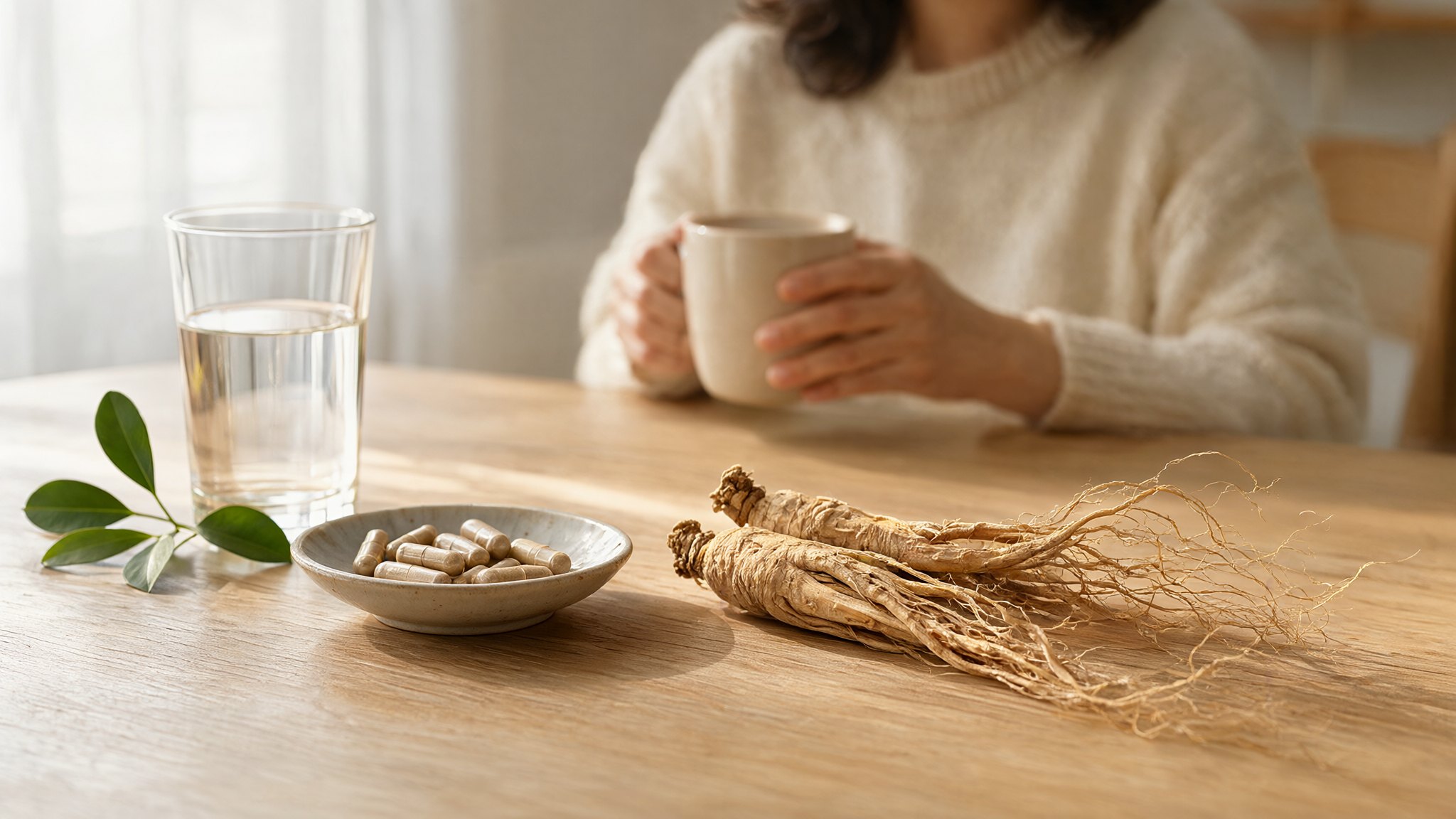
This guide walks through what those trials gave women, how much, and for how long, then puts those doses next to a real label. Our product in this category is Eternal Elixir Korean Panax Ginseng 1600mg, which provides 1,600mg of Korean red ginseng extract per two-capsule serving. For the full picture on ginseng in general, start with our ginseng benefits and dosage guide. If you are building a wider routine, our comparison of the best supplements for women over 40 covers the basics first.
Key takeaways
- Ginseng benefits for women are best studied around menopause: a 2022 review of 15 trials found small improvements in menopausal symptoms, hot flashes and quality of life, with most trials at some risk of bias.
- Trials in women mostly used 2 to 3 g a day of Korean red ginseng for 8 to 16 weeks. A label that lists ginsenoside content lets you compare your dose with theirs.
- Skip ginseng if you are pregnant or breastfeeding, and talk to your doctor first if you take blood thinners, diabetes medicine or have a hormone-sensitive condition.
Ginseng benefits for women: what the trials actually tested
Most ginseng research enrolls men or mixed groups. The studies that enrolled only women cluster around one life stage, the years around and after menopause, and almost all of them used Korean red ginseng (Panax ginseng root that is steamed before drying). That matters, because American ginseng and Siberian “ginseng” are different plants with different research.
The strongest summary comes from Lee and colleagues, who reviewed every placebo-controlled trial of ginseng in menopausal women they could find up to April 2022. Their review in Complementary Therapies in Clinical Practice included 15 trials. Pooling three of them (515 women), ginseng reduced overall menopausal symptom scores and hot flashes compared with placebo.
Three trials also showed a small gain in quality-of-life scores. The authors were clear about the limits: most trials raised some concern about bias, and ginseng showed no direct effect on hormones, sexual function scores or the thickness of the uterine lining.
One of the better single trials sits inside that evidence base. In a 12-week study in Menopause, Kim and colleagues gave 72 postmenopausal women aged 45 to 60 either 3 g of red ginseng a day (60 mg of ginsenosides) or a placebo. The ginseng group improved more on two menopause symptom scales. Total and LDL cholesterol also fell in that group, and serum estradiol did not change.
Not every trial agreed. A larger Swedish study of 384 symptomatic postmenopausal women, published in 1999, found only a trend toward better overall well-being after 16 weeks, with no significant change in hot flushes (Wiklund and colleagues). Exploratory subscales for mood and general health did favor ginseng. Put together, the research points to a small, real-world effect for some women, which is a fair reason to try it and a poor reason to expect a dramatic change.
Energy and fatigue after menopause
Tiredness is one of the most common reasons women in their 50s look at ginseng, and here the evidence is newer. In an 8-week trial published in Nutrients in 2021, Chung and colleagues gave 63 postmenopausal women aged 46 to 69 either 2 g a day of Korean red ginseng or a placebo. Scores on a standard fatigue severity scale dropped by an average of 7 points with ginseng and 1 point with placebo.
The same women showed a rise in mitochondrial DNA copy number and in total antioxidant status in their blood. Those are lab markers researchers use to track cellular aging and oxidative stress. They are interesting, but they are not the same thing as feeling younger, and one 8-week trial cannot show long-term effects.
The fatigue result is the part most women can use. It fits with the wider ginseng research on tiredness, which our guide to ginseng benefits for men covers from the other side: the male trials focus far more on sexual function and much less on day-to-day energy. If low energy is your main concern, rule out the common causes first. Low iron, thyroid problems and poor sleep are all more likely than a lack of ginseng.
Trying Korean red ginseng in the US? Eternal Elixir’s Korean Panax Ginseng 1600mg ships fast across the United States with 90 capsules per bottle. Browse the longevity range →
Sexual wellness and mood: where the results split
Ginseng is often sold to women for libido. One small crossover trial supports that.
In a study in The Journal of Sexual Medicine, Oh and colleagues gave 32 menopausal women three 1 g capsules of Korean red ginseng a day or a placebo, then switched them. Among the 28 who finished, arousal scores on the Female Sexual Function Index rose from 3.10 to 3.50 with ginseng. Two women had vaginal bleeding while taking it, which is worth knowing before you start.
When the 2022 review pooled three trials on sexual function (491 women), the overall effect was not statistically significant. So the honest reading is that some women in some trials reported better arousal, and the combined data do not confirm it.
Mood follows a similar pattern. The Swedish trial saw better scores on depression and well-being subscales, but those were exploratory results rather than the main outcome. Ginseng is not a substitute for care if your mood has changed in a way that worries you.
How much ginseng should a woman take? Trial doses vs a real label
Here is the gap most articles skip. Trials in women gave between 2 and 3 g of Korean red ginseng a day, and the one that reported ginsenosides gave 60 mg of them. Supplement labels list milligrams of extract, and extracts vary widely in strength. The useful comparison is ginsenosides per day, when the label states them.
| Source (per day) | Ginseng given | Length | Main finding in women |
|---|---|---|---|
| Kim 2012, 72 women | 3 g red ginseng, 60 mg ginsenosides | 12 weeks | Better menopause symptom scores |
| Chung 2021, 63 women | 2 g Korean red ginseng | 8 weeks | Less fatigue |
| Oh 2010, 28 women | 3 g Korean red ginseng | Crossover | Higher arousal score |
| Eternal Elixir label, 2 capsules | 1,600mg extract, 80 mg ginsenosides or more | Your choice | Not trialed as a finished product |
Our Korean Panax Ginseng 1600mg is standardized to at least 5% ginsenosides, so one two-capsule serving carries 80 mg or more. That is above the 60 mg a day in the Kim trial, from a smaller amount of extract. At $44.99 for 90 capsules (45 label servings), it works out to about $1.00 per serving at the price we checked on 10 October 2026.
This exact formula has not been tested in a clinical trial, and the trial products were not identical to it. View the Eternal Elixir Korean Panax Ginseng label to check the ginsenoside figure for yourself.
A sensible approach for most women is to start at one capsule with breakfast for a week, then move to the full serving if you feel fine. Take it in the morning, since some people find it mildly stimulating. Trials ran for 8 to 16 weeks, so give it at least two months before you judge it. Our supplement dose gap report shows the same trial-versus-label check for other ingredients.
Who should skip ginseng, or check first
Ginseng was well tolerated in the trials above, but it is an active herb with real interactions. The Eternal Elixir label gives the same advice we give here: follow the physical label and check with a qualified professional when appropriate. Skip it, or talk to your doctor first, if any of these apply to you:
- Pregnancy or breastfeeding. There is not enough safety data, so avoid it.
- Blood thinners such as warfarin. Ginseng may affect how these drugs work, so check before combining them.
- Diabetes medicine. Ginseng can lower blood sugar, which may add to the effect of your medication.
- A hormone-sensitive condition, such as a history of breast cancer or endometriosis. The trials found no estrogen change, but your care team should make this call.
- Stimulants or heavy caffeine use, if you notice jitteriness or poor sleep.
Side effects reported for ginseng are usually mild, most often trouble sleeping, headache or an upset stomach. The Oh trial also recorded two cases of vaginal bleeding during ginseng use. Stop and get advice if you have unusual bleeding or a racing heart.
Ginseng benefits for women: common questions
How much ginseng should a woman take?
Trials in women used 2 to 3 g of Korean red ginseng a day for 8 to 16 weeks. The one trial that reported ginsenosides gave 60 mg a day. A 1,600mg extract standardized to 5% ginsenosides, like Eternal Elixir Korean Panax Ginseng 1600mg, provides 80 mg or more per two-capsule serving. Follow your product label and start low.
Which is better for women, maca or ginseng?
They are different plants used for different reasons, and few trials compare them head to head. Ginseng has the larger body of placebo-controlled research in menopausal women, with 15 trials in one 2022 review. If energy is your main goal, our guide to the best supplements for energy compares more options.
Does ginseng raise estrogen levels?
Not in the trials that checked. The Kim 2012 trial found no change in serum estradiol, and the 2022 review found no direct effect on hormones or on the thickness of the uterine lining. Women with a hormone-sensitive condition should still ask their doctor before using it.
Can ginseng help with hot flashes?
Studies suggest a small effect. Pooled data from three trials (515 women) showed fewer hot flashes than placebo, while a 1999 trial of 384 women found no significant change in hot flushes. Results vary between women and between products.
Is it safe for women to take ginseng every day?
Daily use for 8 to 16 weeks was well tolerated in the trials above. Many people take a break after a few months. Avoid it during pregnancy or breastfeeding, and check with your doctor if you take blood thinners or diabetes medicine. Our ranking of the best ginseng supplements shows how labels compare on standardization.
Ready to start your longevity stack?
Full-size bottles · Fast US shipping · Third-party tested
Shop Eternal Elixir →Recommended for you
About Eternal Elixir
Eternal Elixir is a supplement company specializing in longevity and nootropic formulations. All products are third-party tested for purity, manufactured under strict quality controls, and ship fast across the United States. Browse the full range at eternalelixir.com/shop.
Sources
- Lee HW, Ang L, Lee MS. Using ginseng for menopausal women’s health care: a systematic review of randomized placebo-controlled trials. Complementary Therapies in Clinical Practice. 2022. PMID 35691259
- Kim SY, et al. Effects of red ginseng supplementation on menopausal symptoms and cardiovascular risk factors in postmenopausal women: a double-blind randomized controlled trial. Menopause. 2012. PMID 22027944
- Chung TH, et al. The effects of Korean red ginseng on biological aging and antioxidant capacity in postmenopausal women: a double-blind randomized controlled study. Nutrients. 2021. PMID 34578969
- Oh KJ, et al. Effects of Korean red ginseng on sexual arousal in menopausal women: placebo-controlled, double-blind crossover clinical study. The Journal of Sexual Medicine. 2010. PMID 20141583
- Wiklund IK, et al. Effects of a standardized ginseng extract on quality of life and physiological parameters in symptomatic postmenopausal women: a double-blind, placebo-controlled trial. International Journal of Clinical Pharmacology Research. 1999. PMID 10761538
- Eternal Elixir US store, Korean Panax Ginseng 1600mg product page. Price and label checked 10 October 2026.