Last updated: · Published by Eternal Elixir
Edited by Elaine Fletcher, Researcher
Pterostilbene vs resveratrol is a comparison between two closely related plant polyphenols, and the honest answer is that neither wins outright. Pterostilbene is the methylated cousin of resveratrol: it carries two methoxy groups in place of two hydroxyl groups, which makes it more fat-soluble and gives it a longer half-life in animal studies (Kapetanovic 2011). Resveratrol, meanwhile, has by far the larger body of human research behind it.
If you want the compound with more clinical history, resveratrol usually fits better. If you want the structural version that persists longer in the body per animal data, pterostilbene is the more interesting molecule. This guide walks through both so you can decide for yourself, and our best pterostilbenes roundup is the place to start if you already know what you want.
Quick answer: both are stilbene polyphenols. Pterostilbene is the dimethylated analog, more lipophilic, with a longer half-life shown in animal studies. Resveratrol has far more human trials. Pick resveratrol for the research depth, pterostilbene for the pharmacokinetic profile, or both together if budget allows.
Pterostilbene vs resveratrol at a glance
The table below puts the two molecules side by side on the points that actually change a buying decision. Every Eternal Elixir figure comes straight from our own product labels. The chemistry points come from the published literature we cite in the sources list at the end.
| Feature | Pterostilbene | Resveratrol |
|---|---|---|
| Source foods | Blueberries, and smaller amounts in grapes | Grapes, red wine, Japanese knotweed |
| Chemical structure | Two methoxy groups and one hydroxyl group (dimethylated analog) | Three hydroxyl groups on the stilbene backbone |
| Absorption profile | More fat-soluble. Longer half-life in animal pharmacokinetic studies | Absorbed but heavily and quickly metabolized in humans |
| Research base | Mostly animal and cell work, with some early human trials | Extensive human trial literature spanning decades |
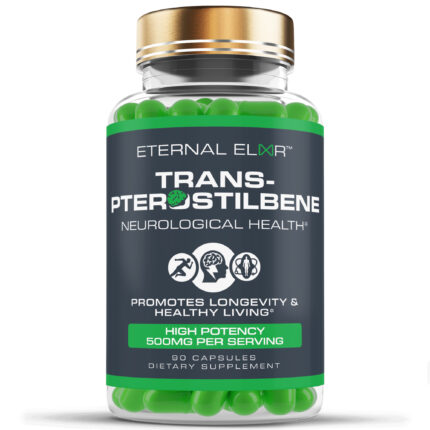
| Our label serving | 1 capsule (500 mg trans-pterostilbene) | 1 capsule (600 mg trans-resveratrol, 98% purity) |
| Price per serve (ours) | $0.72 | $0.67 |
| Pack size and price | 90 capsules, $64.99 | 90 capsules, $59.99 |
A note on the structure row: resveratrol has three hydroxyl groups attached to its carbon backbone. Pterostilbene replaces two of those hydroxyls with methoxy groups. That single structural difference drives nearly every practical contrast between the two molecules, from solubility to metabolism to how long each persists in circulation.
Why the chemistry matters: absorption and metabolism
Resveratrol is absorbed in the small intestine, but the body metabolises it rapidly into glucuronide and sulfate conjugates. That metabolism is the reason its measured presence in blood plasma falls quickly after ingestion. Researchers have documented this pattern repeatedly in human pharmacokinetic studies, which is why formulators began looking at methylated analogs in the first place.
Pterostilbene swaps two of those hydroxyl groups for methoxy groups. Methoxy groups are more resistant to the conjugation enzymes that strip phenolic rings, so the molecule survives longer before the kidneys clear it. Animal studies have borne this out: pterostilbene shows a longer half-life and greater area under the curve than resveratrol when dosed in comparable animal models. Kapetanovic and colleagues reported this in a 2011 rat pharmacokinetic study, which found markedly higher oral bioavailability for pterostilbene than for resveratrol.
Those are animal findings, and we state them as such. The limit is real: extrapolating rat half-lives to human dosing intervals is not straightforward, because glucuronidation and sulfonation rates differ between species. Human pharmacokinetic work on pterostilbene exists but is much thinner than the resveratrol equivalent. When a brand quotes a specific human bioavailability percentage for either molecule, ask for the peer-reviewed human trial behind the number.
What the research actually shows
Resveratrol: the evidence depth
Resveratrol has accumulated human trial data since the early 2000s, when the metabolic effects of the molecule entered mainstream discussion. The human literature is large, and the outcomes studied span metabolic markers, vascular function, and exercise physiology. Not every trial shows a benefit, and effect sizes in positive trials are often modest. But the sheer volume means the safety profile in adults is well characterized, and reviewers have had a lot to work with.
The honest read: resveratrol is a polyphenol with plausible mechanisms and mixed but nonzero human support. What it has shown in some human work is changes in surrogate markers, which is a narrower claim than many labels imply. We flag that distinction throughout, and Eternal Elixir holds its own product pages to the same standard.
For a plain-language rundown of how resveratrol fits into a wider longevity stack, our best longevity supplements guide covers the evidence hierarchy in more detail.
Pterostilbene: the thinner but interesting file
Pterostilbene research is dominated by cell and animal work, with a much smaller human literature. The animal models cover inflammatory pathways, metabolic markers, and cognitive measures in rodents, among other endpoints. Results in those models are often promising. The catch, and we mean this plainly: rodent dose translation to humans is imperfect, and several animal findings have not been replicated in human trials at comparable doses.
The human trials that do exist are small. Riche and colleagues published a randomized, double-blind, placebo-controlled trial in 2014 (Evidence-Based Complementary and Alternative Medicine) looking at pterostilbene and metabolic parameters in adults. The trial reported changes in blood pressure readings, and in the pterostilbene-only groups a rise in LDL cholesterol, among other endpoints.
Small n, short duration, and a specific population mean the findings are suggestive rather than definitive. We cite it because it is one of the few properly controlled human trials, not because it settles anything.
Cell work on sirtuin activation and AMPK pathways is mechanistically interesting. Cell studies show that the compound interacts with these pathways in vitro. Whether the concentrations used in a dish match what your blood achieves after a capsule is a separate question, and often the honest answer is that nobody has shown it does. We prefer brands that flag this rather than overstate the cell data.
What neither compound has been shown to do in people
Neither pterostilbene nor resveratrol has strong human evidence for any single outcome yet, and neither has been shown to extend human lifespan. The animal lifespan work on resveratrol is interesting but species-specific, and the translational gap to humans remains open. Any brand claiming more is ahead of the data, and Eternal Elixir includes itself in that standard.
Pterostilbene vs resveratrol benefits: the structure and function picture
What follows is the most we would say about each compound in good conscience, framed as support for normal physiology.
What pterostilbene supports
- Antioxidant activity: the methoxy groups on the ring contribute to the molecule’s radical-scavenging behavior in cell models. In your body, it adds to your overall dietary polyphenol intake, which supports the normal antioxidant network.
- Healthy circulation: the 2014 Riche human trial examined vascular markers. We would say it “supports healthy circulation”, and we would not go further than that on one small trial.
- Healthy ageing: as a polyphenol, it is part of the plant-rich dietary pattern associated with healthy ageing. That association is population-level, not a guarantee that a capsule moves any needle for you personally.
What resveratrol supports
- Antioxidant activity: resveratrol is a phenolic compound and behaves as one in vitro and in vivo. It contributes to the body’s antioxidant network, which is a real but modest contribution.
- Healthy circulation: human trials have examined flow-mediated dilation and endothelial markers with mixed results. The structure and function phrasing we would defend is “supports normal vascular function”, not anything stronger.
- Healthy metabolic function: trials in metabolic populations have reported changes in insulin sensitivity and related markers, with inconsistent findings across studies. Framing it as “supports healthy glucose metabolism already in the normal range” is as far as the honest data goes.
If your priority is the polyphenol with the deepest human safety record, the Eternal Elixir Trans-Resveratrol 600mg page lists the label in full. If the pterostilbene pharmacokinetics appeal more, the pterostilbene benefits and dosage guide goes deeper on that molecule alone.
Safety, side effects, and interactions
Both compounds have favourable safety profiles at typical supplemental doses. Neither is associated with serious adverse events in the published literature at the levels found in a standard capsule. The caveats below are the ones we think every buyer should know before ordering, not because they are likely problems but because they are the honest limits.
If you take warfarin, aspirin therapy, or any other blood-thinning medication, talk to your doctor before adding either polyphenol. Resveratrol has documented antiplatelet activity in vitro, and the theoretical interaction with anticoagulants is worth a conversation with the person who manages your prescription. The same logic applies if you have surgery scheduled within a few weeks.
If you manage your cholesterol with your doctor, mention pterostilbene as well. In the 2014 Riche trial, pterostilbene taken on its own raised LDL cholesterol in some groups, so it is worth having your numbers in view before and after you start.
If you are pregnant or breastfeeding, neither compound has sufficient human pregnancy data for us to recommend it without your obstetrician’s input. Talk to your doctor first. The same applies if you have kidney or liver conditions, since polyphenol metabolism runs through both organs.
Common mild effects reported in trials and postmarket summaries include digestive upset, headache, and nausea at higher doses. These are usually dose-related and settle when the dose drops. If a side effect persists, stop and check with a pharmacist or physician.
For the full interactions list and drug timing notes, our resveratrol interactions guide covers the specifics in more detail than this summary allows.
Can you take pterostilbene and resveratrol together?
Yes, and there is a reasonable rationale for doing so. They share a mechanism family but differ in kinetics: pterostilbene persists longer, resveratrol peaks and clears faster. Taking both spreads the polyphenol exposure across a wider window than either alone.
No published trial has specifically examined the combination in humans, so we are reasoning from pharmacology rather than from a dedicated interaction study. The doses in standard single-ingredient capsules are well below any level associated with adverse events in the individual trial literature.
Our practical take if you stack them: follow each label (1 capsule per serving), start one at a time for a week to isolate any digestive effect, and keep the total polyphenol load sensible if you also eat a plant-rich diet. If you are on regular medication, the earlier interactions paragraph applies to the combination as well.
If you would rather compare more brands first, our best resveratrol supplements roundup covers how Eternal Elixir stacks up against other single-ingredient options.
Pterostilbene vs resveratrol dosage
Pterostilbene dosage
There is no established recommended daily intake for pterostilbene, because no body has published one. What exists is the dose range used in trials and the label amounts on commercial products. Our own capsule is a straightforward reference point.
The Eternal Elixir label reference is 1 capsule per serving, supplying 500 mg of trans-pterostilbene. At 90 servings per pack, a single bottle covers three months at the label rate. We do not publish a maximum, and we would be wary of any brand that does without a human dose-escalation trial behind the number. The 2014 trial used doses in the same general range as commercial capsules, which is reassuring but is one small study.
Timing is flexible. Pick a time of day you will remember and keep it consistent, because consistency matters more than the hour.
Resveratrol dosage
Resveratrol has a similar story: no official daily intake, but a much larger trial database showing the dose ranges researchers have used. Trials span from low single-digit milligrams to several hundred, with effects and tolerability varying accordingly. Commercial capsules typically sit well above the red wine intake equivalent, which is part of why supplements exist as a concentrated option.
The Eternal Elixir label is 1 capsule supplying 600 mg of trans-resveratrol, standardized to 98% purity. That is a single-ingredient capsule with nothing else hidden in the blend. Ninety servings per pack at the label rate.
Same timing logic applies: choose a consistent time of day and follow the label. If you take a medication that affects platelet function, ask your pharmacist how to fit it in.
Ready to choose? Eternal Elixir Trans-Pterostilbene 500mg and Trans-Resveratrol 600mg are both in stock, with 30-day returns on unopened products and free shipping over $100.
Add Trans-Pterostilbene 500mg to cart · $64.99Which should you choose?
There is no single correct answer, because the right pick depends on what you want from the capsule and how you weight evidence depth against pharmacokinetic theory. The list below maps goals to the compound that fits best, in our view.
- Maximum human evidence and safety data: resveratrol. It has decades of trial history and a well-characterized profile. Our 600 mg capsule is the straightforward pick.
- Longer plasma persistence per animal data: pterostilbene. The methylation story is real chemistry, even if human translation is thinner. Our 500 mg capsule is the clean version of it.
- Both mechanisms, wider exposure window: take one of each. Start one, add the second a week later, and watch for any digestive change.
- A polyphenol to round out a plant-poor diet: either works as a top-up. The food-first answer is more berries and grapes, and the capsule is the gap-filler, not the replacement.
- Budget is the main constraint: at $0.67 versus $0.72 per serve, resveratrol edges it on cost. The difference over a month is under two dollars, so we would not let it decide the choice on its own.
- Taking regular medication, especially blood thinners or cholesterol medication: either, after a conversation with your doctor. The interactions section above has the specifics.
Pterostilbene vs astaxanthin, and other common pairings
Astaxanthin comes up in comparison because it is another fat-soluble antioxidant with a lipophilic profile. The differences are larger than the similarities. Astaxanthin is a carotenoid, not a stilbene, with a distinct structure and a different mechanism set.
If you are choosing between a stilbene and a carotenoid for antioxidant support, you are really asking which class of compound you want more of in your routine. Many people take one of each rather than choosing.
CoQ10 is another frequent point of confusion. CoQ10 is a mitochondrial electron carrier, not a polyphenol. It supports cellular energy pathways directly in a way polyphenols do not. The two are complementary rather than substitutes, and stacking them is common in longevity routines.
FAQ
What are the benefits of pterostilbene?
The structure and function claims we would make are that it supports the body’s normal antioxidant activity, contributes to the dietary polyphenol load associated with healthy ageing, and supports normal vascular function. The evidence behind those is mostly animal and cell work, with a small human trial base.
What is the right pterostilbene dosage?
Our label reference is 1 capsule supplying 500 mg of trans-pterostilbene per serving, per the label. There is no official recommended daily intake for the compound. Published human trials have used doses in a comparable range, which supports the label amount as a reasonable starting point rather than a maximum.
How much pterostilbene per day is safe?
The doses in the published trial literature sit broadly in the range commercial capsules deliver, and adverse events reported are mild and digestive rather than serious. Without a large dose-ranging human trial, we are cautious about endorsing any specific ceiling. Stick to the label serving, and talk to your doctor if you want to go higher or take regular medication.
Is pterostilbene better than resveratrol?
Better depends on the criterion. Pterostilbene has a more fat-soluble structure and a longer half-life in animal studies. Resveratrol has a far larger human trial base and better-characterized safety data. Neither dominates on every axis, which is why our honest answer is that the choice follows your priorities.
Can you take pterostilbene and resveratrol together?
Yes. They share a mechanism family but differ in how long each persists, so taking both broadens exposure across the day. No dedicated combination trial exists in humans, but the individual doses in standard capsules are well within safe ranges.
Start one, add the second a week later. Our resveratrol interactions guide covers medication checks for the pair.
What is the best time to take pterostilbene?
Whenever you will remember it. The Eternal Elixir label simply says 1 capsule per serving, and there is no proven best hour. Consistency across days likely matters more than the specific time you choose.
What are pterostilbene side effects?
Mild digestive upset, headache, and nausea are the effects reported in trials and postmarket summaries, usually at higher doses. If any effect persists, stop and check with a pharmacist. Serious events at standard supplemental doses are uncommon in the literature.
How do you pronounce pterostilbene?
Tear-oh-STIL-been, with a silent initial p. The pter prefix is the same Greek root as in pterodactyl, meaning wing, referring to the molecular shape. It trips people up in writing but is straightforward once you have heard it aloud.
Are resveratrol supplements effective?
Effective for what, exactly, is the honest frame. Trials have reported changes in surrogate markers like flow-mediated dilation and insulin sensitivity, with mixed and often modest effects. For polyphenol top-up and antioxidant network support, the mechanism is real even when the magnitude is small.
What should you not mix with resveratrol?
Blood-thinning medications deserve a mention to your doctor because of resveratrol’s antiplatelet activity in vitro. If you take warfarin, aspirin therapy, or similar, a quick pharmacist check before stacking is a sensible precaution rather than paranoia.
Pterostilbene vs astaxanthin: which is better?
They are different compound classes, a stilbene versus a carotenoid (see our pterostilbene buying guide), so the comparison is about which class you want more of rather than which is superior. Both are lipophilic antioxidants with distinct mechanisms. Many routines include one of each rather than forcing a choice between them.
Is coQ10 or resveratrol better?
They do different jobs. CoQ10 sits in the mitochondrial electron transport chain and supports cellular energy production directly. Resveratrol is a polyphenol with antioxidant and signalling roles. They are complements, not substitutes, and many people take both rather than choosing.
The bottom line
Pterostilbene vs resveratrol is a comparison between close chemical cousins where the tiebreaker is usually evidence depth versus pharmacokinetic theory. Resveratrol wins on human trial count and safety history. Pterostilbene wins on fat solubility and persistence, per the animal data.
Both support normal antioxidant activity and healthy circulation in the structure and function sense. That is the honest summary of pterostilbene vs resveratrol in 2026.
If you want the deeper research base, choose the Trans-Resveratrol 600mg at $0.67 per serve. If the methylated pharmacokinetic profile appeals and you accept the thinner human file, the Trans-Pterostilbene 500mg at $0.72 per serve is the clean version of that bet. Taking both is a defensible third path, and neither is expensive enough to make the stack painful.
Eternal Elixir sells both capsules in a single-ingredient format with no proprietary blends, and every label is published in full. 30-day returns on unopened products. Free shipping over $100.
These statements have not been evaluated by the Food and Drug Administration. This product is not intended to diagnose, treat, cure, or prevent any disease.
Sources
- Kapetanovic IM et al. Pharmacokinetics, oral bioavailability, and metabolic profile of resveratrol and its dimethylether analog, pterostilbene, in rats. Cancer Chemother Pharmacol, 2011. PubMed 21116625
- Riche DM et al. Pterostilbene on metabolic parameters: a randomized, double-blind, and placebo-controlled trial. Evid Based Complement Alternat Med, 2014. PubMed 25057276