Last updated: · Originally published August 3, 2026 · Published by Eternal Elixir
Edited by Elaine Fletcher, Researcher
The benefits of methylene blue fall into two groups. The established ones are medical: hospitals give it by IV for a blood problem called methemoglobinemia, and surgeons use it as a dye. The benefits people take it for at home are narrower. The best human evidence is one small randomized trial in which a single oral dose changed brain activity during attention and memory tasks and raised correct answers on a memory test by 7%. Claims about cellular energy, skin aging, mood and longevity rest on cell and animal studies or on no data at all. Before any of that matters, methylene blue must not be combined with SSRIs, SNRIs, MAOIs or other serotonergic medicines.
Quick answer
- Human evidence: short-term changes in memory retrieval and brain network activity after one oral dose, in two small randomized trials from the same group.
- Lab evidence only: cellular energy, antioxidant activity and skin aging.
- No evidence: longer life, and mood effects at supplement doses in healthy people.
- Daily use: no trial has tested benefits or long-term safety of daily low-dose use.
- Who should not take it: anyone on serotonergic medicines, with G6PD deficiency, pregnant or breastfeeding, or under 18.
The Benefits of Methylene Blue, Graded by Evidence
Most articles list the benefits of methylene blue as a flat bullet list, which implies that “improves memory” and “slows skin aging” are equally well supported. They are not. The table below grades each commonly claimed benefit by the strongest evidence that exists, and says what it means for someone taking an oral supplement.
| Claimed benefit | Strongest evidence | Evidence level | What it means for a supplement user |
|---|---|---|---|
| Hospital use for methemoglobinemia | Standard clinical use by IV | Established, in hospital | None directly. It is an IV dose given with monitoring |
| Short-term memory retrieval | Randomized, double-blind, placebo-controlled trial, 26 adults | Moderate: small but controlled | One dose of 280 mg, measured an hour later |
| Attention and working memory brain activity | Same trial, functional MRI | Moderate: imaging measure | Shows the brain responded, not that people performed better in daily life |
| Brain network connectivity | Second randomized trial from the same group | Moderate: imaging measure | Same single-dose design |
| Cellular energy | Mechanism studies in cells and animals | Preclinical | Plausible, not shown in people taking capsules |
| Antioxidant activity | Cell and animal models, summarized in reviews | Preclinical | Not measured in human supplement trials |
| Skin aging | Cultured skin cells and skin models | Preclinical | Not tested with oral supplements |
| Mood | No trial in healthy people at supplement doses | Insufficient | Anecdote only |
| Longer life | No human data at any dose | Insufficient | No basis for the claim |
Read that table plainly and the picture changes. Three of the claimed benefits have randomized human evidence behind them, all from single doses in small groups. Three are preclinical: plausible and unproven in people. Two have nothing. That is not a reason to dismiss methylene blue. It is a reason to buy it with the right expectations.
Where the Benefits of Methylene Blue Come From
Almost every claimed effect traces back to one place: the electron transport chain in your mitochondria, the process cells use to turn fuel and oxygen into energy. Methylene blue can accept and pass on electrons itself. A 2021 review in Cells by Xue, Thaivalappil and Cao describes it as able to bypass parts of that chain (Complex I and III) and lower oxidative stress to some degree. That is why it keeps turning up in research on aging. Two things are worth knowing about that paper: it is a review of other studies, not a new experiment, and one author founded a skincare company built on methylene blue, which the paper discloses.
The detail most coverage misses is that the effect flips with dose. Rojas, Bruchey and Gonzalez-Lima reviewed the research in Progress in Neurobiology (2012) and described a hormetic dose-response: at low doses methylene blue acts as an electron carrier with antioxidant effects, and at high doses the effects go the other way. Most of that evidence comes from animal studies.
This is why “more is better” fails with methylene blue, and why the amount on the label matters more than it does for most supplements. Our methylene blue dosage guide sorts the hospital, research and supplement numbers so you can tell which one applies to you.
Memory and Attention: What the Human Trials Found
The strongest evidence comes from a randomized, double-blind, placebo-controlled trial by Rodriguez and colleagues, published in Radiology in 2016. Twenty-six healthy adults aged 22 to 62 took either a single oral dose of 280 mg of USP-grade methylene blue (about 4 mg/kg) or a placebo. The team ran functional MRI scans during an attention task and a short-term memory task before the dose and 1 hour after it.
- Attention: more activity in the insular cortex on both sides of the brain during the attention task.
- Working memory: more activity in frontal, parietal and occipital regions during the memory task.
- Memory retrieval: 7% more correct answers than placebo (P = .01).
- Side note: every participant who took methylene blue reported blue urine afterward.
A second randomized trial from the same group, published in Brain Imaging and Behavior in 2017, used the same before-and-after design. A single low oral dose was linked to lower blood flow in a task network during a visual-motor task and stronger resting-state connections between regions that handle perception and memory.
Two caveats belong next to the 7% figure. First, both trials tested one dose in a small group. They show what happened in one session, not what happens after three months of daily use. Second, the dose was 280 mg, which is 28 of our 10mg capsules. No trial has tested whether a daily supplement serving produces the same effect, a smaller one, or none. Anyone citing these studies as proof that a daily capsule makes you sharper is overreading them.
Add Methylene Blue Capsules 10mg to cart · $59.99If memory and focus are your goal, methylene blue is one option among several. Our methylene blue supplement comparison sets our products against other US brands, and our comparison of NMN and resveratrol covers two compounds that work through NAD+ metabolism instead.
Cellular Energy, Antioxidant Activity and Aging
This is where methylene blue gets most of its media attention and has the least human evidence. The logic is sound on paper: if mitochondria become less efficient with age, and methylene blue supports electron transport, then supporting mitochondria might support everything downstream of them.
The lab work is real. The Cells review covers studies on brain aging, memory, skin aging and progeria, a rare premature aging disease, and reports reduced oxidative stress across those models. But almost all of it was done in cultured cells and animals. The step from a dish or a mouse to a person swallowing a capsule is exactly where most promising compounds fail.
The honest summary: methylene blue has a plausible mechanism for supporting cellular energy, and human confirmation is still missing. The same is true of much of the longevity category. The evidence for Ca-AKG and cellular aging has a similar shape, as does the research on shilajit and energy in men. Our supplement dose gap report shows how often label doses fall short of trial doses across the category.
Why Do Some People Say They Feel Good on Methylene Blue?
You will find plenty of first-person reports of better mood or energy on methylene blue. There is a pharmacological reason people point to, and it is also the reason for its main danger. Ramsay and colleagues showed that methylene blue is a potent, reversible inhibitor of MAO-A, one of the main enzymes that breaks down serotonin (British Journal of Pharmacology, 2007). At the blood levels reached after IV doses, they calculated that MAO-A would be completely inhibited.
That property is not evidence of a mood benefit at supplement doses. No trial we could find has measured mood in healthy people taking supplement-sized amounts. Expectation also plays a big part in how people feel after taking anything new, which is why placebo-controlled trials matter. What the MAO-A effect does prove is the interaction risk: combined with serotonergic medicines, it can cause serotonin syndrome.
How Long Does Methylene Blue Take to Work?
In the two imaging trials, researchers measured changes 1 hour after a single oral dose. After an IV dose, Peter and colleagues measured a terminal half-life of about 5.25 hours in a small study of 7 volunteers (European Journal of Clinical Pharmacology, 2000). That is why most people who use methylene blue take it in the morning.
For daily use, there is no answer, because no trial has tested daily low doses over weeks or months. If you try it, hold one amount steady for a few weeks and change one thing at a time, so you can tell whether it is doing anything for you.
What the Benefits of Methylene Blue Do Not Include
It has no human evidence for longer life. No trial has measured lifespan or healthspan in people taking oral methylene blue. Claims to the contrary extrapolate from cells.
It is not the same as hospital methylene blue. In hospitals it is given by IV at 1 mg per kilogram of body weight, with monitoring, for specific acute problems. That dose sits on a different part of the dose curve from a 10mg capsule, and results from one setting do not carry over to the other.
It is not a substitute for sleep. Mitochondrial support does little for someone sleeping five hours a night. If fatigue or brain fog is your main complaint and it is new or getting worse, see a doctor before buying anything.
Disadvantages and Safety: Who Should Not Take It
For a meaningful share of readers, this section matters more than the benefits.
Do not take methylene blue if any of these apply
- You take an SSRI, SNRI, MAOI or any other serotonergic medicine. The combination carries a risk of serotonin syndrome.
- You have G6PD deficiency.
- You are pregnant or breastfeeding.
- You are under 18.
Methylene blue can turn urine blue or green. If you take any prescription medicine, talk to your doctor before you start.
Serotonergic medicines are the main concern. Beyond SSRIs, SNRIs and MAOIs, this group includes tricyclic antidepressants, triptans, tramadol and St John’s wort. The StatPearls entry on methylene blue notes that fatal cases of serotonin syndrome have been described when it was combined with serotonergic drugs.
G6PD deficiency is a second contraindication. People with this inherited enzyme deficiency are at markedly higher risk of red blood cell breakdown after methylene blue.
Other disadvantages. It stains teeth, tongue, fabric and countertops, which matters most with drops. Its effects flip at higher doses, so stacking extra servings is counterproductive, not just wasteful. And industrial or lab-stain grades are not made for people and should never be swallowed. Use only a product sold for oral use that states its grade.
Our Methylene Blue Capsules and Drops
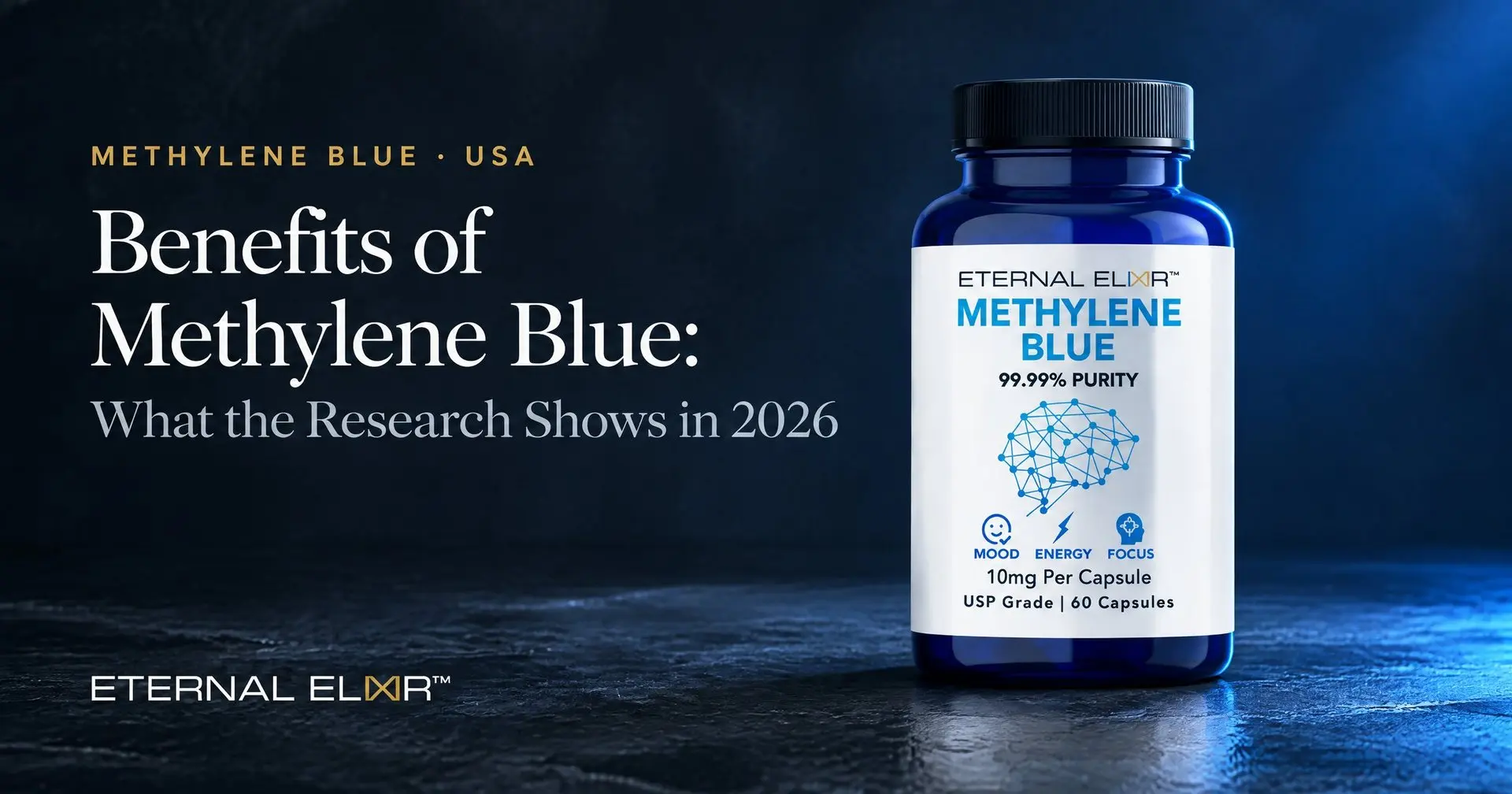
Eternal Elixir makes both products below, and the capsules are our pick for most people who have cleared methylene blue with their doctor. Each capsule holds 10mg of USP-grade methylene blue with 10mg of ascorbic acid, the label serving is one capsule, and the bottle holds 60 capsules for $59.99, or $1.00 a capsule. The dose is fixed, so there is nothing to measure and nothing to spill.
Our Methylene Blue Liquid 1% USP suits people who want to start below 10mg. The label gives 500mcg per drop and 10mg per full dropper, in a 50mL bottle with no additives declared, for $49.99. Both product pages state the evidence level for each ingredient and say plainly that the finished products have not been tested in clinical trials. USP describes the grade of the raw ingredient, not a test of the finished product.
Frequently Asked Questions
What are the benefits of taking methylene blue daily?
No one knows yet. The human evidence comes from single-dose studies that measured memory and brain activity an hour later. No trial has tested what daily supplementation does over weeks or months, so any claim about daily benefits is extrapolation.
Can you take methylene blue every day?
Supplement labels give a daily serving, but no trial has tested the long-term safety of daily low-dose use in healthy adults. If you take a serotonergic medicine, the answer is no. If you do not, stay at the lowest label serving and talk to your doctor if you take any prescription medicine.
What are the disadvantages of methylene blue?
The main ones are its interaction with serotonergic medicines, its risk for people with G6PD deficiency, and the gap between what it is marketed for and what has been tested. It also stains, and its effects flip at higher doses, so taking more does not help.
How long does it take methylene blue to start working?
The imaging trials measured changes 1 hour after a single dose. Whether a daily supplement serving has any effect over time has not been tested, so give any routine a few weeks at a steady amount before you judge it.
Why do I feel so good on methylene blue?
Methylene blue inhibits MAO-A, an enzyme that breaks down serotonin, and some people link how they feel to that effect. No trial has measured mood in healthy people at supplement doses, and expectation plays a large part. The same MAO-A effect is why it is dangerous with serotonergic medicines.
What should you not take with methylene blue?
Avoid SSRIs, SNRIs, MAOIs, tricyclic antidepressants, triptans, tramadol and St John’s wort. All of them raise serotonin and can combine dangerously with methylene blue. If you take any prescription medicine, clear it with your doctor first.
How much do Eternal Elixir methylene blue capsules cost?
Methylene Blue Capsules 10mg USP cost $59.99 for 60 capsules, or $1.00 a capsule, with free US shipping on orders over $100. Each capsule holds 10mg of USP-grade methylene blue and 10mg of ascorbic acid.
The Bottom Line
The benefits of methylene blue that rest on human evidence are real and narrow: short-term changes in memory and brain network activity after one dose. Everything else, from cellular energy to longer life, is still a lab result or a hope. If you want to try it, start at the lowest label serving, take it in the morning, and skip it entirely if you take a serotonergic medicine.
If methylene blue is ruled out for you, the same evidence-first approach applies elsewhere. Our NMN supplement rankings and our NMN 500mg capsules cover a different route to cellular energy, with its own evidence and limits. You can also browse the full Eternal Elixir range.
Sources
- Rodriguez P, Zhou W, Barrett DW, et al. Multimodal randomized functional MR imaging of the effects of methylene blue in the human brain. Radiology. 2016;281(2):516-526. PMID 27351678
- Rodriguez P, Singh AP, Malloy KE, et al. Methylene blue modulates functional connectivity in the human brain. Brain Imaging and Behavior. 2017;11(3):640-648. PMID 26961091
- Xue H, Thaivalappil A, Cao K. The potentials of methylene blue as an anti-aging drug. Cells. 2021;10(12):3379. PMID 34943887
- Rojas JC, Bruchey AK, Gonzalez-Lima F. Neurometabolic mechanisms for memory enhancement and neuroprotection of methylene blue. Progress in Neurobiology. 2012;96(1):32-45. PMID 22067440
- Ramsay RR, Dunford C, Gillman PK. Methylene blue and serotonin toxicity: inhibition of monoamine oxidase A (MAO A) confirms a theoretical prediction. British Journal of Pharmacology. 2007;152(6):946-951. PMID 17721552
- Peter C, Hongwan D, Küpfer A, Lauterburg BH. Pharmacokinetics and organ distribution of intravenous and oral methylene blue. European Journal of Clinical Pharmacology. 2000;56(3):247-250. PMID 10952480
- Ostrovsky A, Afzal M. Methylene Blue. StatPearls. Updated January 2, 2026. NBK557593
- Eternal Elixir product labels: Methylene Blue Capsules 10mg USP and Methylene Blue Liquid 1% USP.
These statements have not been evaluated by the Food and Drug Administration. This product is not intended to diagnose, treat, cure, or prevent any disease.