Last updated: · Published by Eternal Elixir
Edited by Elaine Fletcher, Researcher
Written by Ryan Roberts, researcher
If you are wondering when to take berberine, the practical answer is with a meal, split across the day when you take more than one capsule. Human trials gave berberine in divided daily doses, such as 500 mg three times a day, rather than as one large serving.
Eternal Elixir makes the Berberine HCl 500mg capsules referenced on this page, so weigh our product notes with that in mind. For the wider evidence on what berberine does, start with our berberine benefits and dosage guide. This page stays on timing.
Key takeaways
- When to take berberine: with or just before a meal, and split into two or three servings if your daily amount is above 500 mg.
- The meal is the anchor, not the clock. No trial has compared morning with evening dosing.
- Repeated berberine use slowed several drug-processing liver enzymes in a human study, so spacing it a few hours from a medicine does not remove that effect. Check with your clinician first if you take prescription drugs.
When to take berberine: the short version
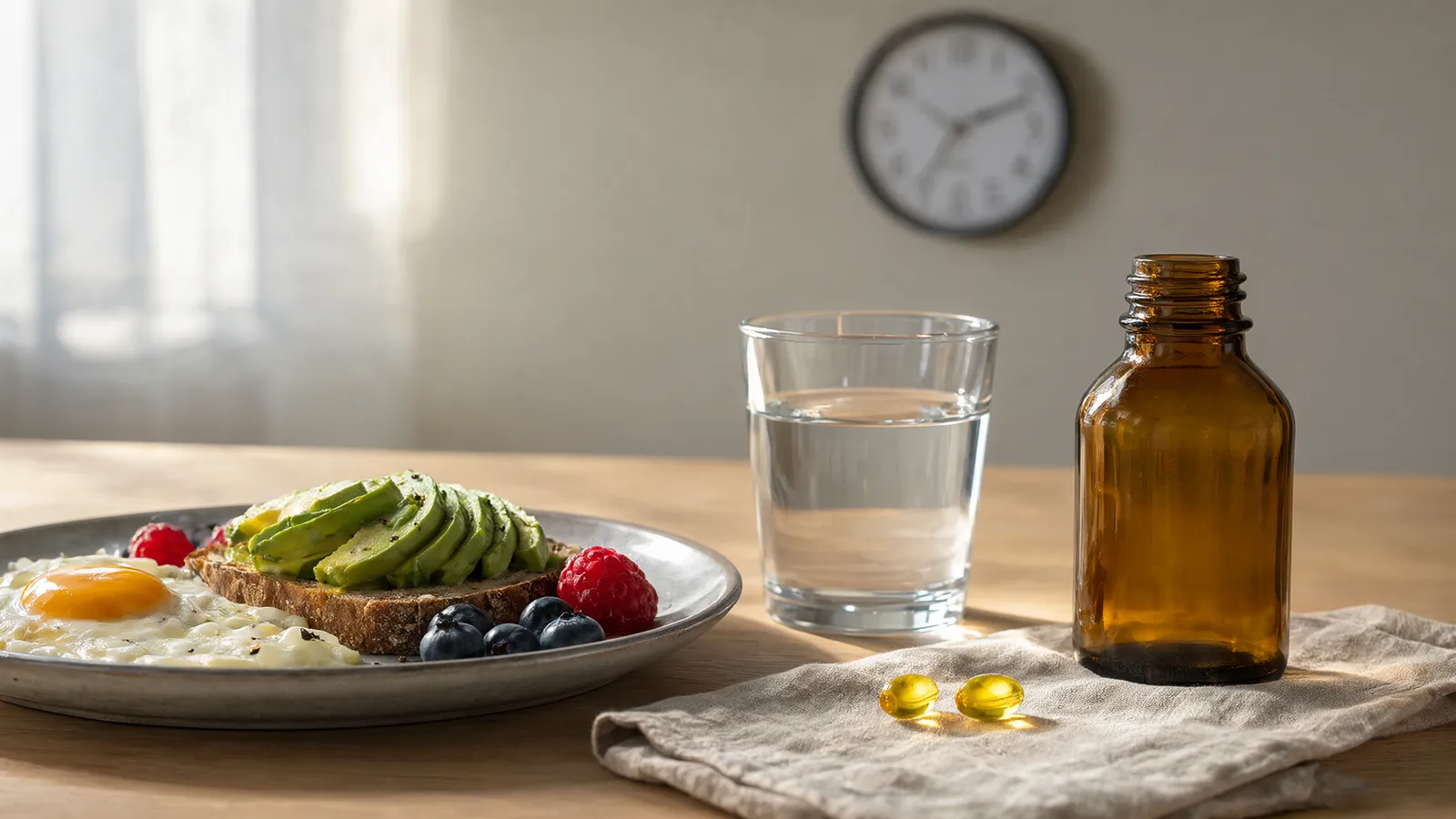
Take each berberine serving with food, at the start of a meal or during it. If you use one 500 mg capsule a day, pair it with your largest meal. If you use two, take them with two different meals several hours apart. If you use three, take one with breakfast, lunch and dinner.
That pattern copies how human trials dosed it, and it keeps the digestive side effects that cause most people to quit as low as possible. It is also how we suggest using Eternal Elixir Berberine HCl 500mg: one capsule per meal, up to three meals.
The clock time matters less than the plate in front of you. A 7 AM capsule with a coffee and nothing else is a worse choice than a 10 AM capsule with a real breakfast. The table below turns that rule into a starting schedule.
| Daily amount | Capsules (500 mg each) | When to take them |
|---|---|---|
| 500 mg | 1 | With your largest meal of the day |
| 1,000 mg | 2 | Breakfast and dinner, or your two main meals |
| 1,500 mg | 3 | One with breakfast, lunch and dinner |
Most people do better building up to the higher rows over two or three weeks than starting there. Try one capsule with your largest meal for the first week, then add the next serving if your stomach is settled. Labels differ on serving size, from 400 mg to 500 mg per capsule and different numbers of capsules per day, and our berberine supplements comparison lines those directions up side by side.
Why meals are the anchor for berberine timing
Berberine is poorly absorbed. A 2022 review of its pharmacokinetics in Phytotherapy Research (Khoshandam and colleagues) put its oral bioavailability at less than 1%. A large share of each capsule stays in the gut, and fecal excretion was the main route out. That has two consequences for timing.
First, the gut is where berberine does much of its work and where its side effects show up. In a 2008 pilot study in Metabolism: Clinical and Experimental (Yin and colleagues), 20 patients (34.5%) reported transient gastrointestinal effects during the three-month trial. Food in the stomach is the simplest buffer available, which is why with-meal dosing is the usual recommendation.
Second, a single large dose does not give you proportionally more berberine in the blood. Splitting the day’s amount across meals spreads the exposure out and spreads the digestive load too. If one serving is the problem, you can drop that one and keep the rest.
Before or with? Some brands suggest 15 to 30 minutes before eating.
No trial we could verify compared a pre-meal dose with a with-meal dose, so treat either as reasonable. If a pre-meal capsule upsets your stomach, move it into the meal. The Eternal Elixir label lists one capsule per serving and leaves the meal choice to you.
Skip the comparison shopping: Berberine HCl 500mg from Eternal Elixir ships fast across the United States with 90 capsules per bottle. Browse the longevity range →
How clinical trials scheduled their berberine doses
Timing advice online often sounds more certain than the research behind it. The most useful thing the trials offer is their dosing schedules, because those are the patterns that were actually tested for tolerability over weeks and months. They are the closest thing to hard evidence on when to take berberine. Here are three verified human studies and how each one gave berberine.
| Study | Daily amount | Schedule | Length and population |
|---|---|---|---|
| Yin et al., 2008 | 1,500 mg | 500 mg three times a day | 3 months, adults with type 2 diabetes |
| Zhang et al., 2008 | 1,000 mg | Daily total stated in the abstract | 3 months, 116 adults with type 2 diabetes and dyslipidemia |
| Guo et al., 2012 | 900 mg | 300 mg three times a day | 2 weeks, healthy men (drug interaction study) |
The randomized trial by Zhang and colleagues in The Journal of Clinical Endocrinology and Metabolism gave 1.0 g a day for three months against placebo. Mild to moderate constipation was reported in five people taking berberine. Its abstract states the daily total but not how it was split, so we have not filled in a schedule for it.
Two points stand out. Every schedule we could confirm spreads the day’s amount across two or three servings, and none tested a single morning dose against a single evening dose. These were also clinical populations or small healthy groups, so the schedules tell you what was tolerated, not what is ideal for every reader. They describe study conditions, and they are not a promise of any particular result.
Matching berberine to your meal pattern
Real eating patterns are messier than breakfast, lunch and dinner. The rule stays the same, a capsule goes with a meal, but where those meals fall changes the plan. These schedules use Eternal Elixir Berberine HCl 500mg, which has one 500 mg capsule per label serving and 90 capsules per bottle at $49.99, or about $0.56 per serving.
| Eating pattern | Suggested timing | Capsules a day | Bottle lasts | Cost per day |
|---|---|---|---|---|
| Three meals | Breakfast, lunch, dinner | 3 | 30 days | $1.67 |
| Two meals or a 16:8 window | First and last meal of the window | 2 | 45 days | $1.11 |
| One main meal | With that meal only | 1 | 90 days | $0.56 |
Three meals a day
This is the easiest fit for the 500 mg three times a day pattern used by Yin and colleagues. Keep the capsule bottle where you eat, not in the bathroom, so the habit attaches to the meal. If lunch is often skipped, drop to two capsules on those days rather than taking one on an empty stomach.
Two meals or a 16:8 eating window
Take one capsule with the meal that opens your window and one with the meal that closes it. That keeps the two servings several hours apart and keeps both inside the fed period. Taking berberine during the fasting hours is the version most likely to cause nausea, and it removes the food buffer that makes the schedule tolerable.
One main meal
If you eat once a day, one capsule with that meal is the sensible ceiling. Stacking two or three capsules into a single meal concentrates the digestive load, which is the opposite of what the split schedules in the trials were doing. A bottle then lasts about three months, which lines up with the length of the trials above. To compare that daily cost with other labels, our berberine supplement rankings work out what a month costs at each label’s directions.
Night shifts and irregular days
Ignore the clock and follow your meals. A nurse who eats at 7 PM, 1 AM and 6 AM can treat those as breakfast, lunch and dinner. The one adjustment worth making is to avoid a dose right before sleep if you take any glucose-lowering medication, for the reasons covered in the next section.
Morning or night: does the time of day matter for berberine?
No human trial we could verify compared morning berberine with evening berberine, so there is no evidence that one hour beats another. For most people, when to take berberine during the day comes down to which meals they eat and how their stomach responds. A capsule with dinner is a reasonable choice if dinner is your biggest meal.
A late-night dose on an empty stomach is the exception to avoid. Berberine is studied for its effects on glucose metabolism, and that is the reason to be careful about stacking it with a glucose-lowering medicine overnight, when you are not eating and may not notice a low reading. If you take any prescription for blood sugar, ask your prescriber how berberine fits around it before adding a bedtime capsule.
For sleep itself there is no controlled data either way. If you notice any change after an evening capsule, move it to an earlier meal and see whether the change follows it.
Spacing berberine around medications and other supplements
This is the part of the timing question that most guides skip. In a crossover study published in the European Journal of Clinical Pharmacology, Guo and colleagues gave healthy men 300 mg of berberine three times a day for two weeks. Afterward, the activity of three drug-processing liver enzymes (CYP2D6, CYP2C9 and CYP3A4) was reduced. For example, exposure to the test drug midazolam rose by about 40%.
The timing lesson is the important one. An effect that builds over two weeks of repeated dosing is not something you can schedule around by leaving two hours between a capsule and a pill. If you take medicines processed by those enzymes, the conversation belongs with your pharmacist or doctor, not with a timing chart. The 2022 pharmacokinetic review also lists metformin, cyclosporine and digoxin among drugs where combined use with berberine may produce important interactions.
Supplements are simpler. There is no verified evidence that berberine needs to be kept apart from common longevity supplements, so the practical rule is to give each one the meal timing it already needs.
TUDCA also goes with food, as our guide on when to take TUDCA explains, so the two can share a meal. Glutathione timing follows different logic, covered in our piece on the best time to take glutathione. If you pair berberine with calcium alpha-ketoglutarate, our Ca-AKG evidence review sets out what that ingredient has and has not shown in people.
Frequently asked questions about when to take berberine
Can I take berberine before bed?
You can if it goes with an evening meal and you take no glucose-lowering medication. No trial has tested bedtime dosing against daytime dosing. If you use a blood sugar prescription, ask your prescriber before adding a capsule late at night.
When should I take berberine if I fast?
Take it inside your eating window, with the first and last meals. Taking it during fasting hours removes the food buffer and makes stomach upset more likely. One capsule with a single daily meal is the sensible limit on one-meal days.
How do you take berberine with metformin?
Only with your prescriber’s agreement. A 2022 review lists metformin among drugs with possible important interactions, and both affect glucose metabolism. Your prescriber can decide whether the combination suits you and how to monitor it.
What helps berberine absorb better?
Less than 1% of oral berberine reaches the bloodstream, according to a 2022 pharmacokinetic review. Splitting the daily amount across meals is the practical step most people can take. Newer forms are covered in the forms section of our berberine evidence guide.
Is berberine safe for everyone?
No. People who are pregnant or breastfeeding, and people on medicines processed by CYP2D6, CYP2C9 or CYP3A4, should get medical advice first. Digestive effects were the common complaint in the trials above, and one of them reported constipation in five people.
Build your longevity stack
Third-party tested · Full-size bottles · Fast US shipping
Shop Eternal Elixir →Recommended for you
About Eternal Elixir
Eternal Elixir is a supplement company specializing in longevity and nootropic formulations. All products are third-party tested for purity, manufactured under strict quality controls, and ship fast across the United States. Browse the full range at eternalelixir.com/shop.