Last updated: · Originally published September 24, 2026 · Published by Eternal Elixir
Edited by Elaine Fletcher, Researcher
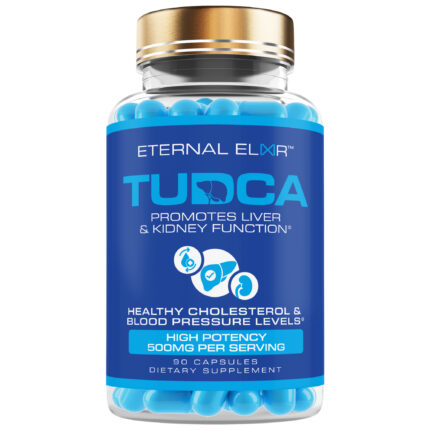
Quick answer: Take TUDCA with a meal, at about the same time each day. If you take more than 500 mg a day, split it between two meals, such as breakfast and dinner. That matches how human trials gave TUDCA (for example 250 mg three times a day, or 1 g twice a day) and how your body moves bile acids around meals. No study has compared morning with evening TUDCA, or taking it with food against an empty stomach, so treat any timing rule as a sensible default rather than a proven one. Our pick is Eternal Elixir TUDCA 500mg: one 500 mg capsule per label serving, 60 capsules, $1.00 a serving, which makes a split 1,000 mg day one capsule at each of two meals.
Eternal Elixir makes TUDCA 500mg, and it is our pick in this guide. Our product facts come from our US product page. Competitor figures come from their US product pages, read in September 2026, and every study claim links to its source. For what TUDCA is and what the wider research shows, see our TUDCA benefits, dosage and safety guide. This page stays on timing. Here is how we write and review content.
When to take TUDCA: a simple default schedule
With a 500 mg capsule, take one with the meal you eat most reliably. At 1,000 mg a day or more, take half with an earlier meal and half with dinner. Then adjust to how your digestion responds.
| Your situation | Suggested timing | Why | Evidence level |
|---|---|---|---|
| 500 mg a day | With your main meal, same time daily | Meals start gallbladder emptying and bile acid flow | Physiology, not tested for TUDCA |
| 1,000 mg a day or more | Split between two meals | Trials split the daily amount (1 g twice daily, 250 mg three times daily) | How trials dosed it |
| Prone to loose stools | With meals, in smaller split doses, stepping down if needed | One large trial protocol allowed a temporary dose cut | Trial protocol, meal effect not tested |
| Evening or bedtime | With dinner or at bedtime | A bedtime dose of UDCA kept overnight bile acid secretion up | Small studies of a related bile acid |
| Empty stomach | Fine, with no shown advantage | Absorbed in the ileum either way | Indirect data from UDCA |
| Around alcohol | No timing rule exists | No human study has tested it | Not studied |
“How trials dosed it” means human studies used that pattern, not that they proved it works better. “Related bile acid” means the data come from ursodeoxycholic acid (UDCA), the compound TUDCA is built from, not from TUDCA itself.
Why meal timing could matter for a bile acid
TUDCA (tauroursodeoxycholic acid) is UDCA joined to the amino acid taurine. Like the bile acids your liver makes, it travels a daily loop called the enterohepatic circulation. The gallbladder stores and concentrates bile between meals, and signals released during digestion, such as the gut hormone cholecystokinin, make it empty bile into the intestine (Housset and colleagues, 2016).
About 95% of bile acids are then reabsorbed at the end of the small intestine, the ileum, and sent back to the liver. A pool of roughly 3 g of bile acids goes around this loop 4 to 12 times a day (Chiang, Comprehensive Physiology, 2013). Because the pool moves in pulses around meals, taking TUDCA with food puts it alongside that flow. That is a reasonable inference, not a measured benefit.
TUDCA does not seem to drive the loop itself. A single 10 mg/kg dose did not change how the gallbladder emptied after a meal, in healthy people or in people with gallstones (Portincasa and colleagues, 1996).
How long TUDCA stays in the body
- Where it is absorbed. TUDCA is actively absorbed only in the ileum. In 24 healthy adults, levels in saliva peaked about 291 minutes, close to five hours, after an oral dose, in line with blood measurements (Simoni and colleagues, 2013).
- How long levels stay up. In one trial, 12 healthy adults took 1,500 mg of TUDCA eight hours before testing. The researchers chose that gap from pilot work in three rhesus monkeys, in which blood TUDCA peaked about eight hours after a dose and returned to baseline by about 24 hours (Walsh and colleagues, Clinical Science, 2016).
- The liver takes most of it first. The liver clears much of the absorbed TUDCA on its first pass and sends it into bile, which limits how much reaches the rest of the body (Albanese and colleagues, 2022).
We found no published study comparing TUDCA levels after fed and fasted doses in healthy adults. What data exist point to absorption over several hours and raised levels for most of a day. That fits once- or twice-daily dosing.
How human trials dosed TUDCA
Most TUDCA trials enrolled people with specific medical conditions under supervision. They tell you about dosing patterns and tolerability, not what TUDCA will do for a healthy person.
| Study | Who took part | Daily amount | Schedule | Length |
|---|---|---|---|---|
| Walsh, 2016 | 12 healthy adults | 1,500 mg | Single dose, 8 hours before testing | 1 day |
| Kars, 2010 | 20 adults with an average BMI of 37 | 1,750 mg | Daily, split not stated | 4 weeks |
| Muraca, 1995 | 33 adults with gallstones | 3.5 to 16.6 mg/kg | Daily | 4 to 6 weeks |
| Invernizzi, 1999 | 12 women with primary biliary cholangitis | 750 mg | Daily, crossover with UDCA | 2 months per phase |
| Setchell, 1996 | Adults with primary biliary cholangitis | 500 mg, 1,000 mg or 1,500 mg | Daily | 6 months |
| Ma, 2016 | 199 adults with primary biliary cholangitis | 750 mg | 250 mg three times daily | 24 weeks |
| Ladakis, 2025 | 47 adults with progressive MS analyzed | 2 g | 1 g twice daily | 16 weeks |
| Phase II ALS study | 34 adults with ALS | 2 g | 1 g twice daily | 54 weeks |
| TUDCA-ALS protocol | Adults with ALS, 320 planned | 2 g | 1 g twice daily, as 250 mg capsules | 18 months |
Two patterns stand out. Every multi-day trial that reported its schedule split the daily amount into two or three doses. And none of the reports we reviewed tested meal timing, so trial data cannot say whether with or without food is better.
Why split the dose?
There are three reasons, and none has been tested head to head. Splitting matches how the trials dosed. Levels seem to rise over hours and fall within about a day, so two doses should keep supply steadier. And bile acids that reach the colon draw in water and speed up transit (Camilleri, Gut and Liver, 2015), so smaller single doses may mean fewer loose stools. That last point is a rationale, not a proven effect.
Should you take TUDCA with or without food?
Taking TUDCA with food
With food is the better default. A meal starts bile flow, and TUDCA joins it. There is no food-effect study for TUDCA, but there is one for UDCA. Healthy adults took 500 mg of UDCA either fasting (36 people) or after a 900-calorie high-fat meal (31 people). The meal delayed the UDCA peak from 3.3 to 4.5 hours without changing its height, raised total UDCA exposure over 72 hours from 25.4 to 30.8 µg·h/mL, and also raised the body’s own bile acids (Huang and colleagues, Frontiers in Pharmacology, 2023).
So food slowed absorption of the closely related bile acid without reducing it. TUDCA is more water-soluble than UDCA, so the result may not transfer exactly. You do not need a high-fat meal. An ordinary meal you eat every day is enough.
Taking TUDCA on an empty stomach
Some labels say to take TUDCA on an empty stomach. Double Wood’s, for example, says to take two capsules a day that way. We found no published human study showing it works better like that. Because TUDCA is absorbed in the ileum, it reaches that site either way. Taking it before breakfast is reasonable. If you get loose stools, cramping or nausea, move it to a meal before you cut the amount.
Should you take TUDCA in the morning or at night?
No study has compared morning and evening TUDCA. The best time of day is the one you will keep, tied to a meal you eat consistently. Breakfast is an easy anchor for a single dose or the first half of a split dose. Use lunch if you skip breakfast.
Taking TUDCA at night or before bed
Night dosing is a reasonable choice, and there is an argument for it borrowed from UDCA. Overnight, eating stops and the bile acid loop slows. In six people with gallstones, 675 mg of UDCA at bedtime kept the liver’s bile acid secretion up overnight and cut the time spent secreting cholesterol-saturated bile from 9.5 hours to 1.2 hours (Lanzini and colleagues, Gastroenterology, 1988). In six other patients, a single 600 mg bedtime dose enriched bile with UDCA more than three 200 mg mealtime doses (Inoi and colleagues, 1998).
These were tiny UDCA studies that measured bile composition in patients, so bedtime TUDCA is an option, not a proven upgrade. If loose stools disturb your sleep, move the evening dose to dinner or earlier.
How much TUDCA per day, and how to start
Human studies used 500 mg to 2 g a day. Some dosed by body weight: 10 mg/kg in the gallbladder study, and 3.5 to 16.6 mg/kg in a dose-response study that reported its bile results at 11 mg/kg (Muraca and colleagues, 1995). For a 154 lb (70 kg) adult, 10 mg/kg is about 700 mg a day. More is not automatically better. At 500, 1,000 and 1,500 mg a day, UDCA-type bile acids made up an average of 34.4%, 32.8% and 41.6% of bile (Setchell and colleagues, Gut, 1996). The 2 g amounts in the neurological trials were given under medical supervision.
A practical start, based on trial habits rather than a tested protocol:
- Week one: 500 mg once a day with a main meal.
- If that suits you and your label allows more: add a second dose at a different meal rather than doubling one dose.
- If your stools loosen: step back for one to two weeks. The TUDCA-ALS protocol allowed a cut from 1 g to 0.5 g twice daily for up to two weeks so people could adapt.
What each schedule looks like with our capsules
| Daily amount | Eternal Elixir TUDCA 500mg capsules | When | A 60-capsule bottle lasts | Cost per day |
|---|---|---|---|---|
| 500 mg | 1 | With your main meal | 60 days | $1.00 |
| 1,000 mg | 2 | One with breakfast, one with dinner | 30 days | $2.00 |
Add TUDCA 500mg to cart · $59.99
Capsule size decides how finely you can split. Our 500 mg capsule makes a 500 mg or 1,000 mg day simple. A 250 mg capsule gives smaller steps, like the ones in the 250 mg three-times-daily trial. Here is how three US options compare on price, as of Sep 2026:
| Product | TUDCA per capsule | Capsules | Label serving | Price | Cost per 500 mg | Buy |
|---|---|---|---|---|---|---|
| Eternal Elixir TUDCA 500mg (our pick) | 500 mg | 60 | 1 capsule | $59.99 | $1.00 | View product |
| Double Wood TUDCA | 250 mg | 60 | 2 capsules, on an empty stomach | $27.95 | $0.93 | Double Wood |
| Nutricost TUDCA 250mg | 250 mg | 60 | 1 capsule | $27.97 | $0.93 | Nutricost |
| Nutricost TUDCA 500mg | 500 mg | 30 | 1 capsule | $28.97 | $0.97 | Nutricost |
Double Wood and Nutricost’s 250 mg bottle have the lowest cost per 500 mg here, at $0.93, and their 250 mg capsules allow finer steps. Double Wood uses a gelatin capsule. Ours holds 500 mg in a plant cellulose capsule, and its 60 capsules last twice as long at one a day as Nutricost’s 30-count 500 mg bottle. Our Double Wood review, Nutricost review and BulkSupplements review cover each brand’s wider range, including TUDCA powder. Our comparison of eight TUDCA supplements covers more brands, and our report on trial doses versus US label doses explains why label and trial doses often differ.
Loose stools, and how dosing with food relates
Earlier trials reported soft stools or short-lived diarrhea after the first doses. In the 16-week trial at 2 g a day, overall adverse events were similar to placebo, but diarrhea occurred in 3 of 26 people on TUDCA and none of 21 on placebo (Ladakis and colleagues, 2025). At 250 mg three times daily, one case of diarrhea among the 129 people on TUDCA was judged related to it (Ma and colleagues, Medicine, 2016). No trial has tested whether meals reduce these effects. Splitting doses across meals and stepping down for a while are the logical adjustments.
How long should you take TUDCA?
Human studies ran from a single dose up to 18 months: 4 weeks, 16 weeks, 24 weeks, six months, 54 weeks and a planned 18 months, mostly in monitored patient groups. Nobody has studied years of daily use in healthy adults, or compared cycling with continuous use. A sensible convention, not an evidence-based cycle, is to use TUDCA in blocks of 8 to 12 weeks, then review with your doctor, including any blood work they suggest.
As for how long it takes to work: TUDCA is absorbed over several hours, but studies measured their outcomes after weeks to months. Do not expect to feel a difference from one capsule.
TUDCA and alcohol: what the research says about timing
We found no human study of TUDCA timing around alcohol, or of combined use. There is no evidence-based waiting period in either direction, and spacing your dose does not change how alcohol affects the liver. Keeping alcohol intake low is still the sensible approach for healthy liver function, and TUDCA is no way to offset heavy drinking. If alcohol use worries you, talk with your doctor.
What not to take with TUDCA
Bile acid sequestrants such as cholestyramine, colestipol and colesevelam work by binding bile acids in the gut (Camilleri, 2015), so taking one alongside TUDCA would likely bind it too. If you take one, or UDCA, or any prescription medicine, ask your pharmacist or doctor how to space doses. No studies cover timing with other liver-support supplements. If you pair TUDCA with glutathione, taking both with a meal keeps things simple. See our glutathione supplement comparison, our liver supplement comparison and our TUDCA vs milk thistle and NAC breakdown.
No study has tested TUDCA and glutathione together. The pairing is a convenience for people who already take both.
Is TUDCA hard on the liver?
The trials above have not shown that. In the 24-week trial of 199 adults with a liver condition, TUDCA was well tolerated, with adverse event rates similar to UDCA and no serious adverse events. In the 16-week trial at 2 g a day, adverse events overall did not differ from placebo, and one hospital stay for bile duct inflammation in the TUDCA group was judged unlikely to be caused by it. Most of these trials were short and in people under medical care, and there are no long-term data in healthy adults. Talk to your doctor before starting if you are pregnant or breastfeeding, have a gallbladder, bile duct or liver condition, take prescription medicines, or have had your gallbladder removed. Our TUDCA safety overview covers precautions in more detail.
Our TUDCA 500mg: who it suits
We make this one, so here are the label facts. Each capsule contains 500 mg of TUDCA with rice flour and a cellulose capsule. A bottle holds 60 capsules at one capsule per label serving, for $59.99, or $1.00 a serving. You save 10% on two bottles, 15% on three and 20% on five, and US shipping is free over $100. The product page states that TUDCA research mostly involves people with diagnosed conditions and clinician-directed dosing.
One capsule sits at the low end of the 500 mg to 2 g range used in trials, and two capsules match the 1,000 mg middle arm of the six-month dose study. It suits you if you want a simple once- or twice-daily schedule in 500 mg steps and a plant-based capsule. It does not suit you if you want 250 mg steps or the lowest cost per 500 mg, where the 250 mg options above do better.
Add TUDCA 500mg to cart · $59.99
Frequently asked questions about when to take TUDCA
Should you take TUDCA in the morning or at night?
No study has compared the two, so pick the time you can keep. A practical default is with your main meal. Small studies of UDCA, the related bile acid, found a bedtime dose kept overnight bile acid secretion up, so night dosing is a reasonable option rather than a proven advantage.
Should you take TUDCA with or without food?
Either is reasonable, and with food is the better default. Meals trigger bile release, and TUDCA joins that flow. In a study of UDCA, a meal delayed absorption slightly but did not reduce it. TUDCA itself has not been tested fed against fasted.
Can you take TUDCA on an empty stomach?
Yes, and some labels say to. No published study shows it works better that way. TUDCA is absorbed at the end of the small intestine either way. If you get loose stools or stomach upset, move the dose to a meal.
How much TUDCA should you take per day?
Human studies used 500 mg to 2 g a day, often around 10 mg per kg, which is about 700 mg for a 154 lb adult. Start with 500 mg once a day with a meal, follow your label, and ask your doctor before using higher trial amounts.
Add TUDCA 500mg to cart · $59.99
What should I not take with TUDCA?
Bile acid sequestrants such as cholestyramine bind bile acids in the gut and would likely bind TUDCA taken at the same time. If you take one, or UDCA, or any prescription medicine, ask your pharmacist how to space doses.
Is TUDCA hard on the liver?
Trials of up to 2 g a day have not shown liver harm, and it was well tolerated in a 24-week trial of 199 adults with a liver condition. Those trials were short and medically supervised, and there are no long-term data in healthy adults. Talk to your doctor first if you have a liver or gallbladder condition.
Is it better to take liver supplements at night or in the morning?
For most liver supplements, including TUDCA, no study has compared the two. For TUDCA, the only timing data come from small UDCA studies that favored a bedtime dose for bile composition. Consistency with a meal matters more than the clock.
How long should you take TUDCA?
Trials lasted from a single dose to 18 months, mostly in monitored patient groups. Long-term use in healthy adults has not been studied. A sensible approach is blocks of 8 to 12 weeks, then a review with your doctor.
How long after taking TUDCA can I drink alcohol?
No human study has tested TUDCA timing around alcohol, so there is no evidence-based waiting period. Spacing your dose does not change how alcohol affects the liver. For healthy liver function, keep alcohol intake low.
How long does it take for TUDCA to kick in?
In healthy adults, TUDCA peaked roughly five hours after an oral dose, but studies measured outcomes after weeks to months. Do not expect to feel a difference after one capsule.
The bottom line on when to take TUDCA
Take TUDCA with a meal at a consistent time, and split anything above 500 mg across two meals. That follows trial habits and bile acid physiology, though no study has tested timing directly. Bedtime dosing is a reasonable option based on UDCA data. Start low, step down if your stools loosen, and review with your doctor after 8 to 12 weeks. Our pick is Eternal Elixir TUDCA 500mg, which makes a one- or two-capsule day easy to follow. You can also browse the full Eternal Elixir range.
References
- Chiang JY. Bile acid metabolism and signaling. Comprehensive Physiology, 2013. PubMed 23897684
- Housset C, Chrétien Y, Debray D, Chignard N. Functions of the gallbladder. Comprehensive Physiology, 2016. PubMed 27347902
- Portincasa P, Di Ciaula A, Palmieri V, et al. Tauroursodeoxycholic acid, ursodeoxycholic acid and gallbladder motility in gallstone patients and healthy subjects. Italian Journal of Gastroenterology, 1996. PubMed 8782006
- Simoni P, Magliulo M, Mirasoli M, et al. A new point-of-care portable immunosensor for non-invasive assessment of oro-ileal transit time by oral fluid tauroursodeoxycholate measurement after its oral load. Journal of Pharmaceutical and Biomedical Analysis, 2013. PubMed 23587552
- Walsh LK, Restaino RM, Neuringer M, Manrique C, Padilla J. Administration of tauroursodeoxycholic acid prevents endothelial dysfunction caused by an oral glucose load. Clinical Science, 2016. PubMed 27503949
- Setchell KD, Rodrigues CM, Podda M, Crosignani A. Metabolism of orally administered tauroursodeoxycholic acid in patients with primary biliary cirrhosis. Gut, 1996. PubMed 8675100
- Invernizzi P, Setchell KD, Crosignani A, et al. Differences in the metabolism and disposition of ursodeoxycholic acid and of its taurine-conjugated species in patients with primary biliary cirrhosis. Hepatology, 1999. PubMed 9918905
- Ma H, Zeng M, Han Y, et al. A multicenter, randomized, double-blind trial comparing the efficacy and safety of TUDCA and UDCA in Chinese patients with primary biliary cholangitis. Medicine, 2016. PubMed 27893675
- Muraca M, Vilei MT, Cianci V, Liu XT, Garotta F. Effect of tauroursodeoxycholic acid on biliary lipid composition: a dose-response study. International Journal of Clinical Pharmacology and Therapeutics, 1995. PubMed 7582394
- Kars M, Yang L, Gregor MF, et al. Tauroursodeoxycholic acid may improve liver and muscle but not adipose tissue insulin sensitivity in obese men and women. Diabetes, 2010. PubMed 20522594
- Albanese A, Ludolph AC, McDermott CJ, et al. Tauroursodeoxycholic acid in patients with amyotrophic lateral sclerosis: the TUDCA-ALS trial protocol. Frontiers in Neurology, 2022. PubMed 36237618
- Ladakis DC, Harrison KL, Smith MD, et al. Bile acid metabolites predict multiple sclerosis progression and supplementation is safe in progressive disease. Med, 2025. PubMed 39447576
- Huang L, Wei W, Huang X, et al. High-fat diets enhance and delay ursodeoxycholic acid absorption but elevate circulating hydrophobic bile salts. Frontiers in Pharmacology, 2023. PubMed 37138846
- Lanzini A, Facchinetti D, Northfield TC. Maintenance of hepatic bile acid secretion rate during overnight fasting by bedtime bile acid administration. Gastroenterology, 1988. PubMed 3410216
- Inoi J, Shimizu I, Tsuji Y, et al. Effect of administration of ursodeoxycholic acid at bedtime on cholesterol saturation of hepatic bile in Japanese patients with gallstone. Journal of Medical Investigation, 1998. PubMed 9864972
- Camilleri M. Bile acid diarrhea: prevalence, pathogenesis, and therapy. Gut and Liver, 2015. PubMed 25918262
- Product pages for Double Wood TUDCA, Nutricost TUDCA and Eternal Elixir TUDCA 500mg and Reduced L-Glutathione 2000mg, read September 2026.
These statements have not been evaluated by the Food and Drug Administration. This product is not intended to diagnose, treat, cure, or prevent any disease.