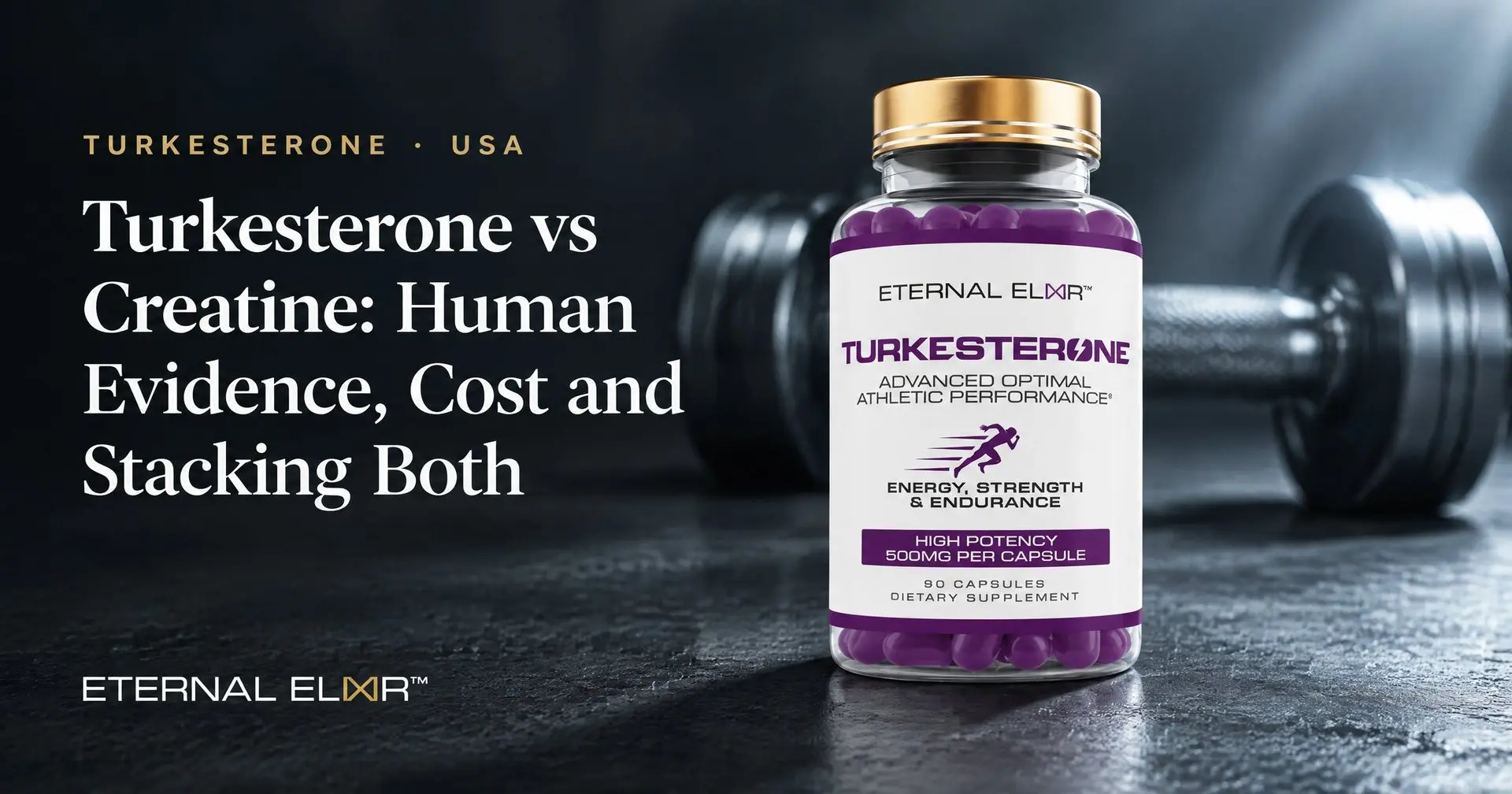
Last updated: · Originally published September 24, 2026 · Published by Eternal Elixir
Edited by Elaine Fletcher, Researcher
Quick answer: Creatine monohydrate is the better-supported supplement by a wide margin. In pooled randomized trials, adding creatine to resistance training produced about 1.1 kg more lean mass than training alone. Turkesterone has two small controlled human studies, and neither found an effect: single doses of 1,000 mg and 2,000 mg changed no measured marker in 11 young men, and 500 mg a day for four weeks did not change body composition in 31 active adults. You can take turkesterone and creatine together, since no interaction is known, but no trial has tested the pair. Creatine is also the cheaper of the two per daily serving.
Eternal Elixir makes a Turkesterone 500mg capsule, which was sold out when we checked our store in September 2026, and we don’t sell creatine. That gives us a stake in half of this comparison. So every study figure below comes from the published paper, and every competitor price comes from the brand’s own product page, read in September 2026. Here is how we write and review content.
Key takeaways
- Creatine: a 2022 meta-analysis of 35 randomized trials (1,192 participants) found 1.10 kg more lean mass when creatine was paired with resistance training.
- Turkesterone: the only two human trials, both published in 2024, found no significant change in IGF-1, metabolic rate or body composition.
- No trial has tested turkesterone during a supervised training program. Its relative, ecdysterone, has a handful of small training trials with mixed results.
- In a 2026 lab analysis, four products labeled as 10% turkesterone held between about 1% and 110% of the expected amount.
- Stacking: no known interaction and no combination trial. Start creatine first, add turkesterone later only with a lot-tested product, and set an end date.
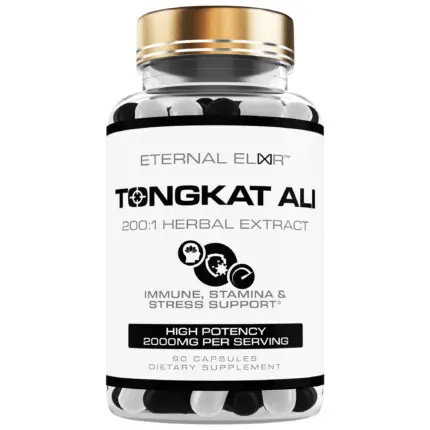
Our turkesterone is away and we don’t make creatine. If you want something in stock from our range for a men’s training routine, our Tongkat Ali is a different ingredient with its own research. It is not a substitute for either supplement in this comparison.
Is turkesterone better than creatine?
No, not on current human evidence. The International Society of Sports Nutrition (ISSN) position stand calls creatine monohydrate the most effective ergogenic nutritional supplement currently available to athletes for increasing high-intensity exercise capacity and lean body mass during training. It also notes more than 1,000 studies since creatine became a popular supplement in the early 1990s (Kreider et al., 2017).
Turkesterone’s controlled human record is two papers from 2024. A Baylor University team gave 11 men single doses (Harris et al., 2024), and a Nova Southeastern University team gave 31 active adults 500 mg a day for four weeks (Antonio et al., 2024). Both came back null.
One disclosure matters on the creatine side. Several authors of the ISSN creatine reviews advise or have received funding from creatine manufacturers, and they declare it in the papers. The pooled trial data come from many research groups, so the conclusion holds, but it is worth knowing who wrote the summaries.
Evidence level: creatine, strong (dozens of randomized trials and several meta-analyses). Turkesterone, preliminary (two small human studies, both null).
Turkesterone vs creatine: the human evidence side by side
| Evidence measure | Creatine monohydrate | Turkesterone |
|---|---|---|
| Controlled human trials | Dozens. One 2022 meta-analysis pooled 35 randomized trials with 1,192 participants (Delpino et al., 2022) | Two: 11 men in a single-dose crossover and 31 active adults over four weeks |
| Longest exposure studied | Up to 30 g a day for five years, reported as well tolerated in healthy people (Kreider et al., 2017) | Four weeks at 500 mg a day |
| Doses studied | 3 to 5 g a day, or 20 g a day for 5 to 7 days when loading | 500 mg a day, and single doses of 1,000 mg and 2,000 mg |
| Outcomes measured | Lean mass, strength, sprint and repeated-effort performance, kidney markers | IGF-1, resting metabolic rate, fuel use, heart rate, blood pressure, stomach symptoms, body composition by DXA scan |
| Main result | About 1.1 kg more lean mass than training alone (1.10 kg in Delpino et al., 2022, and 1.14 kg in adults under 50 in Desai et al., 2024) | No significant difference from placebo on any outcome |
| Cost per label serving (as of Sep 2026) | $0.24 to $0.28 per 5 g | $0.32 to $0.67 |
The turkesterone and ecdysterone trials, one by one
Most turkesterone marketing leans on research into ecdysterone (20-hydroxyecdysone), a related plant ecdysteroid. These are the controlled human trials we could verify, turkesterone first. They are small, and they disagree.
| Study | Participants | Compound and daily dose | Duration | Result |
|---|---|---|---|---|
| Harris et al., 2024, Muscles | 11 healthy men, average age 23 | Turkesterone from Double Wood Supplements, single doses of 1,000 mg and 2,000 mg, and a placebo | 24 hours after each dose | No significant change in IGF-1, resting metabolic rate, or fat and carbohydrate use. IGF-1 rose slightly, but not significantly. No significant change in stomach symptoms, heart rate or blood pressure |
| Antonio et al., 2024, Research Directs in Health Sciences | 31 active adults (14 men, 17 women) | 500 mg of Ajuga turkestanica extract, or a rice flour placebo | 4 weeks on usual diet and exercise | No difference in body mass, lean mass, fat mass or body fat percentage |
| Wilborn et al., 2006 | 45 resistance-trained men, four arms | Ecdysterone, 200 mg | 8 weeks of training | No effect on fat-free mass, strength, sprint power, testosterone or cortisol |
| Isenmann et al., 2019 | 46 young men | Ecdysterone products at two doses | 10 weeks of strength training | Larger gains in muscle mass and bench press with ecdysterone. No rise in liver or kidney markers |
| Denben et al., 2023 | 20 young men | Ecdysterone from asparagus, 30 mg | 12 weeks of training, then detraining | No effect on muscle mass, strength or anabolic hormones after training. Lower cortisol and less strength loss during detraining |
| Dissemond et al., 2025 | 28 trained men, 24 finished | A commercial ecdysterone and diosgenin product, taken as labeled | 12 weeks of training | No group differences. Lab tests found under 1% of the labeled ecdysterone in the capsules |
Only one trial found a muscle benefit, and it used ecdysterone, not turkesterone. Its product was screened for anabolic steroid contamination before the study began (Isenmann et al., 2019). Antonio’s team later pointed out that the placebo group in that trial lost a little muscle despite 10 weeks of training, which makes the gap between the groups harder to read. Ecdysterone and turkesterone are related but different molecules, so a result for one does not carry over to the other.
The Harris doses were not arbitrary. The authors chose them because most turkesterone labels recommend 1,000 mg a day and advise against going past 2,000 mg.
Is turkesterone effective for muscle growth?
Not in people, so far. The claim rests on animal work. A 1976 study cited by the Harris team gave castrated rats 0.5 mg/kg of turkesterone and other ecdysteroids daily for 10 days and reported gains in muscle mass and protein content. In humans, the two trials that exist found nothing: no significant IGF-1 rise after single doses, and no change in lean mass after four weeks at 500 mg a day.
Neither turkesterone study put participants through a supervised training program, which is where creatine shows its effect. The four-week trial asked people to keep their usual diet and exercise habits. So the fair summary is narrower than “turkesterone doesn’t work.” It has not been shown to work, and the one multi-week test at a typical label dose came back flat. The Antonio authors list possible reasons: turkesterone’s absorption in humans is unclear, it may not interact with human receptors the way it does in animal models, and placebo effects may explain some of the online reports.
Evidence level: muscle gains in rats, none shown in two small human studies.
How they work: different mechanisms, different levels of proof
Creatine: more fuel for hard sets
A typical diet supplies 1 to 2 g of creatine a day, which leaves muscle stores about 60% to 80% full. Supplementing raises muscle creatine and phosphocreatine by 20% to 40%, and phosphocreatine regenerates ATP during short, intense efforts (Kreider et al., 2017). You get a little more work out of each hard set, and that adds up over weeks of training. That is also why the effect depends on exercise. In the Delpino meta-analysis, creatine added lean mass alongside resistance training, but the change without exercise was not significant.
Turkesterone: a plausible pathway without human confirmation
Ecdysteroids do not appear to work through the androgen receptor that testosterone uses. In rats and muscle cells, ecdysterone-driven muscle cell growth was blocked by an estrogen receptor beta antagonist but not by an antiandrogen (Parr et al., 2014). Researchers suspect turkesterone behaves the same way, feeding into growth signals such as IGF-1. The one human test of that idea found no significant IGF-1 rise (Harris et al., 2024).
Absorption is another open question. After a single 50 mg dose of ecdysterone in 12 volunteers, about 18% was recovered unchanged in urine, with a half-life of around three hours (Ambrosio et al., 2021). No equivalent human data have been published for turkesterone.
Because creatine works on energy supply and ecdysteroids are thought to act on growth signaling, there is no mechanistic reason to expect them to cancel each other out. That does not mean they add together. Only a combination trial could show that, and none exists.
The label-accuracy problem with turkesterone supplements
A trial result means little if the capsule doesn’t hold what the label says, and ecdysteroid products have a poor record here. A 2020 analysis of 12 ecdysterone supplements found actual content generally much lower than labeled (Ambrosio et al., 2020). In the 2025 training trial, the study product held under 1% of its labeled ecdysterone and 10.4% of its labeled diosgenin (Dissemond et al., 2025).
Turkesterone products were tested directly in a 2026 LC-MS analysis of 13 ecdysteroid supplements (Todorova et al., 2026). Four were Ajuga turkestanica extracts labeled as 10% turkesterone:
| Label claim | Expected turkesterone | Measured turkesterone | Measured ecdysterone |
|---|---|---|---|
| 500 mg extract, minimum 10%, with ginseng and astragalus | 50 mg | 54.77 mg | 0.47 mg |
| 500 mg extract, 10% | 50 mg | 0.64 mg | 24.98 mg |
| 500 mg extract, 10% (an American brand) | 50 mg | 6.23 mg | 2.5 mg |
| 600 mg extract, 10% | 60 mg | 40.03 mg | 35.51 mg |
Only one of the four met its claim. Another delivered about 1% of the expected turkesterone but about 25 mg of ecdysterone, so its buyers were in effect taking an ecdysterone supplement. The paper does not name the brands.
What three US turkesterone labels declare
| Product | Extract per capsule | Turkesterone stated | Capsules | Label serving | Price (as of Sep 2026) |
|---|---|---|---|---|---|
| Eternal Elixir Turkesterone 500mg (sold out) | 500 mg Ajuga turkestanica extract | Not stated. The label declares extract mass only | 60 | 1 capsule | $19.99 |
| Double Wood Turkesterone 10% | 500 mg Ajuga turkestanica (whole plant) | 10%, 50 mg per capsule | 120 | 1 capsule on the facts panel, 2 a day in the directions | $39.95 |
| Nutricost Turkesterone | 600 mg Ajuga turkestanica extract (whole herb) | 10%, 60 mg per capsule | 120 | 1 capsule | $38.97 |
Our label is the least specific of the three on turkesterone content, and our product page says so: it declares 500 mg of extract, not 500 mg of turkesterone. Double Wood publishes a lot certificate on its product page (lot 2530800, tested at 53.5 mg of turkesterone per capsule), and the Harris trial used Double Wood turkesterone. Nutricost says each batch is tested by ISO-accredited laboratories.
The practical rule for any brand, ours included: buy only a product with a lot-specific certificate of analysis that measures turkesterone itself by HPLC or LC-MS. Our reviews of Double Wood Supplements and Nutricost cover both brands in more detail, and our turkesterone supplement comparison sets more labels side by side. Our supplement dose gap report looks at label doses versus research doses across categories.
Cost per day: turkesterone vs creatine
These are one-bottle prices from each brand’s own product page as of Sep 2026, divided by the servings on the label.
| Product | Price | What you get | Cost per label serving |
|---|---|---|---|
| Eternal Elixir Turkesterone 500mg (sold out) | $19.99 | 60 capsules, 1 per serving | $0.33 |
| Double Wood Turkesterone 10% | $39.95 | 120 capsules | $0.33 per capsule, or $0.67 at the 2 capsules a day its directions give |
| Nutricost Turkesterone | $38.97 | 120 capsules, 1 per serving | $0.32 |
| Nutricost Creatine Monohydrate, unflavored 500 g | $23.97 | 5 g scoops, about 100 servings | $0.24 |
| Double Wood Creatine Powder | $27.95 | 100 servings of 5 g | $0.28 |
At label doses the price gap is small. Creatine runs about $0.24 to $0.28 a day and turkesterone about $0.32 to $0.67. The evidence gap is large: for roughly the same money, one supplement has decades of positive training trials and the other has two null studies.
Can you take turkesterone and creatine together?
Yes, as far as current evidence goes. Nothing suggests the combination is a problem, and nothing shows it adds benefit. A PubMed search in September 2026 found no controlled trial combining creatine with turkesterone or ecdysterone.
The only published human report that mentions both is a 2026 case study. A 23-year-old man developed severe exercise-induced muscle breakdown (rhabdomyolysis) after a resistance session of more than four hours, while taking creatine, beta-alanine, citrulline malate, phosphatidic acid, beta-ecdysterone and other supplements (Chowaniec et al., 2026). One case cannot show that any supplement caused it, and the authors pointed to the extreme session and the multi-ingredient stack. It is still a good reason to add one product at a time and to keep training volume steady while you do.
A conservative stacking protocol
- Weeks 1 to 4, creatine alone: 3 to 5 g of creatine monohydrate a day. Loading is optional. The fastest route is 5 g four times a day for 5 to 7 days, while 3 g a day raises muscle stores more gradually over about 28 days (Kreider et al., 2017).
- Log a baseline: weekly morning body weight, waist measurement and two or three lifts at fixed reps.
- Week 5 onward, optional turkesterone: only a product with a lot-specific certificate of analysis. Start at the label’s lowest serving and stay at or below 2,000 mg a day. That is the highest amount given to people in a study, and it was a single dose.
- Timing: no human data exist on turkesterone timing. The Harris team gave it in the morning. For creatine, timing studies are few and small, so taking it every day matters more than when (Antonio et al., 2025).
- Set an end date: after 8 to 12 weeks, compare your log. If there is no clear difference, drop turkesterone and keep creatine.
- Before blood work: tell your doctor you take creatine. In a 2026 meta-analysis of randomized trials, it raised serum creatinine by about 0.13 mg/dL on average without changing urea or estimated kidney filtration (Tsiaras et al., 2026).
- Ask your doctor first if you have a kidney or liver condition, take prescription medicine, are under 18, or are pregnant or breastfeeding.
Side effects and safety compared
Creatine has the deeper safety record. The ISSN position stand reports that weight gain is the only consistently reported side effect, and that intakes up to 30 g a day for five years were well tolerated in healthy people (Kreider et al., 2017). Loading can cause short-term fluid retention of about 0.5 to 1.0 liters, while longer training studies show no change in total body water relative to muscle (Antonio et al., 2021).
Turkesterone’s human safety data are thin. In the single-dose study, neither dose significantly changed stomach symptoms, heart rate or blood pressure in the 11 men (Harris et al., 2024). The four-week trial did not report adverse events, but it was not designed to look for them. No study has measured liver markers or testosterone after turkesterone. The closest data come from the 10-week ecdysterone trial, which found no rise in liver or kidney markers (Isenmann et al., 2019). Our turkesterone side effects guide covers the details.
Drug-tested athletes should be careful with any ecdysteroid product. The Isenmann authors argued that ecdysterone should be banned in tested sport, and the label data above mean a capsule sold as turkesterone may contain mostly ecdysterone. Check your sport’s anti-doping rules before you use one.
Who might still choose turkesterone
- Lifters with the basics covered: a structured program, enough protein, good sleep and at least eight weeks of daily creatine.
- People running a defined self-experiment: willing to log measurements, set a stop date, and accept that the likeliest outcome is no visible difference.
- People who dislike creatine’s early scale weight: skipping the loading phase usually solves this, so it is rarely a good reason to swap.
It is a poor fit if you expect steroid-like results or higher testosterone. Ecdysterone trials that measured hormones found no change in testosterone or other anabolic hormones (Wilborn et al., 2006, and Denben et al., 2023), and no human study has measured testosterone after turkesterone. If hormone support is your goal, our guides to natural testosterone boosters, tongkat ali supplements and fadogia agrestis cover a different evidence base. Our guide to supplements for men over 40 places them in a broader routine.
What we sell for a men’s training routine
Our Turkesterone 500mg supplies 500 mg of Ajuga turkestanica extract per capsule, one capsule per serving, 60 capsules for $19.99. That capsule matches the 500 mg daily dose in the four-week trial, which found no body-composition change, and our product page states that result. It was sold out when we checked. We don’t sell creatine.
While our turkesterone is away, these in-stock products from our men’s range are different ingredients with their own research. None replaces creatine, and none has been shown to build muscle.
- Tongkat Ali 200:1 Extract 2000mg: 2,000 mg of Eurycoma longifolia root extract per 3-capsule serving, 90 capsules, $29.99 or $1.00 a serving. A 2022 meta-analysis pooled five randomized trials and found higher total testosterone in men taking tongkat ali (Leisegang et al., 2022). Those trials used specific standardized extracts, and our product page says this exact 200:1 product has not been clinically tested. Talk to your doctor before using it if you take prescription medicines.
- Tongkat Ali + Fadogia 2010mg: 1,500 mg of Fadogia agrestis 10:1 extract, 500 mg of tongkat ali 200:1 extract and 10 mg of black pepper extract per 3-capsule serving, $19.99 or $0.67 a serving. Our product page states that fadogia lacks human clinical evidence and has a preclinical safety signal, so read our fadogia supplement comparison first.
- Shilajit 1000mg: 1,000 mg of 20:1 shilajit extract standardized to 20% fulvic acid per 2-capsule serving, 60 capsules, $44.99 or $1.50 a serving. Our guide to shilajit for men covers its human trials.
- Korean Panax Ginseng 1600mg: $44.99 a bottle. Our ginseng guide for men reviews the evidence.
Frequently asked questions about turkesterone vs creatine
Is turkesterone better than creatine?
No. A meta-analysis of 35 randomized creatine trials found 1.10 kg more lean mass when creatine was combined with resistance training. Turkesterone has two controlled human studies, in 11 men given single doses and in 31 active adults given 500 mg a day for four weeks, and neither found a significant effect.
Is it good to take turkesterone and creatine together?
No interaction is known, so combining them is not expected to cause problems, but no trial has tested the pair and any added benefit from turkesterone is unproven. A cautious approach is creatine alone for about four weeks, then turkesterone from a lot-tested product with a set end date.
Do turkesterone and creatine cancel each other out?
There is no evidence that they do. Creatine raises muscle phosphocreatine for high-intensity effort, while ecdysteroids such as turkesterone are thought to signal through estrogen receptor beta, based on cell and animal research. The two have never been studied together.
Is turkesterone effective for muscle growth?
Not on current human evidence. Four weeks of 500 mg a day did not change lean mass in 31 active adults, and single doses of 1,000 mg and 2,000 mg did not significantly raise IGF-1 in 11 men. Neither study included a supervised training program. Ecdysterone, a relative, has mixed results in small training trials.
Is it better to take creatine or testosterone?
They are not alternatives. Testosterone is a prescription hormone, and whether you need it is a decision for your doctor after blood tests. Creatine is a dietary supplement that supports high-intensity exercise performance, and it is not a hormone. Of 12 studies that measured testosterone during creatine use, 10 found no change and 2 found small increases after six and seven days (Antonio et al., 2021). Turkesterone is not a testosterone substitute either, and no human study has measured testosterone after taking it.
Why don’t doctors like creatine?
Some clinicians are wary because creatine raises serum creatinine, the blood marker labs use to estimate kidney function. In a 2026 meta-analysis of randomized trials, creatine raised creatinine by about 0.13 mg/dL without changing urea or eGFR, but the higher number can still flag a routine blood test (Tsiaras et al., 2026). The early water weight puts some people off too. In healthy people, the only consistently reported side effect is weight gain. Tell your doctor you take it, especially before blood work, and ask first if you have a kidney condition.
Does creatine cause hair loss?
The evidence says no. The worry traces to a 2009 study of college rugby players in which DHT rose 56% after a week of creatine loading and stayed 40% above baseline after two more weeks. No study has reported hair loss in people taking creatine, and a 2021 review concluded that the evidence does not show creatine raises testosterone or DHT or causes hair loss (Antonio et al., 2021).
How much creatine and turkesterone should you take?
For creatine, 3 to 5 g of monohydrate a day, with optional loading at 5 g four times a day for 5 to 7 days. For turkesterone, no effective dose has been established. The human studies used 500 mg a day for four weeks and single doses of 1,000 mg and 2,000 mg, and most labels suggest 1,000 mg a day and no more than 2,000 mg. Our Turkesterone 500mg label gives one 500 mg capsule per serving.
The bottom line
If you are choosing one, choose creatine monohydrate. It costs about $0.24 to $0.28 a day, it has a long record of adding lean mass and strength alongside training, and weight gain is its only consistently reported side effect. Turkesterone may still interest lifters who have the basics covered. But the two human studies are null, the products vary widely in what they contain, and anyone who tries it should use a lot-tested product and set an end date.
If you came here for a men’s training supplement from our range, our turkesterone is sold out, and the in-stock options above come with what their research does and does not show.
Sources
- Kreider RB, Kalman DS, Antonio J, et al. (2017). International Society of Sports Nutrition position stand: safety and efficacy of creatine supplementation in exercise, sport, and medicine. Journal of the International Society of Sports Nutrition. PMID 28615996
- Delpino FM, Figueiredo LM, Forbes SC, et al. (2022). Influence of age, sex, and type of exercise on the efficacy of creatine supplementation on lean body mass: a systematic review and meta-analysis of randomized clinical trials. Nutrition. PMID 35986981
- Desai I, Wewege MA, Jones MD, et al. (2024). The effect of creatine supplementation on resistance training-based changes to body composition: a systematic review and meta-analysis. Journal of Strength and Conditioning Research. PMID 39074168
- Antonio J, Candow DG, Forbes SC, et al. (2021). Common questions and misconceptions about creatine supplementation: what does the scientific evidence really show? Journal of the International Society of Sports Nutrition. PMID 33557850
- Antonio J, Brown AF, Candow DG, et al. (2025). Part II. Common questions and misconceptions about creatine supplementation: what does the scientific evidence really show? Journal of the International Society of Sports Nutrition. PMID 39720835
- Tsiaras A, Loufopoulos G, Theodoridis X, et al. (2026). The effect of creatine supplementation on kidney function: a systematic review and meta-analysis of randomized controlled trials. Journal of Renal Nutrition. PMID 42035842
- Harris DR, Chapman-Lopez T, Machek SB, et al. (2024). The effects of multiple acute turkesterone doses on indirect measures of hypertrophy and metabolic measures: a preliminary investigation. Muscles. PMID 40757520
- Antonio J, Silver T, Lukowiak A, Jiannine L. (2024). A preliminary investigation of turkesterone: it’s not Deca. Research Directs in Health Sciences. DOI 10.53520/rdhs2024.104126
- Wilborn CD, Taylor LW, Campbell BI, et al. (2006). Effects of methoxyisoflavone, ecdysterone, and sulfo-polysaccharide supplementation on training adaptations in resistance-trained males. Journal of the International Society of Sports Nutrition. PMID 18500969
- Isenmann E, Ambrosio G, Joseph JF, et al. (2019). Ecdysteroids as non-conventional anabolic agent: performance enhancement by ecdysterone supplementation in humans. Archives of Toxicology. PMID 31123801
- Denben B, Sripinyowanich S, Ruangthai R, Phoemsapthawee J. (2023). Beneficial effects of Asparagus officinalis extract supplementation on muscle mass and strength following resistance training and detraining in healthy males. Sports (Basel). PMID 37755852
- Dissemond J, Havers T, Held S, et al. (2025). How reliable is the labeling of a commercial phytosteroid product? A 12-week randomized double-blind training study. Journal of the International Society of Sports Nutrition. PMID 40781783
- Ambrosio G, Wirth D, Joseph JF, et al. (2020). How reliable is dietary supplement labelling? Experiences from the analysis of ecdysterone supplements. Journal of Pharmaceutical and Biomedical Analysis. PMID 31568967
- Todorova V, Ivanova S, Ardasheva R, Ivanov K. (2026). Simultaneous LC-MS profiling of bioactive ecdysteroids in nutrient-dense plant sources and dietary supplements. Molecules. PMID 41976134
- Parr MK, Zhao P, Haupt O, et al. (2014). Estrogen receptor beta is involved in skeletal muscle hypertrophy induced by the phytoecdysteroid ecdysterone. Molecular Nutrition & Food Research. PMID 24974955
- Ambrosio G, Yuliandra T, Wuest B, et al. (2021). Urinary elimination of ecdysterone and its metabolites following a single-dose administration in humans. Metabolites. PMID 34207569
- Chowaniec P, Miedziaszczyk M, Kucia M, et al. (2026). Exercise-induced rhabdomyolysis with supplements (creatine, beta-alanine, citrulline malate, and beta-ecdysterone). Cureus. PMID 41952948
- Leisegang K, Finelli R, Sikka SC, Panner Selvam MK. (2022). Eurycoma longifolia (Jack) improves serum total testosterone in men: a systematic review and meta-analysis of clinical trials. Medicina (Kaunas). PMID 36013514
- Product labels and prices: Double Wood Supplements, Nutricost and Eternal Elixir product pages, read September 2026.
These statements have not been evaluated by the Food and Drug Administration. This product is not intended to diagnose, treat, cure, or prevent any disease.