Last updated: · Originally published September 18, 2026 · Published by Eternal Elixir
Edited by Elaine Fletcher, Researcher
Quick answer: TUDCA (tauroursodeoxycholic acid) is a bile acid your body makes in small amounts by attaching the amino acid taurine to ursodeoxycholic acid (UDCA). People take it for bile flow and liver support. Its benefits in human studies are real but narrow. Most trials enrolled people under medical care, and the dosage ran from 500 mg to 2,000 mg a day. On safety, it was well tolerated, and loose stools were the most common complaint. Studies in healthy adults are small, short and mixed. Our pick is Eternal Elixir TUDCA 500mg: one 500 mg capsule per label serving, 60 capsules, $1.00 a serving. One capsule equals the lowest daily dose used in human trials, and most trials used more.
Eternal Elixir makes TUDCA 500mg, and it is our pick in this guide. Our product facts come from our US product page. Competitor figures come from their own US product pages, read in September 2026, and every study claim links to its source. Each benefit below carries an evidence level so you can see what kind of study stands behind it. Here is how we write and review content.
What is TUDCA?
TUDCA is short for tauroursodeoxycholic acid. It belongs to the bile acid family: compounds your liver makes from cholesterol, stores in the gallbladder and releases into the small intestine, where they help you absorb dietary fat. Your liver makes about 200 to 600 mg of new bile acids a day, and a pool of about 3 g circulates between the gut and the liver 4 to 12 times a day (Chiang, Comprehensive Physiology, 2013).
TUDCA is a small part of that pool. The same review puts the pool at roughly 40% cholic acid, 40% chenodeoxycholic acid and 20% deoxycholic acid, and UDCA and its taurine form are not among the main ones listed. Your body builds TUDCA in steps. The liver turns cholesterol into primary bile acids, gut bacteria convert some of them into UDCA, and UDCA returns to the liver, which attaches taurine to make TUDCA (Kusaczuk, Cells, 2019). The taurine makes it more water-soluble than UDCA.
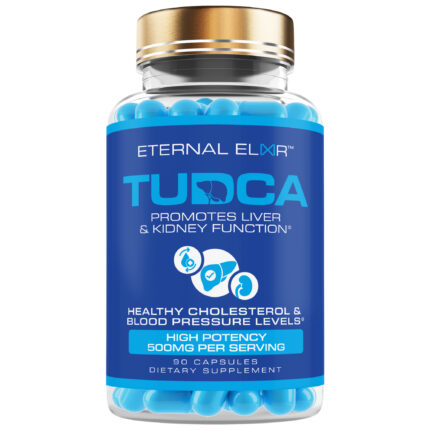
Traditional Chinese medicine valued animal bile, including bear bile, for centuries (Kusaczuk). Today TUDCA is sold as a supplement ingredient in its own right. Double Wood, for one, says its TUDCA is made from cholic acid, which is converted to UDCA and then joined to taurine. Our label lists 500 mg of TUDCA per capsule with rice flour and a cellulose capsule, and nothing else.
TUDCA, UDCA and taurine are three different things
UDCA (ursodeoxycholic acid) is the parent bile acid and a long-standing prescription medicine. TUDCA is UDCA with taurine attached, and in the US it is sold as a dietary supplement. Taurine is an amino acid and only one part of the TUDCA molecule, so a taurine supplement is not a TUDCA supplement.
Inside the body the line between TUDCA and UDCA blurs. In a six-month study, much of the oral TUDCA lost its taurine and had glycine or taurine reattached as it cycled through the gut and liver (Setchell and colleagues, Gut, 1996). In 12 young adults given a single 1,500 mg dose, blood UDCA rose more than blood TUDCA did (Hemingway and colleagues, 2020). A TUDCA capsule raises both.
How TUDCA works: bile flow and the chaperone idea
Two mechanisms get cited. The first is plain bile acid physiology. About 95% of bile acids are reabsorbed at the end of the small intestine and sent back to the liver (Chiang, 2013). Taking TUDCA adds a water-soluble bile acid to that loop and changes the mix. That shift is the best-measured thing TUDCA does in people, and the next section gives the numbers.
The second is the “chemical chaperone” idea. The endoplasmic reticulum (ER) is the part of a cell that folds new proteins. When misfolded proteins pile up, the cell mounts a stress response, and in cell and animal studies TUDCA eases that response (Kusaczuk, 2019). Most product pages lead with this mechanism. It is mostly a lab finding. In the one randomized human trial that measured ER stress markers in muscle and fat tissue, those markers did not change on TUDCA or on placebo, even though insulin sensitivity improved (Kars and colleagues, 2010). The authors wrote that the target cells and mechanism still needed work.
TUDCA benefits: what human studies show
Here is every benefit area with human data we could find, and the kind of evidence behind each one. “Patient group” means people under medical care for a diagnosed condition. Those results tell you how TUDCA behaves in the body, not what it will do for a healthy adult.
| Area | What human studies found | Who, dose, length | Evidence level |
|---|---|---|---|
| Bile acid mix | More UDCA-type bile acids in bile, fewer of the less water-soluble kinds | Patients with a chronic liver condition, 500 to 1,500 mg a day, 6 months | Human, patient group |
| Liver enzyme markers | About the same as the prescription bile acid UDCA | 199 patients, 750 mg a day, 24 weeks | Human randomized trial, patient group |
| Insulin sensitivity | About 30% higher in liver and muscle, no change in fat tissue | 20 adults with an average BMI of 37, 1,750 mg a day, 4 weeks | One small randomized trial |
| Blood vessel function | Held steady after a sugar drink in one study, no effect in a second test | 12 healthy young adults per study, 1,500 mg, single dose | Two small studies, mixed |
| Cellular stress (ER stress) | No change in human muscle or fat markers | The same 20-adult trial | Mostly cell and animal data |
| Brain and nerve research | Early signals in patients, plus safety data at 2,000 mg a day | 34 and 47 patients, 2,000 mg a day, 16 to 54 weeks | Small trials in patient groups, none in healthy adults |
| Fat digestion, including after gallbladder removal | No controlled trial found | None | Rationale only |
Bile acid mix: the best-measured effect
In the Setchell study, adults with a mild chronic liver condition were randomly assigned 500, 1,000 or 1,500 mg of TUDCA a day for six months. Total UDCA in all its forms rose to an average of 34.4%, 32.8% and 41.6% of the bile acid pool, and the shares of chenodeoxycholic acid and cholic acid fell. The authors judged this shift toward a more water-soluble pool potentially more favorable than what UDCA itself achieves, because gut bacteria alter TUDCA less.
Two cautions apply. These were patients, not healthy adults. And on this measure the 1,000 mg dose did no better than 500 mg, so more was not clearly better. Evidence level: human, patient group.
Liver enzymes: TUDCA against prescription UDCA
The largest TUDCA trial randomized 199 adults with a chronic autoimmune bile duct condition to 250 mg of TUDCA or 250 mg of UDCA three times a day for 24 weeks (Ma and colleagues, Medicine, 2016). About 76% on TUDCA and 81% on UDCA reached the main target, a drop of more than 25% in the liver enzyme alkaline phosphatase, and the gap was not statistically significant. Side effect rates were similar.
That shows TUDCA behaves much like UDCA under specialist care. It does not show what TUDCA does for a healthy liver, and it is no reason to swap a prescribed medicine for a supplement. Talk to your doctor before changing any medicine. Evidence level: human randomized trial, patient group.
Insulin sensitivity: one small trial at a high dose
Kars and colleagues gave 20 adults with an average BMI of 37 either 1,750 mg of TUDCA a day or a placebo for four weeks. They measured insulin sensitivity with a clamp test, the reference method, plus muscle and fat biopsies. Insulin sensitivity in the liver and muscle rose by about 30% on TUDCA (p < 0.05) and did not change on placebo. Fat tissue did not respond.
This is the result most TUDCA marketing quotes. Keep its limits in view: one trial, 20 people, four weeks, at three and a half times our serving. We found no larger trial that repeated it. Evidence level: one small randomized trial.
Blood vessel function: one yes, one no
Two small studies gave healthy young adults a single 1,500 mg dose and tested flow-mediated dilation, a measure of how well an artery widens. In the first, 12 adults drank a glucose load. On placebo their dilation fell 32% an hour later. On TUDCA it fell 4%, and blood glucose and insulin were the same under both conditions (Walsh and colleagues, Clinical Science, 2016).
In the second, 12 adults had blood flow to one arm cut off for 20 minutes. Dilation dropped afterward by the same amount on TUDCA and placebo (Hemingway and colleagues, 2020). Single doses, tiny groups and lab tests: interesting physiology, not a reason to buy. Evidence level: two small studies, mixed.
Brain and nerve research: early, and in patients only
A 54-week pilot trial gave 34 people with a progressive motor neuron disease 1 g of TUDCA twice a day or placebo, on top of their prescribed medicine. More people on TUDCA met the study’s responder threshold, their function scores declined more slowly, and adverse events did not differ between groups (Elia and colleagues, European Journal of Neurology, 2016). A larger European trial planned to enroll 320 patients to test the idea properly (Albanese and colleagues, 2022). We could not find its results in PubMed when we checked in September 2026.
In a 16-week trial, 47 adults with a progressive neurological disease took 2,000 mg of TUDCA a day or placebo. Safety was the main question. TUDCA raised several bile acids in the blood, but clinical outcomes did not differ significantly from placebo (Ladakis and colleagues, Med, 2025). None of this tells you anything about memory or focus in healthy adults, and we found no human trial that tested them. Evidence level: small trials in patient groups.
Fat digestion and life after gallbladder removal
Many people buy TUDCA because fatty meals sit badly with them, or because they have had their gallbladder removed. The reasoning is that it tops up the bile acid pool. We found no controlled trial of TUDCA for either use, so this is a rationale, not a finding. If you have had your gallbladder removed, ask your doctor before you start. Evidence level: rationale only.
TUDCA dosage: trial doses against US labels
Human studies used 500 mg to 2,000 mg a day. US capsules usually hold 250 mg or 500 mg. Here is how they line up:
| Source | Daily amount | Length | Who took it |
|---|---|---|---|
| Setchell, 1996 | 500, 1,000 or 1,500 mg | 6 months | Patients with a chronic liver condition |
| Ma, 2016 | 750 mg (250 mg three times a day) | 24 weeks | 199 patients |
| Walsh, 2016 and Hemingway, 2020 | 1,500 mg | Single dose | 12 healthy young adults in each |
| Kars, 2010 | 1,750 mg | 4 weeks | 20 adults with an average BMI of 37 |
| Elia, 2016 | 2,000 mg (1 g twice a day) | 54 weeks | 34 patients |
| Ladakis, 2025 | 2,000 mg | 16 weeks | 47 patients |
| Typical US label | 250 to 500 mg per capsule | Open-ended | Self-directed |
| Eternal Elixir TUDCA 500mg | 500 mg (1 capsule) | Open-ended | Self-directed |
Our serving is one 500 mg capsule. To put it plainly, that is the lowest daily dose any of these trials used. It sits below the 750 mg a day in the largest trial, and it is a third or less of the 1,500 mg to 2,000 mg doses in the blood vessel, insulin and neurological studies. In the six-month bile study, 1,000 mg a day did about as well as 500 mg. Follow the label serve of one capsule a day, and ask your doctor before taking more.
Add TUDCA 500mg to cart · $59.99
The longer trials that reported a schedule split the daily amount: the largest used three doses of 250 mg, and the 54-week trial gave 1 g twice a day. Labels disagree about food. Double Wood’s says to take two capsules a day on an empty stomach, and no study has compared fed and fasted TUDCA. Our guide on when to take TUDCA, with or without food covers timing in detail. The gap between trial and label doses is common across supplements, and our dose gap report on trial doses versus US labels maps it category by category.
TUDCA side effects and safety
In the trials above, TUDCA was well tolerated, and digestive complaints were the main side effects.
- 24 weeks at 750 mg a day. Adverse events were reported by 44% of people on TUDCA and 40% on UDCA, and most were judged unrelated to either drug. Only 4 of the 129 people on TUDCA (3.1%) had events judged related to it, one of them diarrhea. There were no serious adverse events (Ma and colleagues, 2016).
- 16 weeks at 2,000 mg a day. At least one adverse event occurred in 38% of the TUDCA group and 33% of the placebo group (p = 0.77). Diarrhea affected 3 of 26 people on TUDCA and none of 21 on placebo. One hospital stay for bile duct inflammation in the TUDCA group was judged unlikely to have been caused by it (Ladakis and colleagues, 2025).
- 54 weeks at 2,000 mg a day. Adverse events did not differ from placebo (Elia and colleagues, 2016).
Loose stools make sense for a bile acid. Bile acids that reach the colon draw in water and speed up transit (Camilleri, Gut and Liver, 2015). If it happens, cutting back the dose is a sensible first step.
Who should talk to a doctor before taking TUDCA
- Anyone who is pregnant or breastfeeding, because there are no safety data.
- Anyone with a liver, gallbladder or bile duct condition, including gallstones or a blocked bile duct.
- Anyone who has had their gallbladder removed.
- Anyone taking prescription medicines, especially UDCA or a bile acid sequestrant such as cholestyramine, colestipol or colesevelam. Sequestrants bind bile acids in the gut, so they would likely bind TUDCA too.
- Anyone under 18.
Can TUDCA hurt your liver?
None of the trials above linked TUDCA to liver harm. Most were short, though, and most enrolled patients whose doctors were watching them. There are no long-term data in healthy adults. Our own product page says the same thing in its evidence note: TUDCA research often involves people with diagnosed disease and clinician-directed dosing.
How to choose a TUDCA supplement
Four label details matter more than the marketing:
- TUDCA per capsule. 250 mg capsules give finer steps. 500 mg capsules mean fewer pills.
- Capsules per label serving. Some brands need two capsules to reach 500 mg, which halves how long a bottle lasts.
- A stated amount. Skip blends that do not state how much TUDCA they contain.
- Cost per 500 mg, worked out from the label serving, not the headline price.
Here is how our TUDCA compares with two popular US brands, with prices as of Sep 2026:
| Product | TUDCA per capsule | Capsules | Label serving | Price | Cost per 500 mg | Buy |
|---|---|---|---|---|---|---|
| Eternal Elixir TUDCA 500mg (our pick) | 500 mg | 60 | 1 capsule | $59.99 | $1.00 | View product |
| Double Wood TUDCA | 250 mg | 60 | 2 capsules | $27.95 | $0.93 | Double Wood |
| Nutricost TUDCA 250mg | 250 mg | 60 | 1 capsule | $27.97 | $0.93 | Nutricost |
| Nutricost TUDCA 500mg | 500 mg | 30 | 1 capsule | $28.97 | $0.97 | Nutricost |
Add TUDCA 500mg to cart · $59.99
At one-bottle prices, Double Wood and Nutricost’s 250 mg bottle cost less per 500 mg than ours, $0.93 against $1.00, and their 250 mg capsules allow smaller steps. Double Wood’s three-pack at $75.47 brings it to about $0.84 per 500 mg. Ours drops to $0.80 a serving on the five-bottle tier, which is 20% off. What ours gives you is a full 500 mg in one plant cellulose capsule with two other ingredients, and 60 servings a bottle, twice the servings in Double Wood’s bottle or Nutricost’s 500 mg bottle. Double Wood uses a bovine gelatin capsule. Our comparison of eight TUDCA supplements covers more brands, and our Double Wood review and Nutricost review look at each brand’s wider range.
TUDCA vs milk thistle, NAC and glutathione
These are often bought for the same reason but do different jobs. TUDCA is a bile acid. Milk thistle is a plant extract whose active compounds are known as silymarin. Glutathione is an antioxidant your cells make from three amino acids, and NAC is a form of one of them, cysteine. Our TUDCA vs milk thistle and NAC breakdown compares their human research side by side, and our liver supplement comparison ranks the wider category.
If you already take glutathione, our Reduced L-Glutathione 2000mg gives 2,000 mg per two-capsule serving, at $39.99 for 30 servings, or $1.33 a serving. Our glutathione supplement comparison covers other options.
We found no human trial of TUDCA and glutathione taken together. The pairing is a convenience for people who already take both. Our range also includes Berberine HCl 500mg, and our berberine supplement comparison covers its human trials. For how single ingredients fit together without doubling up, see our longevity supplement stacks comparison.
Our TUDCA 500mg: who it suits and who it doesn’t
We make this one, so here are the label facts. Each capsule holds 500 mg of TUDCA with rice flour and a cellulose capsule. A bottle holds 60 capsules at one capsule per label serving, for $59.99, or $1.00 a serving. Two bottles save 10%, three save 15% and five save 20%. We offer a 30-day money-back guarantee, free US shipping over $100, and orders ship in 24 hours.
It suits you if you want 500 mg steps, one capsule per serving, a plant-based capsule and a two-month supply at one capsule a day. It does not suit you if you want 250 mg steps, the lowest one-bottle price per 500 mg, or trial-sized doses, since the label serve is one 500 mg capsule a day.
Add TUDCA 500mg to cart · $59.99
Frequently asked questions about TUDCA
What is TUDCA used for?
People take TUDCA mainly for bile flow and liver support. In human studies it shifted the bile acid mix toward more water-soluble bile acids and was well tolerated. Most of that research was in patients under medical care, and it is not a treatment for any medical condition.
Is TUDCA the same as taurine or UDCA?
No. TUDCA is UDCA with the amino acid taurine attached. UDCA is a prescription bile acid, taurine is an amino acid, and TUDCA is sold as a supplement. In the body, part of a TUDCA dose is converted to other forms of UDCA.
How much TUDCA should I take a day?
Follow your label. Human trials used 500 mg to 2,000 mg a day, often split into two or three doses. Our label serving is one 500 mg capsule, the lowest daily dose used in those trials. Ask your doctor before going above your label.
Is it safe to take TUDCA every day?
Daily use was well tolerated in trials lasting up to 54 weeks, mostly in supervised patients. Diarrhea was the most common side effect. There are no long-term data in healthy adults, so check with your doctor if you plan to take it for months.
What should you not take with TUDCA?
Avoid taking it alongside bile acid sequestrants such as cholestyramine, colestipol or colesevelam, which bind bile acids in the gut. If you take UDCA or any prescription medicine, ask your pharmacist or doctor about timing first.
How long does TUDCA take to work?
Apart from single-dose lab tests, trials measured their outcomes after four weeks to about a year. There is no effect you should expect to feel from a single capsule. Judge it over weeks, not days.
What is the best TUDCA supplement?
Our pick is Eternal Elixir TUDCA 500mg: one 500 mg capsule per label serving, 60 capsules, rice flour and a cellulose capsule as the only other ingredients, at $1.00 a serving. If the lowest one-bottle cost per 500 mg matters most to you, Double Wood and Nutricost’s 250 mg bottle come in at $0.93.
Add TUDCA 500mg to cart · $59.99
The bottom line on TUDCA
TUDCA is a water-soluble bile acid with a small, honest evidence base. It changes the bile acid mix, it matched prescription UDCA on liver enzymes in patients, and it was well tolerated at up to 2,000 mg a day. The insulin and blood vessel results are small and unconfirmed, and the brain research is early and limited to patients. Start at your label serving, expect nothing you can feel on day one, and bring your doctor in if you have a liver or gallbladder condition or take prescription medicines. Our pick is Eternal Elixir TUDCA 500mg, and you can browse the full Eternal Elixir range as well.
Sources
- Chiang JY. Bile acid metabolism and signaling. Comprehensive Physiology, 2013. PubMed 23897684
- Kusaczuk M. Tauroursodeoxycholate: bile acid with chaperoning activity. Molecular and cellular effects and therapeutic perspectives. Cells, 2019. PubMed 31757001
- Setchell KD, Rodrigues CM, Podda M, Crosignani A. Metabolism of orally administered tauroursodeoxycholic acid in patients with primary biliary cirrhosis. Gut, 1996. PubMed 8675100
- Hemingway HW, Moore AM, Olivencia-Yurvati AH, Romero SA. Effect of endoplasmic reticulum stress on endothelial ischemia-reperfusion injury in humans. American Journal of Physiology: Regulatory, Integrative and Comparative Physiology, 2020. PubMed 33074709
- Kars M, Yang L, Gregor MF, et al. Tauroursodeoxycholic acid may improve liver and muscle but not adipose tissue insulin sensitivity in obese men and women. Diabetes, 2010. PubMed 20522594
- Ma H, Zeng M, Han Y, et al. A multicenter, randomized, double-blind trial comparing the efficacy and safety of TUDCA and UDCA in Chinese patients with primary biliary cholangitis. Medicine, 2016. PubMed 27893675
- Walsh LK, Restaino RM, Neuringer M, Manrique C, Padilla J. Administration of tauroursodeoxycholic acid prevents endothelial dysfunction caused by an oral glucose load. Clinical Science, 2016. PubMed 27503949
- Elia AE, Lalli S, Monsurrò MR, et al. Tauroursodeoxycholic acid in the treatment of patients with amyotrophic lateral sclerosis. European Journal of Neurology, 2016. PubMed 25664595
- Albanese A, Ludolph AC, McDermott CJ, et al. Tauroursodeoxycholic acid in patients with amyotrophic lateral sclerosis: the TUDCA-ALS trial protocol. Frontiers in Neurology, 2022. PubMed 36237618
- Ladakis DC, Harrison KL, Smith MD, et al. Bile acid metabolites predict multiple sclerosis progression and supplementation is safe in progressive disease. Med, 2025. PubMed 39447576
- Camilleri M. Bile acid diarrhea: prevalence, pathogenesis, and therapy. Gut and Liver, 2015. PubMed 25918262
- Product pages for Double Wood TUDCA, Nutricost TUDCA, and Eternal Elixir TUDCA 500mg and Reduced L-Glutathione 2000mg, read September 2026.
These statements have not been evaluated by the Food and Drug Administration. This product is not intended to diagnose, treat, cure, or prevent any disease.