Last updated: · Originally published August 23, 2026 · Published by Eternal Elixir
Edited by Elaine Fletcher, Researcher
Quick answer: Fadogia agrestis is a West African shrub whose stem extract is sold in the US for testosterone support. In male rats, a water extract of the stem raised testosterone within five days, and the same doses given for 28 days changed testicular, liver and kidney markers in ways the researchers called adverse. No human trial has been published. Single-ingredient US labels we checked give 300 to 600 mg a day. If you want to try it, our pick is Eternal Elixir Tongkat Ali + Fadogia: a full label with 1,500 mg of a 10:1 fadogia extract, 500 mg of a 200:1 tongkat ali extract and 10 mg of BioPerine per three-capsule serving, at $0.67 a serving. Tongkat ali is the half of that formula with human trials behind it.
Eternal Elixir makes Tongkat Ali + Fadogia, and it is our pick in this guide. Our product facts come from our own US product pages. Competitor figures come from their US product pages, read on September 25, 2026, and every study claim links to its source. Here is how we write and review content.
What is fadogia agrestis?
Fadogia agrestis is a shrub in the Rubiaceae family, the plant family that also includes coffee. It grows in West Africa, and researchers have recorded it in a survey of traditional plant medicine in Burkina Faso and in a study of Ghana’s herbal markets. Botanists now often list it as Vangueria agrestis, so some chemistry papers use that name instead. The part sold in supplements is the stem.
US product pages explain it with one mechanism. The plant is said to raise luteinizing hormone (LH), the pituitary signal that tells the testes to make testosterone. That story is plausible, but it has not been measured. None of the four rat studies indexed on PubMed reports LH in its abstract, and no study in people exists. What the rat papers measured was testosterone itself, mating behavior and organ chemistry.
You will find it in three forms: ground stem powder, a concentrated extract with a stated ratio such as 10:1, and blends that pair it with tongkat ali. If you are still choosing an ingredient, our comparison of natural testosterone boosters ranked by human evidence and dose puts fadogia next to options with far more trials. The pattern will look familiar if you have read about turkesterone and its thin safety data: big social media demand and a small research file.
Fadogia agrestis benefits: what is claimed and what has been shown
People take fadogia hoping for three things. Here is where each one stands.
- Testosterone support. Shown in male rats over five days. Not tested in men. Evidence level: animal only.
- Sex drive. Rat mating measures improved in the same five-day study, and a 2023 rat study found better nitric oxide markers in penile and testicular tissue. Not tested in men. Evidence level: animal only.
- Muscle and training performance. Some product pages mention it. We found no published study of fadogia and muscle, strength or performance in animals or people. Evidence level: none published.
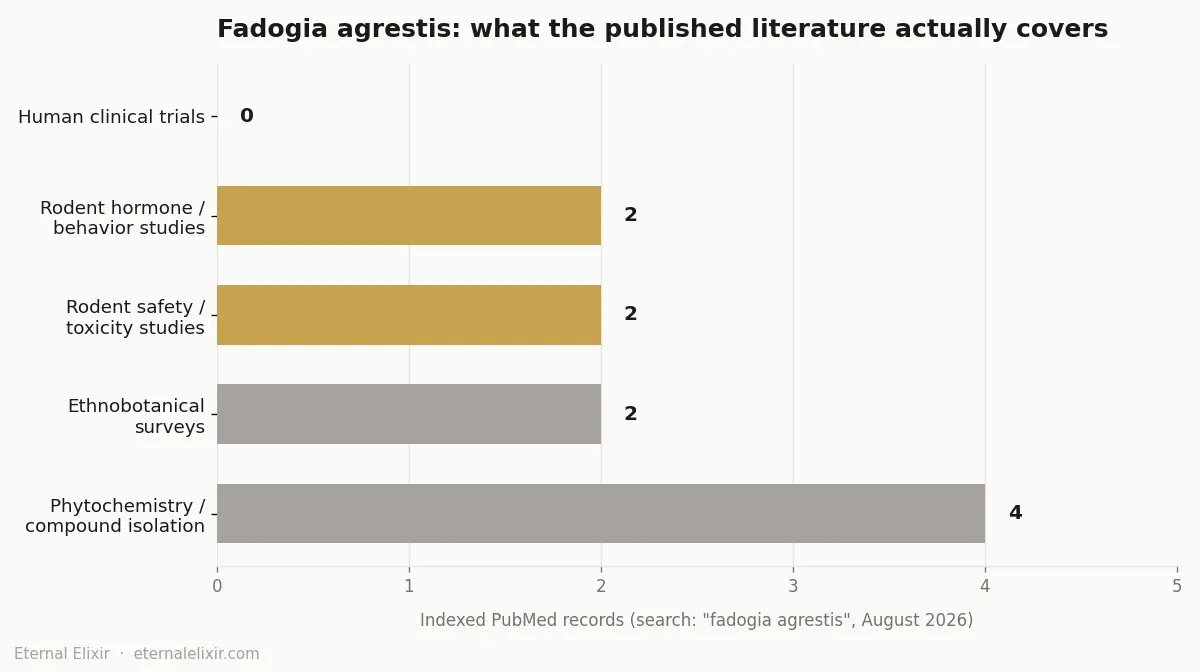
A PubMed search for “fadogia agrestis” on September 25, 2026 returned 10 records. Four are chemistry papers that identify compounds in the plant or test supplements. Two are surveys of traditional plant use. Four are rat studies, all from one research group at the University of Ilorin in Nigeria. None is a human trial, and that count matters more than any single result below.
The 2005 rat study behind the testosterone claim
Yakubu, Akanji and Oladiji gave 60 male rats a water extract of fadogia stem by mouth once a day. The rats were split into four groups of 15: one control group given water and three groups given 18, 50 or 100 mg of extract per kg of body weight. The team measured mating behavior and blood testosterone on days 1, 3 and 5. All three doses raised mount and intromission frequency. By day 5, testosterone was two, three and six times the control level at the low, middle and high dose (Asian Journal of Andrology, 2005).
That is a real hormonal effect in rats. It lasted five days, used an extract of unstated strength and involved no people. It tells you nothing yet about a man taking capsules for two months.
The 28-day follow-up that found testicular changes
The same group then gave the same three doses for 28 days (Journal of Ethnopharmacology, 2008). At every dose, testis weight relative to body weight went up, as did testicular cholesterol, sialic acid, glycogen and gamma-glutamyl transferase activity. Testicular alkaline phosphatase, glutamate dehydrogenase and protein went down. The authors called these changes signs of adverse effects on testicular function. In a 10-day recovery period, the rats recovered on some measures, mainly at the lowest dose.
Product pages quote the 2005 paper and rarely this one. Both come from the same lab, the same extract and the same rat model, so they belong together. Short dosing raised testosterone. Four weeks of dosing changed the testes.
Liver and kidney markers after 28 days
A third paper from the group (Human and Experimental Toxicology, 2009) looked at liver and kidney tissue after the same 28-day schedule. No rats died, none showed outward signs of toxicity, and organ weights matched the controls. But three enzymes (alkaline phosphatase, lactate dehydrogenase and gamma-glutamyl transferase) fell inside the liver and kidney and rose in the blood. Serum malondialdehyde, a marker of fat oxidation in cell membranes, rose at every dose. The authors read this as a loss of membrane integrity in liver and kidney cells.
A 2023 rat study on sexual function markers
The newest paper (Ogunro and Yakubu, Reproductive Sciences, 2023) used 30 male Wistar rats in six groups of five. Most groups were given the drug paroxetine to suppress sexual function. They then received water, sildenafil at 50 mg/kg, or fadogia extract at 18, 50 or 100 mg/kg. Like sildenafil, the extract brought nitric oxide, cGMP and antioxidant enzymes in penile and testicular tissue back to the levels of rats never given paroxetine. The authors said clinical trials would be needed before any use in people.
Zero human trials
Twenty-one years after the first rat paper, the human column is still empty. Examine, which summarizes supplement research, says no human studies have been done and that no dosage can be recommended because it is unclear whether fadogia is safe at any dose. In 2024, the US brand Momentous dropped its own fadogia product, saying its science team had flagged that the research was not progressing to its standards.
Does fadogia agrestis increase testosterone?
In rats, yes. In men, nobody knows, because nobody has measured it. The 2005 study found testosterone two to six times the control level after five days. No trial has repeated that in people, so any percentage you see quoted for men is borrowed from rodents. WebMD’s summary says there is currently no evidence that it can help raise testosterone levels.
The rat data also gives a reason for caution. The testosterone rise came from five days of dosing. The testicular changes came from 28 days at the same amounts. A supplement that raises a hormone for a week and changes the chemistry of the tissue that makes it after a month is not a simple win, even in rats.
If testosterone support is your goal, tongkat ali is the ingredient with human data, and we cover it below. Evidence level for fadogia and testosterone: animal only, from one lab.
Fadogia agrestis dosage
Double Wood’s directions start at one 300 mg capsule a day and allow two after a week. Vitamin Shoppe’s own brand gives 600 mg of a 10:1 extract in one capsule. Our blend gives 1,500 mg of a 10:1 extract across three capsules. None of these amounts came from a human study, because there isn’t one.
Converting the rat doses to a human dose
Animal doses are not scaled to people by body weight. The standard method adjusts for body surface area. For rats, you divide the mg/kg dose by 6.2 to get the human equivalent (Nair and Jacob, 2016). For a 70 kg adult, about 154 lb:
- 18 mg/kg in rats is about 2.9 mg/kg in people, or roughly 200 mg a day.
- 50 mg/kg is about 8.1 mg/kg, or roughly 565 mg a day.
- 100 mg/kg is about 16.1 mg/kg, or roughly 1,130 mg a day.
So a 600 mg label sits near the middle rat dose. The low dose, the one where the rats recovered best after 28 days, works out to about a third of that. Our full three-capsule serving of 1,500 mg is above the human equivalent of the highest rat dose. One capsule of our blend gives 500 mg of the fadogia extract, close to the middle dose.
Two caveats apply. The rats got a water extract of unstated strength, so a milligram of it is not the same material as a milligram of a commercial 10:1 extract. And the conversion is a rough guide to exposure, not a proven safe or effective dose. If you want to stay inside the range the rats were given, start with one capsule and talk to your doctor before going higher. Our report on trial doses versus US label doses compares trial doses with US label doses for other ingredients.
Why a milligram figure needs an extract ratio
A “600 mg” label can mean 600 mg of ground stem or 600 mg of a 10:1 extract. A 10:1 ratio means ten parts of stem went into one part of extract, so 600 mg of it stands for about 6,000 mg of stem. The front label looks the same either way, and only the ratio tells you which one you are buying. Our product page states that its 1,500 mg of 10:1 extract equals 15,000 mg of starting stem material.
Labels can also be wrong about what is in the bottle. A University of Mississippi team (Avula and colleagues, Planta Medica, 2019) built a test for marker compounds in fadogia and ran it on 17 supplements sold as fadogia. Twelve contained the plant’s phenolic compounds, at 0.3 to 2.7 mg per daily dose. In the other five, the compounds were not detected at all.
How three US fadogia products compare on the label
Prices are from each brand’s US site as of Sep 2026. Servings are from each label or product page.
| Product | Fadogia per serving | Extract ratio stated | Other actives per serving | Capsules | Price | Cost per serving | Buy |
|---|---|---|---|---|---|---|---|
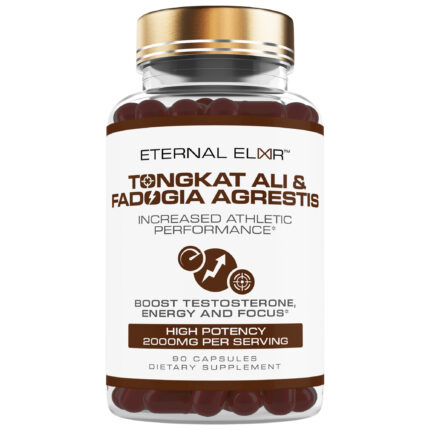
| Eternal Elixir Tongkat Ali + Fadogia (our pick) | 1,500 mg (3 capsules) | 10:1 | Tongkat ali 200:1 extract 500 mg and BioPerine 10 mg | 90 | $19.99 | $0.67 | View product |
| Vitamin Shoppe Fadogia Agrestis 10:1 Extract | 600 mg (1 capsule) | 10:1 | None | 60 | $19.99 | $0.33 | Vitamin Shoppe |
| Double Wood Fadogia Agrestis | 300 mg (1 capsule), up to 600 mg (2 capsules) | Not stated | None | 180 | $29.95 | $0.17 per capsule, $0.33 for 600 mg | Double Wood |
Add Tongkat Ali + Fadogia to cart · $19.99
Per gram of fadogia extract, our blend costs $0.44, against $0.56 for Vitamin Shoppe’s 10:1 capsule, and the tongkat ali comes on top. Vitamin Shoppe has the lowest price for a single 600 mg dose of a stated 10:1 extract. Double Wood gives the most capsules per bottle and works out to $0.55 per gram, though its page does not state an extract ratio, so its grams are not directly comparable. One line in its FAQ also says 600 mg per capsule where the description says 300 mg, and its single bottle was backordered when we checked. Our Double Wood review covers the rest of its range, and our side-by-side of six fadogia supplements covers more brands.
Should you cycle fadogia?
Many users take it for a few weeks and then stop for a while. No study has tested any on-off schedule, so every cycle you read about is a habit, not a protocol. What the rat work does show is that the testicular, liver and kidney changes were measured after 28 days of daily dosing. Nobody has checked what happens at two or three weeks, in rats or in people.
Fadogia agrestis side effects and safety
There is no human safety record, because there is no human record at all. What exists is rat toxicology, and it points the same way twice. Four weeks at the tested doses changed testicular chemistry and raised markers of stress in liver and kidney cells.
Whether that happens in people at label doses is unknown, and unknown is not the same as safe. WebMD notes that the plant’s safety and benefits are not well defined and that research on side effects and drug interactions is incomplete.
Talk to your doctor before taking fadogia if you take prescription medicines, have liver or kidney problems, or are trying to conceive. It is not for anyone under 18 or anyone who is pregnant or breastfeeding. Stop taking it and get medical help if you notice signs of an allergic reaction, such as swelling, hives or trouble breathing.
Quality is the second risk. The Mississippi testing found no marker compounds in five of 17 products sold as fadogia. Buy from a seller that publishes the full label, the extract ratio and the dose per capsule.
Tongkat ali vs fadogia agrestis: which is better?
Tongkat ali has the stronger case, because it has been tested in people. Fadogia has not.
| Attribute | Fadogia agrestis | Tongkat ali (Eurycoma longifolia) |
|---|---|---|
| Origin | West African shrub, stem used | Southeast Asian tree, root used |
| Human trials | None published | Randomized trials in men, five pooled in a 2022 meta-analysis |
| Best-studied extract | None in people | Physta, a standardized water extract of the root |
| Safety data | Rat studies: testicular, liver and kidney marker changes at 28 days | 12-week trial in 105 men reported no clinically relevant safety changes |
| Evidence level | Animal only | Small randomized human trials, often industry funded |
The most relevant tongkat trial here (Chinnappan and colleagues, Food and Nutrition Research, 2021) randomized 105 men aged 50 to 70 with total testosterone below 300 ng/dL. They took 100 mg or 200 mg of Physta, or a placebo, daily for 12 weeks. Total testosterone rose more than with placebo in both Physta groups, from week 4 at 200 mg and by week 12 at 100 mg. Fatigue scores fell. Blood counts and liver and kidney tests showed no safety changes the authors judged clinically relevant. The study was funded by Biotropics Malaysia, which makes Physta, and two authors worked there.
A 2022 systematic review in Medicina (Leisegang and colleagues) included nine studies and pooled five randomized trials. Total testosterone rose with tongkat ali compared with control. The authors wrote that more research is needed before clinical use.
Evidence level for tongkat ali: several small randomized human trials on specific standardized extracts. Our Tongkat Ali 200:1 extract is not Physta, and it has not been tested in a trial itself.
Why do brands pair the two? The idea is that they act at different points in the same hormone pathway. That idea has never been tested, because no study has given people fadogia and tongkat ali together. If you want only the ingredient with human trials, take tongkat ali on its own. Our comparison of seven tongkat ali supplements covers the options.
Our pick: Eternal Elixir Tongkat Ali + Fadogia
If you have read the evidence and still want to try fadogia, this is the formula we make for you. Each three-capsule serving lists 1,500 mg of Fadogia agrestis 10:1 stem extract, 500 mg of Tongkat Ali 200:1 root extract and 10 mg of BioPerine black pepper extract. Nothing is hidden in a proprietary blend. A bottle holds 90 capsules, which is 30 label servings, for $19.99, or $0.67 a serving.
- A dose you can adjust. Each capsule holds a third of the serving, so you can start at one capsule (500 mg of fadogia extract) and stay near the middle rat dose.
- Ratios on the label. The 10:1 fadogia ratio and the 200:1 tongkat ali ratio are both stated.
- Lower cost per gram. $0.44 per gram of fadogia extract, the lowest of the three products in our table, with tongkat ali included.
- A product page that shows its limits. It states the evidence level for each ingredient and says the finished blend has not been tested in a trial.
Who it suits: adults who want to try fadogia alongside a human-studied partner ingredient, at a dose they can raise slowly. Who it doesn’t suit: anyone who wants a proven testosterone product, because fadogia’s effects are unproven in people. Skip it if you are trying to conceive, and ask your doctor first if you have liver or kidney problems or take prescription medicines. If you want only tongkat ali, choose the standalone above.
Two bottles save 10%, three save 15% and five save 20%. Orders over $100 ship free in the US.
Add Tongkat Ali + Fadogia to cart · $19.99
Many men build a routine around better-studied ingredients first. Our guide to what shilajit research shows for men covers one option, and our Shilajit 1000mg uses a 20:1 extract with 20% fulvic acid. Another is panax ginseng for energy and drive. If training is the goal, our turkesterone vs creatine breakdown shows how much deeper the human evidence runs for creatine. You can also see how our men’s formulas fit a longevity supplement routine or browse the full Eternal Elixir range.
How to choose a fadogia supplement in the US
- Look for an extract ratio. A milligram number without one does not tell you how much plant you are getting.
- Skip proprietary blends. If fadogia sits inside a blend total, you cannot know your dose.
- Ask about identity testing. Five of 17 products in the Mississippi study had no detectable marker compounds, so a certificate of analysis that confirms identity is worth asking for.
- Pick a format that lets you start low. The rats recovered best at the lowest dose, so a serving split across several capsules is useful.
- Compare price per gram of extract. Bottle prices hide capsule size. Divide the price by the grams of fadogia in the bottle.
BulkSupplements also sells fadogia as a loose powder as well as capsules. If you are weighing powder against capsules, our BulkSupplements review explains the trade-offs.
Frequently asked questions
What does fadogia agrestis do to you?
In male rats, a water extract of the stem raised testosterone and improved mating measures within five days. Given for 28 days, the same doses changed testicular, liver and kidney markers in ways the researchers called adverse. No published trial has measured any effect in people, so what it does in humans is unknown.
Does fadogia agrestis actually increase testosterone?
It did in rats. By day five of a 2005 study, testosterone was two to six times the control level, depending on the dose. No human trial has tested it, so there is no measured effect in men.
What is better, tongkat ali or fadogia agrestis?
Tongkat ali. It has randomized trials in men, including a 12-week trial in 105 men aged 50 to 70 in which total testosterone rose more than with placebo. Fadogia has rat data only. If you choose one, choose tongkat ali. Blends pair them on the idea that they act at different points in the same pathway, but that pairing has not been tested.
Add Tongkat Ali 200:1 to cart · $29.99
What are the potential dangers of fadogia agrestis?
In rats, 28 days of daily dosing changed testicular chemistry and raised markers of stress in liver and kidney cells. There is no human safety data. Product quality is a second risk: in one analysis, five of 17 fadogia supplements had no detectable marker compounds. Talk to your doctor first if you take prescription medicines, have liver or kidney problems, or are trying to conceive.
How much fadogia agrestis should I take?
No dose has been tested in people. The single-ingredient US labels we checked give 300 to 600 mg a day. Converted by body surface area, the three rat doses equal roughly 200, 565 and 1,130 mg a day for a 70 kg adult, and the rats recovered best at the lowest one. Starting low and keeping courses short is the cautious approach.
What is the best fadogia agrestis supplement?
Our pick is Eternal Elixir Tongkat Ali + Fadogia, which we make. It lists every dose, states a 10:1 fadogia ratio, lets you start at one capsule and costs $0.44 per gram of fadogia extract with tongkat ali included. If you want fadogia on its own, Vitamin Shoppe’s 10:1 capsule has the lowest price for a single 600 mg dose that we found. Our fadogia supplement comparison covers six products.
The bottom line on fadogia agrestis
Fadogia raised testosterone in rats over five days and changed testicular, liver and kidney markers over 28. It has never been tested in people. If you try it, choose a label that states the extract ratio, start at the low end and keep courses short. Pair it with tongkat ali, the ingredient that has human trials, or take tongkat ali alone.
Sources
- Yakubu MT, Akanji MA, Oladiji AT. Aphrodisiac potentials of the aqueous extract of Fadogia agrestis (Schweinf. Ex Hiern) stem in male albino rats. Asian Journal of Andrology, 2005. PubMed 16281088, full text
- Yakubu MT, Akanji MA, Oladiji AT. Effects of oral administration of aqueous extract of Fadogia agrestis (Schweinf. Ex Hiern) stem on some testicular function indices of male rats. Journal of Ethnopharmacology, 2008. PubMed 18023305
- Yakubu MT, Oladiji AT, Akanji MA. Mode of cellular toxicity of aqueous extract of Fadogia agrestis (Schweinf. Ex Hiern) stem in male rat liver and kidney. Human and Experimental Toxicology, 2009. PubMed 19755438
- Ogunro OB, Yakubu MT. Fadogia agrestis (Schweinf. Ex Hiern) stem extract restores selected biomolecules of erectile dysfunction in the testicular and penile tissues of paroxetine-treated Wistar rats. Reproductive Sciences, 2023. PubMed 35969364
- Avula B, Bae JY, Raman V, et al. Quantification of phenolic compounds from Fadogia agrestis and dietary supplements using UHPLC-PDA-MS. Planta Medica, 2019. PubMed 30170324
- Nair AB, Jacob S. A simple practice guide for dose conversion between animals and human. Journal of Basic and Clinical Pharmacy, 2016. PubMed 27057123
- Chinnappan SM, George A, Pandey P, Narke G, Choudhary YK. Effect of Eurycoma longifolia standardised aqueous root extract (Physta) on testosterone levels and quality of life in ageing male subjects: a randomised, double-blind, placebo-controlled multicentre study. Food and Nutrition Research, 2021. PubMed 34262417
- Leisegang K, Finelli R, Sikka SC, Panner Selvam MK. Eurycoma longifolia (Jack) improves serum total testosterone in men: a systematic review and meta-analysis of clinical trials. Medicina, 2022. PubMed 36013514
- Examine, Fadogia agrestis; WebMD, Fadogia Agrestis: Uses, Side Effects, and More; Momentous, The Momentous Standard. All read September 25, 2026.
- Product pages for Vitamin Shoppe Fadogia Agrestis 10:1 Extract, Double Wood Fadogia Agrestis, and Eternal Elixir Tongkat Ali + Fadogia and Tongkat Ali 200:1, read September 25, 2026.
These statements have not been evaluated by the Food and Drug Administration. This product is not intended to diagnose, treat, cure, or prevent any disease.